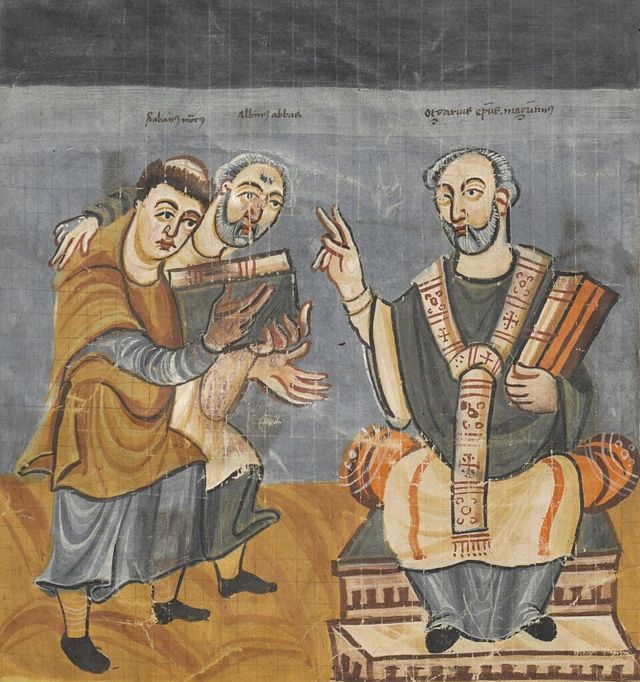
Baring-Gould’s sources: Gallican Marty rologies. Hrabanus, Greven and Molanus in their additions to XJsuardus. Authority: — A life by a writer almost his contemporary, and his own writings. The life was written before 829, according to Sigulf the disciple of Alcuin, who furnished the writer with much of his information. But this life is colourless and poor. Far richer details may be gathered from the epistles of Alcuin. A good modem life of Alcuin is that of Dr. F. Lorenz, professor of history to the University of Halle.] The last of the distinguished Anglo-Saxons whose name shed lustre on the empire of the Frankish monarchs in the eighth century, was Alcuin. Born at York, about the year 735, of a noble family, Alcuin 1 was scarcely weaned from his mother’s breast when he was dedicated to the Church, and entrusted to the care of the inmates of a monastery, and on reaching the proper age, he was placed in the school of Archbishop Egbert, then celebrated for the number of noble youths who crowded thither to imbibe instruction from the lips of that saintly prelate. Alcuin was distinguished above his fellows by his application to the study of the sciences, which were taught by Egbert’s kinsman Aelbert, who succeeded him in 766 in the see of York, and in the management of the school. Alcuin was Aelbert’s favourite pupil; when about twenty years of age, he was chosen to accompany him on a visit to the conti1 His name was originally Albeis, why and when he changed it does not appear.
…nent in search of books, and of new discoveries in science, and on that occasion he resided for a short time in Rome. Immediately after Aelbert’s accession to the archiepiscopal see, he ordained Alcuin deacon, appointed him to fill the place which he had himself occupied in the school, and gave him the care of the extensive library attached to it. Under Alcuin’s superintendence the school increased in reputation, and many foreigners came to partake of the advantages derived from his teaching. Archbishop Aelbert died on the 8th November, 780, and was succeeded by Eanbald, one of Alenin’s pupils, who, in the following year, sent his instructor to Rome to obtain for him the pall at the hands of Pope Adrian I. On his return, Alcuin visited Parma, and there met Charlemagne [king of the Franks, crowned emperor in 800], who had also been at Rome. That monarch was then meditating the foundation of scholastic institutions throughout his dominions, and he seized the opportunity to persuade Alcuin to settle in France, and become his adviser and assistant in his projects of reform.
There must have been something peculiarly engaging in Charlemagne. Alcuin met a great mind, full of noble aspirations, in advance of his age, and he saw that the emperor was a man whom he might direct aright, and who was one to render him every facility for raising the religious, moral and intellectual tone of the mighty empire over which Charlemagne had been placed. But before he joined the king, Alcuin continued his journey home, to fulfil his original commission, and to obtain the consent of the archbishop of York, and of Alfwold, king of Northumbria [the Anglo-Saxon kingdom of northern England and south-east Scotland], to the proposed arrangement. He felt, and so did his spiritual and temporal superiors, that a door had been opened before him, and that it was not for them to attempt to close it. In 782, followed by some of his chosen disciples, Alcuin left England for France. In the court of Charlemagne, Alcuin became, as one great writer1 calls him, the intellectual prime minister of the emperor.
A slight sketch of the condition of the Church in the empire is necessary, that the reader may judge of the abuses Charlemagne and Alcuin had united to rectify. The higher classes of the clergy under the Franks [the Germanic people who ruled Gaul and gave France its name] at the time of the Merovingian princes were, according to the testimony of their contemporary and fellow-clerk, Gregory of Tours [bishop and historian of the Franks (d. 594)], to the last extent barbarous, dissolute, and corrupt. Adultery, murder, simony, false swearing, avarice, abounded among the bishops and dignitaries, and the example of the higher clergy corrupted those below them, and demoralized the laity.
The episcopal thrones in Germany were occupied by Franks, and when S. Boniface [English missionary to Germany, martyred 754] came in the eighth century into Germany to convert the heathen, he found occasion to vehemently inveigh against the morals and conduct of the German bishops. His account of the Frankish clergy gives a terrible picture of disorder. He wrote to Pope Zacharias: “For long religion has been prostrate. In the course of eighty years the Franks have not held a single council, nor published a new decree, nor renewed a single old one. The possessors of the bishoprics are avaricious laymen, or adulterous priests, who only aim at temporal profit. Their deacons live from youth up in adultery and all uncleanness, and whilst still deacons have as many as four or five concubines. Nevertheless they are so bold that they read the Gospel publicly, and are not ashamed to style themselves deacons. If they attain the priestly office, laden with all their crimes, they lead the same criminal life, heap one sin upon another, and yet pretend to intercede for the people, and offer the Holy Sacrifice. The worst is that these men advance from one dignity to 1 Agobard, Archbishop of Lyons.
another, and finally become bishops. If there are any among them who remain chaste, yet they give themselves up to drinking, hunting, and injustice, or go armed to battle, and shed with their own hands human blood, sometimes that of heathen, but sometimes also that of Christians/7 Bishop Gewilieb, of Mayence, was charged by S. Boniface with murder, before a council at Worms, because he had killed in duel a Saxon who had assassinated his father, Bishop Gerold of Worms. S. Boniface also charged Bishop Gewilieb with being addicted to hawking and hunting, and endeavoured to obtain his deposition. The cause of the decay of discipline and general disorder in morals was probably this. The Frank kings saw how much their power would be supported and strengthened if the widely ramifying authority of the Church were made a base for their throne. They therefore richly endowed bishoprics and abbeys, and made the bishops and abbots to be vassals ( ministrales ) of the king. Thus Fredegar, in 74^ speaks of the Burgundian barons, whether bishops or other feudatories.1 They were often employed in affairs of the State, and were thus invested with a very important political influence. The possessions of the Church were regarded by the kings as feudal tenures ( benejicia:), and the bishops and abbots holding them were bound to arm and fight as vassals for their king. It was stipulated by law that the choice of a bishop should be confirmed by the king ■ 2 but for the most part, the kings themselves appointed to the vacant sees, in spite of the often reiterated protests of the councils. Synods could not assemble without the royal permission; their decrees had to be confirmed by the king, being previously invalid. In the meantime the affairs of the Church were discussed and ordered, even 1 Fredigar, Chron., caps. 4, 76. 2 Cone. Aurelian [Roman emperor 270–275], ann. 849. in the meetings of the king’s council of Vassals, the filacitum regis, synodus regia, and the government of ecclesiastical affairs having thus passed into the hands of the State, synods of bishops and clergy became more rare, and at length ceased altogether. This arrangement completed the downfall of the metropolitan [the archbishop who heads a group of dioceses] system. The king became the sole and sovereign judge of the bishops. “ If one of us, O King/7 wrote Gregory of Tours to King Chilperic, “ shall have wished to transgress the path of justice, he is judged by thee, but if thou transgressest, who is to call thee to order ? We may speak to thee, and if it pleases thee, thou mayest attend; but if thou wiliest not to listen, who is to condemn thee, except He Who is very Justice ? ” 1 In proportion as the bishops rose higher in political influence, the other clergy sank deeper. No free man was allowed to receive orders without royal permission. Hence the clergy were chosen for the most part from among the serfs, and on this very account the bishops acquired an unlimited power over them, which frequently manifested itself in the most tyrannical conduct S. Boniface found the German Church in this deplorable condition; bishops and abbots mere creatures of the State, wealthy, and sometimes not even in holy orders [ordination; “orders” means the sacrament by which deacons, priests and bishops are ordained], but enjoying the temporalities [the lands and income attached to a bishopric] without a thought of qualifying to administer the spiritualities of their charge. He strove to bring the bishops from this servitude to the crown into responsibility to the pope, hoping thereby to check the evil. But this could not be done without an alteration in the law. The abbots and bishops who held many feudal tenures were bound by a law of Charles Martel to march to war at the head of their retainers; they were often engaged for a long period in fighting, and their abode in the camp 1 Hist. Franc., v. ig.
speedily assimilated them in morals and sentiments to the other feudal lords. For the extension of Christianity, the first missionaries had established numerous monastic colonies throughout Germany, and these were supported by the agricultural labours ofthe monks. But by degrees the farming interest prevailed over the spiritual in these houses. The monks proved themselves admirable agriculturists, and for the sake of the cultivation of their fields neglected the harvest of souls. When Charlemagne ascended the throne, he found the Frank and German episcopal thrones and abbots' chairs occupied by men without learning and without morals, fighting, drinking, hunting, and utterly neglectful of their spiritual calling. Charlemagne was resolved to raise the people committed to his charge from the chains of ignorance and barbarism which held them fast. To effect this he must begin by correcting the evil in head-quarters. He cut off the chief occasion of evil by exempting the bishops and abbots from military service, and he forbade them to hunt with hawks and hounds in the forests. This latter regulation, though repeatedly formulated, he found it impossible to enforce. The prelates were ready enough to be exempt from war, which broke in on their ease, but the chase was to them a darling pleasure of which they would not be deprived. At length Charlemagne, finding it impracticable to enforce his rule, and unwilling to acknowledge the impracticability, by law permitted the higher clergy to hunt, on condition that the skins of the beasts killed were used for binding books. This reminds us of a story told of Charlemagne which we should be sorry to suppose is fabulous. He was one day hunting in a forest, and lost his way. As night fell he came to a little church and priest’s house, and asked for a lodging. It was readily accorded him, but his fare was scanty, though the best the poor priest could offer. On Mayip.i B. Alenin. 269 the morrow the priest made the emperor hear mass, which he celebrated very devoutly, and then gave his guest, of whose rank he was ignorant, a plain breakfast, and dismissed him with his blessing. The emperor, pleased with his piety, and compassionating the poverty of his host, offered him a piece of gold, which the priest refused, saying, “Sir, I need not thy money, but if thou killest a hind to-day, I pray thee give me the skin, for my old Breviary sadly needs a cover.” Charlemagne, ever ready to advance good men, did not forget the poor priest in the forest, but on the see of Troyes [a bishop’s “see” is his diocese, named from his seat (Latin sedes)] falling vacant, appointed to it his host of that night. If this story rests on a true foundation, the priest was Am alarms, who afterwards as archbishop became a confidential adviser of the emperor. Charlemagne, under the direction of Alcuin, founded schools in which young clerics could be educated and disciplined, to shine as lights in the world, and not become a scandal to Christendom like the clergy under his predecessors. By the determination and zeal of the emperor and Alcuin, the sees were one after another filled with worthy bishops, men of learning and piety, and Charlemagne was able to entrust to them the execution of justice in matters temporal within their dioceses as well as spiritual government. He also chose from among them extraordinary judges ( Missi dominici) whom he sent round every year into every province to exercise the highest oversight and power in things ecclesiastical as well as civil. With every bishop thus appointed was also a count. Bishops and counts were everywhere instructed to work together, and mutually to support one another; ecclesiastical usurpations were not endured,1 and the oppressions of the counts and dukes weighing on the people were removed. In addition to these duties, the bishops were required to make a visitation of their dioceses every year, to maintain ecclesiastical discipline and correct religious abuses. Where there was encroachment on ecclesiastical rights, the bishop might not judge alone, as an interested party, but was obliged to have seven assistants to try the case. Ecclesiastical legislation, the highest judicial power in Church affairs, the management and confirmation of ecclesiastical decrees, still remained with the king, who summoned the spiritual as well as the civil feudatories to diets, conducted spiritual causes by the Apocrisiarius or Archicapellanus, afterwards Archicancellarius, as he did civil causes by the Counts Palatine ( Comites Palatii). At the time of Charlemagne, and afterwards, the bishops lived in some splendour, and in travelling were followed by a large company of servants, as may be judged from the amount of daily provision allowed to them when on a journey. According to a capitulary of Louis the Pious, in 819, every bishop received daily for his provision, when on a journey, 40 loaves, 1 pig, 3 sucking-pigs, 3 hens, 15 eggs, 3 tons of beer, and 4 sacks of grain for the horses. In spite of all Charlemagne’s efforts to rectify the morals of the clergy, the religious condition of the priests was not raised to the level he desired. It was not possible to remedy abuses in a generation, but much, very much, is certainly due to that great king. In the capitularies for 81 1 those clergy are censured who endeavour to obtain the goods of a dying man by promising him Heaven if he makes the priest his heir, and threaten him with hell if he leaves it to the rightful heirs; they are also censured for caring rather to adorn their churches than advance Christian virtue, to improve the singing rather than stimulate their clerks to a holy life, and also for using compulsion to force men into the service of God. However, the moral tone of the clergy must have been much higher at this time, B. Alcuin.
for we find certain decrees of earlier capitularies, such as those forbidding priests to have more wives than one, and to attend buffooneries and coarse spectacles, no longer repeated. Later we know that Hinkmar, archbishop of Rheims, commanded his clergy “not to indulge in vulgar sports with bears and tumblers/7 and that monks were forbidden spending their time in sporting with baiting bears and other wild beasts.1 Charlemagne was not content with leaving the bishops to their own devices. At times he sent orders that they were to preach and cause to be preached in their dioceses on some doctrine or moral theme he designated, and at other times he sent a question in theology to his bishops, requiring them to write answers to it, so that he might be satisfied of their theological knowledge and orthodoxy. By this means no ignorant prelate remained undetected, no unworthy bishop unmasked; for if a bishop did not reach his standard in intellectual or moral requirements, he was forthwith deposed. By this means also Charlemagne raised the character, and thereby the influence of the whole body of clergy, and from being the disgrace they became the honour of his empire. But this dignity to which he elevated them, and the authority it acquired for them, tended to their corruption under his unworthy and feeble successors.
With what justice Charlemagne ruled the Church may be gathered from an incident which exhibits his conduct in the brightest colours. Bishop Theodulf of Orleans and Alcuin had quarrelled. Alcuin had been for many years the teacher, friend, and confidant of the emperor, who reverenced and loved this virtuous man, and made him his adviser in matters of the deepest import to the church and the empire. Now it fell out that a priest who had received sentence for his crimes from Bishop Theodulf escaped from prison, and fled to Tours, where he took refuge in the sanctuary of S. Martin [St. Martin of Tours (d. 397), soldier turned bishop]’s abbey. Theodulf reclaimed the runaway; the monks of S. Martin’s vehemently maintained their privilege of sanctuary, and armed their retainers against the officers of the bishop. All this took place without the knowledge of Alcuin, who was abbot of S. Martin’s, but when he did hear of it he took the side of his monks, and refused to deliver up the culprit to the imperial officer sent by orders of Charlemagne to claim him. Alcuin wrote to the emperor a vehement letter maintaining the rights of the sanctuary; but Charlemagne earnestly deprecated the warmth and opposition of his bosom friend and preceptor, and insisted on the surrender of the culprit. This firmness no doubt cost him a pang, and it hastened Alcuin’s death, but it shows that Charlemagne preferred justice to every other consideration. A great improvement was also wrought by Charlemagne and Alcuin in the condition of the monks. To wean them from absorption in agricultural pursuits, they laboured to impress on them the importance of learning, and by appointing to the monasteries abbots who had been trained in the schools founded and watched over by Alcuin, an impulse was given to learning which made the monasteries of S. Gall [Irish companion of Columbanus, founder of the Swiss monastery that bears his name], Fulda, and in later times Corbey and others, famous nurseries of science and book knowledge. But to return to the main outline of the life of this great instigator of all the reforms wrought by Charlemagne, whose influence on the condition of the Church in that and the succeeding reigns can hardly be over estimated.
It is probable that Alcuin attended Charlemagne iri many of his expeditions; he lost no opportunity in making his influence with the king subservient to the interests of his native country; and after remaining about eight years in France, he resolved to return to York. Charlemagne exacted from him a promise that he would return speedily, and make the court of France his lasting home; a promise Alcuin was not unwilling to give, for he saw that God had given him a mighty work to accomplish, and that he dare not withdraw from it.
“ Although/' said he, “ I possess no small inheritance in my own country, I will willingly resign it, and in poverty serve thee, and remain with thee; let it be thy care to ! obtain the permission of my king and my bishop.” Alcuin came to England in the year 790, as ambassador from Charlemagne to King Offa, to arrange some misunderstanding which had arisen between the two great monarchs, and it appears to have been his intention to return the same year. But he found the kingdom of Northumbria involved in troubles; and in a letter written at this period, he laments that he should not be able to return to France at the time he expected. It was not till 792 that, pressed by the letters of Charlemagne, who desired his assistance in repressing a heresy which threatened to cause a division in the Frank Church, Alcuin left England for the last time, with the permission of Bishop Eanbald and King Ethelred. He took with him a number of English ecclesiastics, who were afterwards present at the council held in 794, at Frankfort-on-the Maine, where the doctrinal innovations of Felix of Urgel and Elipandus of Toledo, who taught that Christ was the Son of God by adoption, were condemned. From 792 to 796 Alcuin continued to reside at the court of Charlemagne, in the same relation to his patron as before his visit to England. His position was rendered agreeable not only by the favour of the royal family, but by being in the society of the most learned and enlightened men of his time. Yet his happiness was frequently clouded by grief at the troubles with which his native country was visited, and of which he heard from his Northumbrian friends. In 793, the Norsemen devastated the island of Lindisfarne, profaned its church, and murdered several of the monks. This calamity, which Alcuin made the subject of one of the best of his poems, is alluded to in several of his letters, and appears to have afforded him keen distress, as well it might, for Lindisfarne was the ancient Christian metropolis of the North of England, endeared by the memory of S. Cuthbert [bishop of Lindisfarne (d. 687)], S. Aidan [Irish monk, founder of Lindisfarne (d. 651)], and many another illustrious saint. During the years which preceded a.d. 796, Charlemagne had been occupied in wars against the Saxons and Huns [nomadic invaders from Central Asia, led in the 5th century by Attila], and in that year, having reduced both these nations to his obedience, his mind was occupied with measures for the propagation of Christianity among the latter people. He consulted Alcuin, who, in an interesting letter, congratulated him on his conquests, and advised him to proceed with mildness rather than harshness in the work of conversion. Alcuin’s liberality of sentiment is remarkably conspicuous in this letter; he recommends the king in the first place to select with care the missionaries whom he is about to send amongst them, and to avoid burdening the converts by the imposition of heavy rates for the support of the Church. He warns him against the immediate exaction of tithes, and entreats him to consider that a tax which established Christians reluctantly consented to pay, would prove intolerable to new converts, and might embitter the people against the religion of Christ. The correspondence of Alcuin during the year 796 is unusually interesting, and exhibits his intelligent mind in a new light. Among the scholars at the court of Charlemagne it was a custom, not unknown in other times, of taking literary names and surnames. In this learned B. Alcuin.
nomenclature Alcuin himself took the name of Flaccus Albinus, which in after ages was frequently appended to his writings; the common name whereby Charlemagne was designated was David; among Alcuin5s more immediate friends, Riculf, archbishop of Mainz, was addressed as Damoetas; the name of Arno was changed into Aquila, and to Angilbert was given the name of Homer. At last, at the age of sixty, Alcuin resolved to leave the court, and spend the rest of his days in seclusion. He determined to return to his native country, and repose for the remainder of his life in the cloister of the monastery of York. He had already made preparations for his departure, and was entrusted with rich presents for King Offa, when the intelligence of new troubles in the kingdom of Northumbria, and of the murder of King Ethelred, diverted him from his project. “ I was prepared with gifts of King Charles to visit you, and to return to my country,5' he wrote to Offa; 4 ‘but I have thought it better on account of the peace of my people to remain in pilgrimage, not knowing what I should do amongst those with whom no one can be secure, and who cannot profit by healthful counsel.55 From this moment Alcuin resolved to spend the remainder of his life in the Frankish empire; but persisting in his intention of living in solitude, he demanded the permission of his royal patron to retire to Fulda. Charles was unwilling to lose the society of his favourite instructor and adviser, and refused his consent; but shortly afterwards he gave him the abbey of S. Martin, at Tours, which had become vacant by the opportune death of the abbot Itherius, with permission to spend as much of his time as he liked within the walls of that monastic house. Alcuin’s mode of life at Tours was one rather of splendid retirement than of pure renunciation of the world. His theological opponent, Elipandus, blamed him for his enormous wealth. Though he seldom quitted his monastery, he continued still to be the favourite counsellor of the king, who in cases of emergency went to consult him at Tours. The monastic school which Alcuin established there, produced some of the most remarkable scholars of the following age. He sent a mission to England to procure books for its library, and it was there that he composed most of his writings.
In 803 the quarrel between himself and Bishop Theodulf of Orleans, already mentioned, led to a temporary estrangement between himself and Charlemagne.
Alcuin died at Tours, on Whit-Sunday, the 19th of May, 804, and was buried with great pomp in the church of S. Martin. In the Lyceum at Bamberg is preserved a Bible written by the hand of Alcuin for Charlemagne.