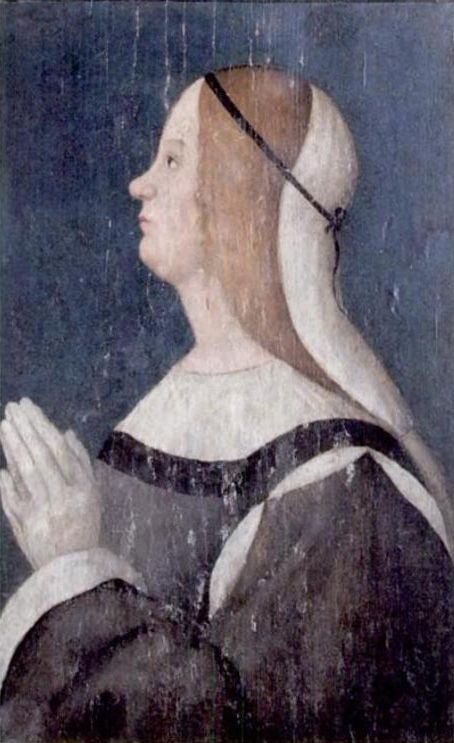
Baring-Gould’s sources: Franciscan Martyrology. Authorities: — Wadding, in his Annals of the Minorites, from MS. material in his possession, and a Life by Galluci in Guido Antonio, Count of Monteferetri and Urbino, and Lord of Gubbio, was father of the lady who is commemorated under the name of Seraphina this day in the Franciscan Martyrology. She was his daughter by his second wife, Catarina Colonna, niece of Pope Martin V. She was born at Urbino, about a.d. 1434, and received at the font the name of Suevia. She was married by proxy at the age of fourteen to Alessandro Sforza, Lord of Pistoja, High Constable of Sicily. Alessandro had already been married to Constantia Varana, by whom he had two sons, Constans and Galeati, and two daughters.
The first years of their married life were happy. Suevia proved a good mother to her step-children, and managed the house with prudence.
In 1460 Alexander returned to Pistoja from the wars, in which he had been constantly engaged, and was struck with the charms of a lady named Pacifica, wife of a physician at Pistoja. This led to great family misery, and Suevia had reason to believe that her husband made several attempts to get rid of her by poison. They quarrelled violently, and on one occasion he so far forgot himself as to maltreat her before the servants. Then he drove her out of his palace, and bade her go to the convent of the Poor Clares. This was in 1 460. The unhappy wife at once went to the convent, and asked to be admitted. But the powerful relatives of Suevia interfered, and Alessandro, to justify his conduct, asserted that she had been unfaithful to him during his absence, and had indeed confessed her fault. The kinsmen, together with her husband and a notary, went to the convent and asked to see Suevia. She appeared at the grating, and was asked if this was true which her husband asserted. She made no answer, but dropped the curtain and withdrew. Her relatives were filled with shame, and the notary entered in his book the statement that she had not denied the charge. But on their way through the streets, the ass on which the notary was seated flung the man of law, and then bit him in the rear as he lay sprawling in the dust; a manifest token that he had done wrong in attributing the silence of Suevia to a consciousness of guilt.
Suevia took the veil, and was elected abbess. After a few years Alessandro repented his treatment of his wife, and got tired of Pacifica. He turned the latter lady out of his B Seraphina.
house with as great indignity as he had shown to his legitimate wife, and wanted to bring Suevia back again. But this was now impossible. She had taken the irrevocable vow, had changed her name to Seraphina, and was enclosed behind bars he was powerless to break through. She died in the odour of sanctity on Sept. 8th, 1478. The body is preserved, and exposed to the veneration of the faithful at Pistoja.