Bl. Seraphina

Building a community where women could live the Gospel together.

Read the essentials →
September 8 · Widow, Abbess

Bl. Seraphina

Bl. Seraphina

Building a community where women could live the Gospel together.

Traditional feast

September 8
1914 / pre-1969 calendar, per Baring-Gould (1897)

Current feast

September 9
Secondary source · Wikipedia

Represents

Widow
Abbess

Their story

Adapted in modern English from the Catholic Encyclopedia (1913) · original text below

Seraphina was born at Urbino about 1434, the daughter of Guido Antonio of Montefeltro, Count of Urbino, and Cattarina Colonna, and was raised at Rome by her mother's brother, Pope Martin V. In 1448 she married Alexander Sforza, Lord of Pesaro.

Ten years later her husband turned to a dissolute life. Nothing she did could reform him. He insulted and mistreated her, even tried to kill her, and finally forced her into the convent of Poor Clares at Pesaro. There she prayed constantly, above all for his conversion, which in the end was granted. She was elected abbess in 1475 and died at Pesaro on 8 September 1478. Her body, exhumed some years later, was found incorrupt (not decayed after death) and is kept in the cathedral at Pesaro. Benedict XIV beatified (declared 'Blessed', the step before sainthood) her in 1754, and the Franciscan (the order of friars founded by St. Francis of Assisi) Order keeps her feast on 9 September.

Struggles & surrender

What they wrestled with, and how they gave it to God

  • Abused by her husband ·
    Catholic Encyclopedia: her husband Alexander Sforza, Lord of Pesaro, insulted and mistreated her, tried to take her life, and finally forced her into the Poor Clares at Pesaro; she prayed for his conversion, which was granted.

Early life

The book says little or nothing about early life. This is how the account begins.

The first years of their married life were happy. Suevia proved a good mother to her step-children, and managed the house with prudence. In 1460 Alexander returned to Pistoja from the wars, in which he had been constantly engaged, and was struck with the charms of a lady named Pacifica, wife of a physician at Pistoja.

What they represent

How they teach us to live

Drawn from themes in the original account

Build up the community you belong to. This life was lived with and for a community.

Learn from the kind of life it was. Building a community where women could live the Gospel together.

From the Catholic Encyclopedia

1913 · 163 words

Born at Urbino about 1434; died at Pesaro, 8 September, 1478. Her parents were Guido Antonio of Montefeltro, Count of Urbino, and Cattarina Colonna. She was brought up at Rome by her maternal uncle, Martin V. In 1448 Seraphina married Alexander Sforza, Lord of Pesaro. Ten years afterwards her husband gave himself up to a dissolute life. All the efforts of Seraphina to reform him were in vain. Instead, he heaped insults and ill-treatment upon her, and even attempted her life, and finally forced her to enter the convent of Poor Clares at Pesaro. Her life there was one of incessant prayer especially for the conversion of her husband, which was finally granted. In 1475 Seraphina was elected abbess of the monastery at Pesaro. Her body, exhumed some years after her death, was found incorrupt, and is preserved in the cathedral at Pesaro. She was beatified by Benedict XIV in 1754, and her feast is kept on 9 September throughout the Franciscan Order.

Read more

The full original · 394 words

Read Baring-Gould’s full account

Baring-Gould’s sources: Franciscan Martyrology. Authorities: — Wadding, in his Annals of the Minorites, from MS. material in his possession, and a Life by Galluci in Guido Antonio, Count of Monteferetri and Urbino, and Lord of Gubbio, was father of the lady who is commemorated under the name of Seraphina this day in the Franciscan Martyrology. She was his daughter by his second wife, Catarina Colonna, niece of Pope Martin V. She was born at Urbino, about a.d. 1434, and received at the font the name of Suevia. She was married by proxy at the age of fourteen to Alessandro Sforza, Lord of Pistoja, High Constable of Sicily. Alessandro had already been married to Constantia Varana, by whom he had two sons, Constans and Galeati, and two daughters.

The first years of their married life were happy. Suevia proved a good mother to her step-children, and managed the house with prudence.

In 1460 Alexander returned to Pistoja from the wars, in which he had been constantly engaged, and was struck with the charms of a lady named Pacifica, wife of a physician at Pistoja. This led to great family misery, and Suevia had reason to believe that her husband made several attempts to get rid of her by poison. They quarrelled violently, and on one occasion he so far forgot himself as to maltreat her before the servants. Then he drove her out of his palace, and bade her go to the convent of the Poor Clares. This was in 1 460. The unhappy wife at once went to the convent, and asked to be admitted. But the powerful relatives of Suevia interfered, and Alessandro, to justify his conduct, asserted that she had been unfaithful to him during his absence, and had indeed confessed her fault. The kinsmen, together with her husband and a notary, went to the convent and asked to see Suevia. She appeared at the grating, and was asked if this was true which her husband asserted. She made no answer, but dropped the curtain and withdrew. Her relatives were filled with shame, and the notary entered in his book the statement that she had not denied the charge. But on their way through the streets, the ass on which the notary was seated flung the man of law, and then bit him in the rear as he lay sprawling in the dust; a manifest token that he had done wrong in attributing the silence of Suevia to a consciousness of guilt.

Suevia took the veil, and was elected abbess. After a few years Alessandro repented his treatment of his wife, and got tired of Pacifica. He turned the latter lady out of his B Seraphina.

house with as great indignity as he had shown to his legitimate wife, and wanted to bring Suevia back again. But this was now impossible. She had taken the irrevocable vow, had changed her name to Seraphina, and was enclosed behind bars he was powerless to break through. She died in the odour of sanctity on Sept. 8th, 1478. The body is preserved, and exposed to the veneration of the faithful at Pistoja.
Feast days

Feast: September 9
Traditional: September 8

Nine days · Free

Pray the novena
with us.

One short email a day for nine days. The day's prayer, a line from Bl. Seraphina's story, and a nudge to keep going.

Also on September 8
A

Sts. Alkmund and Gilbert

September 8 · Feast
A

Sts. Adrian

September 8 · Martyrs
Sts. Eusebius, Nestabo, Zeno and Nestor

Sts. Eusebius

September 8 · Martyrs
← All 1726 saints in the library
Sources & notes

Feast-day sources

Story sources

Sources

Credits

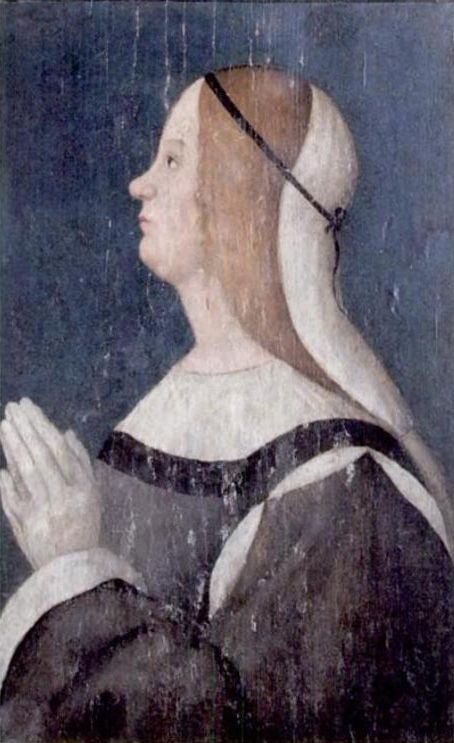
Image: Sveva da Montefeltro (fifteenth-century panel painting).jpg · Anonymous Renaissance painter · Public domain, via Wikimedia Commons

From Sabine Baring-Gould, The Lives of the Saints, new edition in 16 vols. (London: John C. Nimmo, 1897–98); text from the Internet Archive scan (OCR, lightly cleaned; errors possible). Public domain.

Image: Anonymous Renaissance painter, Wikimedia Commons (Public domain)

From “Catholic Encyclopedia (1913)/Bl. Seraphina Sforza,” The Catholic Encyclopedia (New York: Robert Appleton Company, 1907–1914), via Wikisource. Public domain. Matched by name and feast date; text unedited except for our bracketed notes in grey.

From Sabine Baring-Gould, The Lives of the Saints, new edition in 16 vols. (London: John C. Nimmo, 1897–98); text from the Internet Archive scan (OCR, lightly cleaned; errors possible). Public domain in the United States. Reproduced unedited, except for short bracketed notes in grey that we added to explain names and terms (“S.” is the old abbreviation for Saint). Some history and judgments reflect 19th-century scholarship.