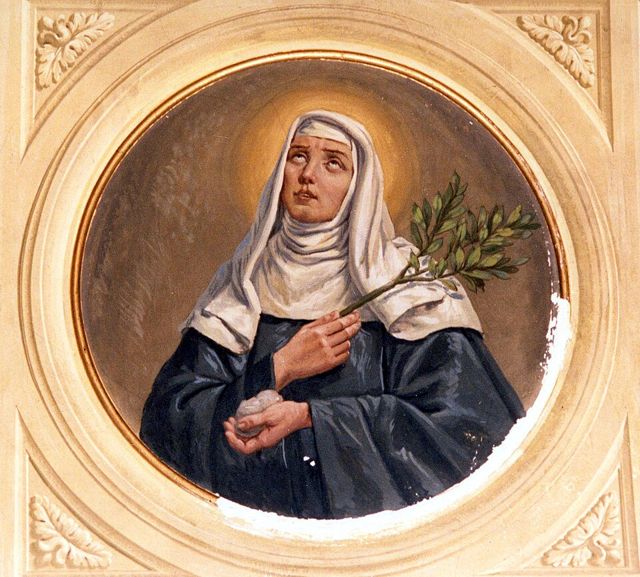
Baring-Gould’s sources: Beatified by Pope Leo X. Her life and revelations were written by Brother Isidore of Isolani, O.S.D., from the account given him by those who had known her well; among others from the notes of Benedetta, and the recital of Thaddæa, two sisters, who had been intimately acquainted with Veronica. This account was printed in 1518, at Milan.
Veronica was the daughter of a pious peasant at Binasco, a small village between Milan and Pavia. Her father was noted for his integrity, and when he sold a horse he always mentioned its defects to the purchaser. Veronica was employed in the fields weeding, as the parents were too poor to send her to the school. Veronica desired earnestly to become a sister in the convent of S. Martha, at Milan, but her mother assured her that it was impossible to join a religious community without a knowledge of letters. Accordingly, every night Veronica laboured, by the light of her little oil lamp, at her alphabet and spelling book; but she made little progress. One night, as she lay with her hands spread out on the table, and her head bowed, disheartened at the difficulty of her task, the Blessed Virgin appeared to her in a robe of dazzling blue, like the summer sky. "My child," said the gentle Mother, "trouble thyself not with this scholarship, the only learning thou needst is comprised in three letters, white, black, and red. This white letter is purity of soul and body; this black letter is simplicity, contentedness with what God sends you, and freedom from taking offence; this red letter is meditation on the passion of my dear Son. Let these three branches of learning be mastered, and all the other letters come of themselves."
Veronica, some years later, entered the convent of S. Martha, as a lay sister, and her duties were to beg for the society, as her ignorance of reading and Latin disqualified her from chanting the choir offices with the full sisters.
She persevered in the study of those three letters shown her by the Queen of Heaven, and in studying them she advanced far on the way of perfection. She was honoured with wondrous revelations, but her modesty was so great that she sought to conceal them. On the Octave of Corpus Christi, 1487, during mass, she saw in the adorable Sacrament exposed in the Tabernacle, the form of Jesus Christ as a little child surrounded by adoring angels. In her simplicity she asked one of the other sisters if she had seen the Holy Child, and when she answered in the negative, Veronica flushed red, and said no more.
It was a great disappointment to her that she was unable to sing the choir offices, and she made it a special object of prayer that her understanding might be enlightened, so that she might join the others in their psalmody. Then an angel descended to her cell, and he held in his hand the psalter, and opening it before her, bade her read, and all her difficulty passed away, and she chanted the psalms of David, with the antiphons and responses, alternately with the Angel of God. One night, when she had been very ill, and deprived of the privilege of communion, she rose from her sick bed, drawn by an irresistible impulse to the church. It was full of light; she cast herself at the altar steps, before the adorable Sacrament, and Jesus in a cloud of glory communicated her Himself.
She lay three years in a lingering illness, all which time she would never be exempted from any of the duty of the house, or make use of the least indulgence, though she was given leave; her answer always was, "I must work whilst I can, whilst I have time."
Sister Thaddæa informed the writer of her life, that on Whitsun-Monday, 1496, she went to the cell of Veronica, who was ill, at the hour of nones, and was astonished to see a bright light streaming from the chinks in the door. Looking in through a hole, she saw Veronica, in dazzling light, chanting nones. Veronica died in the year 1497.
Seal of Robert Wishart, Bp. of Glasgow, 1272-1316. See life of S. Kentigern, p. 193 .
FOOTNOTES:
[44] Lib. I., c. 3, 4.
[45] By David Camerarius, Hector Boece, and Condeus.
[46] From Ken-tiern, chief lord.
[47] Adamnan i. 15.
[48] In viis Domini magna est gloria Domini, et via justorum facta est: et iter sanctorum præparatum est. Ibunt sancti de virtute in virtutem: videbitur Deus corum in Sion.
[49] Near Lunen, on the river Lippe.
S. Pontian , M., at Spoleto, 2nd cent. S. Felix , P. C., at Nola, 3rd cent. S. Macrina , at Neocæsarea, 4th cent. SS. Theodulus, Paul, Proclus, Hypatius, Isaac, and Others , Monks, MM., at Sinai, 5th cent. S. Datius , Abp. of Milan , a.d. 552. S. Fulgentius , B. of Carthagina , a.d. 619. B. Engelmar , H. M. in Bavaria, beginning of 12th cent. B. Sabbas , Abp. of Servia, 13th cent. B. Ordorico , Friar at Udine, in Italy , a.d. 1331. For S. Hilary , see Jan. 13.