A
The Annunciation of S.…
P
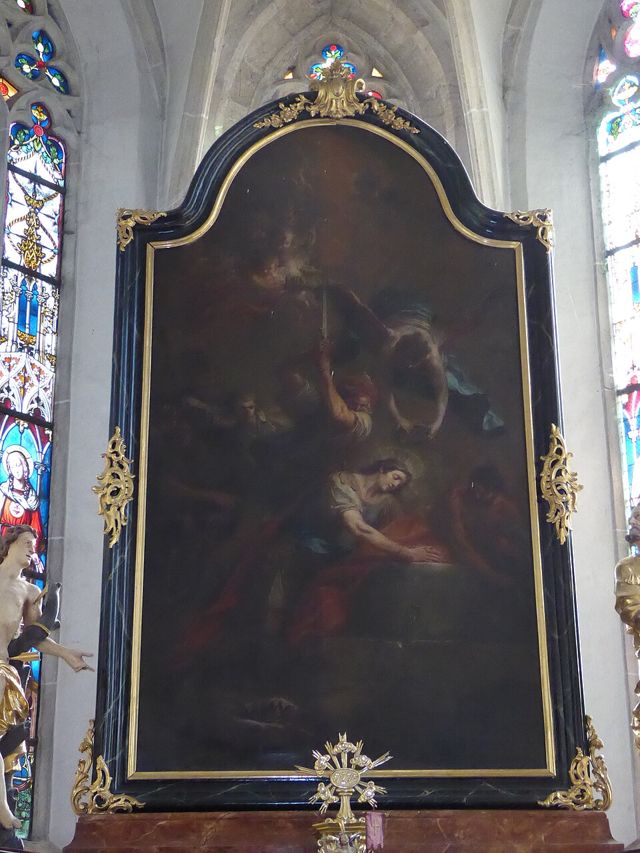
The Penitent Thief
In the Martyrology attributed to S. Jerome, in those of Ado, Notker, Rabanus Maurus, and many others, on this day is marked, "In Jerusalem, our Lord Jesus Christ was crucified," or
Read the essentials →In the Martyrology attributed to S. Jerome, in those of Ado, Notker, Rabanus Maurus, and many others, on this day is marked, "In Jerusalem, our Lord Jesus Christ was crucified," or
March 25
Not verified yet
Feast
In the Martyrology attributed to S. Jerome, in those of Ado, Notker, Rabanus Maurus, and many others, on this day is marked, "In Jerusalem, our Lord Jesus Christ was crucified," or words to this effect. This being by many supposed to be the day of the month on which Christ died. In an ancient Roman Martyrology, published by Rosweydus, on March 25th is inserted, "Annuntiatio Dominica et Crucifixio." Some ancient lines on this day, which occur in some Martyrologies, deserve quotation: "In hac die multa, mirabilia facta sunt, quæ notantur in his versibus":—
Keep their day. Remember them on March 25 with a short prayer, and ask for their help.
In the Martyrology attributed to S. Jerome [translator of the Bible into Latin (d. 420)], in those of Ado, Notker, Rabanus Maurus, and many others, on this day is marked, "In Jerusalem, our Lord Jesus Christ was crucified," or words to this effect. This being by many supposed to be the day of the month on which Christ died. In an ancient Roman Martyrology, published by Rosweydus, on March 25th is inserted, "Annuntiatio Dominica et Crucifixio." Some ancient lines on this day, which occur in some Martyrologies, deserve quotation: "In hac die multa, mirabilia facta sunt, quæ notantur in his versibus":—
Molanus [a 16th-century Flemish scholar who edited saints’ calendars], in his additions to Usuardus [a 9th-century monk of Paris who compiled a list of saints for each day], adds to the two mysteries of the Annunciation and the Crucifixion, "On the same day the genesis of the world; also the victory of Michael, the archangel, over the dragon." This victory is commemorated on this day in many old martyrologies. An old Brussels MS. Martyrology adds, "On the same day the formation of Adam and his ejection from Paradise." Many insert the death of Abel; in that of Canisius, "Abel the just, the proto-martyr of the Old Testament, at once virgin, priest, and martyr, and the first of mankind to die." Also the sacrifice of Melchisedek, and the sacrifice of Isaac, are inserted on this day in many martyrologies. In some likewise, "On this day Israel crossed the Red Sea"; in some, "S. Veronica, who wiped the face of Christ"; in some also the decollation of S. John the Baptist, the passion of S. James, and the liberation of S. Peter.
March 25.
But in the Greek Menæa, March 23rd is marked as that of the "Crucifixion and memorial of the Penitent Thief": on March 22nd is commemorated the Last Supper; on March 24th the Repose in the Tomb; and on March 25th, the Resurrection.
Feast: March 25
One short email a day for nine days. The day's prayer, a line from Memorial of the…'s story, and a nudge to keep going.
From Sabine Baring-Gould, The Lives of the Saints, new edition in 16 vols. (London: John C. Nimmo, 1897), digitized text from Project Gutenberg. Public domain.
From Sabine Baring-Gould, The Lives of the Saints, new edition in 16 vols. (London: John C. Nimmo, 1897), digitized text from Project Gutenberg. Public domain in the United States. Reproduced unedited, except for short bracketed notes in grey that we added to explain names and terms (“S.” is the old abbreviation for Saint). Some history and judgments reflect 19th-century scholarship.