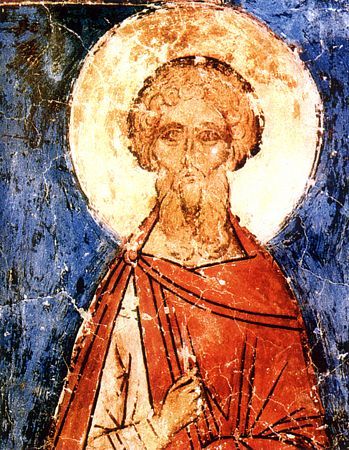
Baring-Gould’s sources: Roman Martyrology, inserted by Baronius, after Molanus; but the Greeks venerate these saints on October 29th. Authority:—The Life of SS. Abraham and Mary, by Ephraem, the companion of Abraham, but not, as has been commonly stated, S. Ephraem Syrus.
Abraham was the son of very wealthy parents at Chidama, in Mesopotamia, near the city of Edessa. His father sought a young and beautiful girl in marriage for his son, and Abraham was married to her with all the pomp befitting the splendour of the rank and wealth and the family. The young man had now tasted all that the world could give, riches, honour, and love, and his heart was still void and craving for something more. Then he felt, with a conviction it was impossible to resist, that God alone could fill that void, and that satisfaction could alone be found in serving Him most perfectly. So, secretly in the night, seven days after his marriage, he escaped, and hid himself in the desert.
His parents, who had refused him nothing for which he had expressed a wish, his wife, who had given him no occasion of offence, were in amazement. They searched for him everywhere, and at the end of seventeen days discovered him in the desert, resolved to live alone. It was in vain that parents and bride urged him to return; he was inexorable, and they were obliged to leave him in his solitude. He had found a small hut, and now he walled up the door, leaving only a window, through which bread and water could be passed in to him by a friend. He had spent ten or twelve years in this retreat when his parents died, and left their immense property to him. He entrusted it to the care of his most intimate friends, to be used for relieving the necessities of the poor.
Now there was, not far off, a village of idolaters, who had stubbornly resisted every missionary effort made to convert them. The bishop of Edessa bethought him of Abraham the hermit, visited him in person, and insisted on his coming forth and preaching to these heathen. In vain did the hermit implore to be permitted to remain in his dear solitude: the bishop put the matter on his obedience, brought him forth, ordained him priest, and sent him amongst the pagans. Abraham then built a church in their midst, and finding that they were deaf to his exhortations, he spent his nights and days in tearful intercession for them, and then, armed with zeal, he rushed upon their idols and overthrew them. A mob at once assembled, and he was beaten till he could not move; and whenever he appeared in the streets, he was assailed with sticks and stones. Undeterred by this opposition, Abraham continued instant in prayer; and, after three years, saw the tide of popular opinion turn, and the villagers who had treated him so ill, now venerated him as an apostle of the truth. Abraham tarried with them another year, to confirm them in the faith, then commended them to the supervision of the bishop, and returned to his cell. Now it happened that a little girl, named Mary, the niece of Abraham, had been left an orphan, and she was brought to the hermit, as her sole relative, to educate. She was aged seven. Abraham bade a cell be built for her near his own, and there the child grew up under his supervision till she was twenty, when a young man, having conceived a violent passion for her, led her away, and then abandoning her, the unfortunate girl fell deeper into degradation, and became a common harlot in the city of Assos, in the Troad. Her the uncle had bewailed her fall with the deepest grief, and had instituted inquiries as to her whereabouts. Hearing that she was at Assos, Abraham broke down the wall which closed his door, and came forth, cast off his habit and sackcloth, and disguising himself as a soldier, went to Assos. And when he came there, he hired a lodging next door to the house of ill-fame where dwelt his niece, and he sought opportunity to meet and speak with her, but could not. Then he went to the house, and ordered supper, and bade that Mary should eat with him. So she, knowing him not, lost to shame, came, tricked out with necklaces and rings, in gaudy wanton dress. Then Abraham reddened with grief, and could ill restrain his tears. But making an effort, he controlled his emotion. So they sat down, and ate, and drank, and she laughed noisily, and talked in a light and wanton way; and as she spake the shadow on Abraham's brow deepened, the corners of his mouth quivered with pain, and a film formed on his eyes. Then the girl kissed him, and looked at him, and suddenly saw in the grave, suffering face before her, something that recalled past days, and she moaned. The man of the house hearing this, said, "Mary, what is the matter with thee? These two years that thou hast been with me thou hast been ever gay." But she looked up again, and met the tearful eyes of Abraham; then she cried out, "Oh, God! would that I had died three years ago. This man recalls to me my dear old uncle in the desert, and days of innocence and pure joy." Then Abraham put the man forth, and locked the door, and turning, threw back his hood, and caught Mary by both hands, and looked at her and said, "Mary, my child!" Then she knew him, and became cold and motionless as a stone. And he said, "My dearest child, what has befallen thee? How hast thou sunk from heaven in the abyss! O why didst thou not disclose to me thy first temptation, and I and Ephraem would have besieged heaven with tears and prayers to save thee? Why didst thou desert me like this, and bring this intolerable anguish of soul upon me?" But she, frightened and trembling, answered not a word. And he, holding her hands fast in his own, said again, "My own Mary, wilt thou not speak to me?" Then his tears burst forth, and the whole man was shaken with sobs. "Upon me be thy sin, my child," he said; "I will answer for it at the Judgment day to God. I will do penance and suffer in expiation of thy crime; only return, my child!" Then she burst forth with, "I cannot look thee in the face, uncle, and how can I call on God, whom I have so outraged?" "I will bear the burden of the sin, let it weigh on me, Mary," said the hermit vehemently; "only return to the old place, and dear Ephraem and I will pray instantly to God for thee. Come child, follow me." Then she fell down, and laid her brow on his feet, and sobbed, and held them, and kissed them, and stammered, "I will follow thee, uncle. What reward shall I give unto the Lord for all the benefits He has done unto me?" But he caught her up, and would not suffer her thus to lie. And she fell again and kissed the ground he had trodden, bringing her hopes of pardon and salvation. And he urged her to fly at once. Then she said, "Uncle, I have here some valuable trinkets, and some dresses. What shall I do with them? Shall I not pack them up and carry them with me?" But he cried out, "Leave them, leave them, they scent of evil." And he took her on his back, as a shepherd carrying his strayed sheep, and unlocked the door, and ran out. And when he came to his hut, he set Mary in the inner cell, and went into the outer room himself. And she, bitterly repenting the past, served God instantly, night and day, with tears. Abraham lived ten years longer, and rejoiced to behold the sincerity of his niece's contrition, and died at the age of seventy, in the fiftieth year of his solitary life; and Mary lived five years after her uncle's death. God wrought miracles of healing by her hands, to comfort the penitent soul, and assure her that her tears had blotted out her transgression.