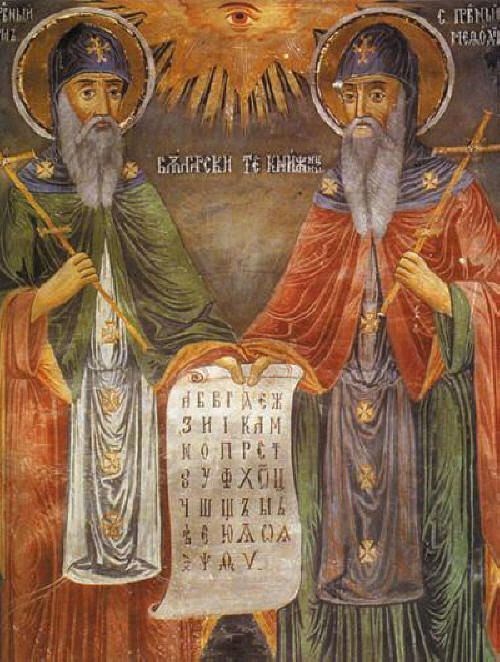
Baring-Gould’s sources: Roman Martyrology. S. Cyril by the Greeks on Feb. 14th, and S. Methodius on May 11th. Authorities:—The Life of S. Clement, a pupil of Methodius, pub. by Pampereus, Vienna, 1802; the Pannonian Life of Methodius; notices in the Life of S. Ludmilla; the Chronicle of Nestor; Cosmas of Prague, &c. The chronology in this article is from the treatise on Cyril and Methodius by Philaret, B. of Rigá, Milan, 1847.
Cyril and Methodius, the apostles of the Sclaves, were brothers, the sons of a man of rank in Thessalonica. Constantine, who afterwards in religion assumed the name of Cyril, the younger, was educated at the court of Constantinople, along with the youthful emperor Michael, from the year 842, by the illustrious Photius, who instructed him in logic, philosophy, mathematics, and languages. His talents and accomplishments afforded him every prospect of a brilliant career in the world, but he chose to lay them at the foot of the cross, and, receiving sacred orders, was appointed librarian to the palace. Soon after, he retired to a little monastery, but was drawn from it again to give lectures on philosophy.
Methodius, his elder brother, as soon as his education was accomplished, entered the army, and was appointed to the government of the Græco-Sclavonic province, which, according to the Pannonian legend, he held for ten years.
In the year 851, Cyril retired to Mount Olympus, along with his brother, who had also resolved to desert the world, and lived in seclusion and the practice of self-discipline. In 858, some dignitaries of the Chazars, a Hunnish race, besought the emperor to send them a learned man to instruct them in the true faith, and Cyril and Methodius were chosen for this purpose.
How long they spent on this mission is not known exactly. They tarried till they could organise the church among the Chazars, and then retired to the Crimea where they worked together at making a Sclavonic translation [the solemn moving of a saint’s relics to a new shrine] of the Holy Gospels. It was whilst there that they discovered what they believed to be the relics [the bodily remains of a saint, or objects they used, kept with honor] of S. Clement of Rome, lying together with the anchor, which had been attached to his neck, where the faithful had reverently laid him. They raised the holy remains, and translated them to Constantinople.
In 862, the Sclavonic princes of Pannonia [a Roman province roughly covering western Hungary and parts of Austria and Croatia], Rostislaw, Swaetopolk, and Kotel requested the emperor Michael and the patriarch [the title of the bishops of the great ancient sees: Rome, Constantinople, Alexandria, Antioch, Jerusalem] Photius, to send them teachers, "because they were without true instructors for the people," and they desired to have instruction and divine worship in their own language. It appears that missionaries of the Latin Church had already penetrated amongst them, but probably had been unable to master the Sclavonic tongue; at any rate, the Pannonians refused to accept them, and turned instead to the East.
None were better calculated to execute this mission than the brothers Methodius and Cyril, the former of whom had for some years governed a Sclavonic province, and both had been born at Thessalonica, on the confines of Sclavonic peoples, and where the language was familiar to the natives. The emperor and the patriarch felt this, and sent for them, and laid before them the desire of these heathen princes for the Gospel. The brothers at once undertook the mission, and set forth. On their way, Methodius was the means of converting the king of the Bulgarians. Boris had a sister, who was a Christian, having been brought up at Constantinople, whither she had been carried captive. The prince, who was passionately fond of hunting, desired the emperor to procure him a picture, which should illustrate his favourite pursuit, and adorn the hall of a new palace he had erected. Methodius was commissioned by the emperor to execute this task, and he appeared before king Boris, not as a missionary, but as a painter. "Let it be a good picture," said the prince, "large and terrible." "So shall it be," answered Methodius, "but one thing I demand,—that I may be left undisturbed here to complete my picture, that no one may see it till it is finished." The king reluctantly gave his consent, and day after day passed, and the painter was not seen. He remained closely shut up within the palace. Weeks rolled by, and Boris chafed with impatience and curiosity. At length the doors were thrown open, and the king entered. Methodius had painted the Last Judgment on the wall of the new hall. Above sat Christ on the great white throne, and below were men receiving sentence, and the angels dividing them. An awe and wonder fell on the king's heart as he contemplated the picture. "What meaneth this?" he asked. And Methodius seized the opportunity of preaching to him righteousness, temperance, and judgment to come. He explained to the king the whole doctrine of the final judgment of men, their fate depending on their works in this world, and the king trembled. He went on to speak of the glories prepared for the baptized who keep the faith. Great and purifying thoughts swelled the bosom of the prince, and going up to the painter, he said, with his head bowed, "Take me, and teach me, that I too may pass to the beautiful side of the picture."
And when Cyril and Methodius had preached the Word of God among the Bulgarians, they journeyed on, bearing the bones of S. Clement, and their Sclavonic translation of the Holy Gospels, into Moravia, where they laboured about four and a half years with great success. The bishops of the neighbouring German provinces, however, viewed the mission of these Easterns with jealousy, and complained to pope Nicolas I. of their performing the liturgy in the Sclavonic language. The unsuccessful war waged by Rostislaw with the Germans, and the deposition of Photius at Constantinople, who had commissioned the two apostles, gave Nicolas the opportunity of summoning the two Greek missionaries to Rome. On their journey (in 868) they were subjected to vexatious treatment at Venice, on account of their cause, but pope Adrian II., who had succeeded Nicolas, dreading to lose Moravia and Pannonia, received them with great cordiality, permitted them to celebrate the divine mysteries in Sclavonic at the grave of the Apostles, ordained their disciples, Formosus and Gonderik, bishops, three others priests, and two lectors. He also sanctioned the use of the Sclavonic liturgy. The following account from the Lections of the Olmutz Breviary will not prove uninteresting. "The blessed Cyril, by the grace of God, after he had converted the Moravians, invented new alphabetical letters, and translated the Old and New Testaments, and many other things from Greek or Latin, into the Sclavonic tongue; and he appointed to be sung Mass, and the other canonical hours in the church. And to this day they are thus sung in Sclavonic parts, especially in Bulgaria, and thereby many souls are drawn to Christ the Lord. And when after some time the said Cyril went to Rome out of devotion, he was rebuked by the sovereign pontiff and the other rulers of the church, because, contrary to the canons, he had appointed the holy Mass to be sung in the Sclavonic tongue. But he, humbly endeavouring to satisfy them, but not able to convince them wholly, snatched up the Psalter, and read the words of the Psalmist, 'Let everything that hath breath praise the Lord.' Omnis spiritus laudet Dominum. And he said, 'If every one that hath breath is to praise the Lord, why, my fathers, do ye forbid me to perform the Mass in the Sclavonic tongue, or to translate other things from Latin and Greek into the vernacular? Finding the people simple and ignorant of the ways of the Lord, I, by the inspiration of God, found this means of drawing many to God. Therefore, pardon me, my fathers, and, following the example of S. Paul, the doctor of the Gentiles,—Forbid not to speak with tongues. (I Cor. xiv. 39.)' And they, hearing him, and wondering at his sanctity and faith, gave him authority in those parts to say Mass, and sing the Canonical Hours, in the aforesaid tongue."
Cyril died in Rome shortly after, Feb. 14th, 869, in a monastery into which he had retired; but Methodius, according to the entreaty of his dying brother, returned to Moravia, to find that the hostility of the German prelates and clergy was not allayed. Political disturbances, fomented by the Germans, broke out between 869 and 901, and Rostislaw was reduced to ruin. Methodius held himself aloof from these contests, and in 870 went with his disciples into Pannonia, where the court received him and gave up to him the castle of Salava in Mosburg, as a residence. Kotel now besought the pope to consecrate Methodius archbishop of Pannonia, and his request was complied with. But the German clergy, especially the archbishops of Salzburg and Mainz, who unfortunately were ambitious rather of extending their authority than of preaching the Gospel to the people, were exasperated by this to the highest pitch, and they stirred up against him the German emperor and the Moravian prince Swaetopolk, and brought matters so far that he was driven into banishment for a year and a half or two years. Pope John VIII. restored to him his see in 874. At last the Moravian Sclaves saw through the ambition of the bishops his opponents, and expelled them the country, at the same time writing to the pope to request him to appoint Methodius archbishop of Moravia. This John VIII. consented to, and "from this time," says the contemporary writer of the Pannonian history of S. Methodius, "the divine doctrine began to grow and spread rapidly, and heathenism and superstition to disappear." But the archbishops of Salzburg and Mainz, who claimed jurisdiction over the Sclavonic races, though not converted by them, could not forgive Methodius the loss of their power and position in the country. They hastened to Rome, and complained that Methodius was heretical on the subject of the Double Procession, that he taught the independence of the Moravian Church, and that he celebrated the Liturgy in the vulgar tongue. Pope John thereupon, in 878, forbade the performance of the Liturgy in Sclavonic, and in the following year summoned Methodius to appear before him in Rome. The German-Latin prelates triumphed; they appeared in Moravia, and declared that Methodius was deposed, and that his authority had been transferred to them. But pope John, on the appearance of the apostle before him, was satisfied of his orthodoxy, and confirmed him in his position and authority over the Moravian Church. Disappointed in their hope of ruining Methodius at Rome, the German prelates now spread the report that the archbishop had incurred the displeasure of the emperor by his submission to the pope. Methodius was therefore obliged to make a journey to Constantinople, where he was cordially received by the emperor Basil, and then dismissed with many presents. As soon as it was proved that the report of the anger of the imperial court was false, the enemies of Methodius endeavoured to dispose Swaetopolk, the prince, against him; and this they were the more able to effect, because the prince was a man of immoral life, and had incurred the reprimand of the archbishop on more than one occasion. Gradually, influenced by these treacherous apostles of Mammon, rather than of Jesus Christ, Swaetopolk became alienated from Methodius; but in spite of all their efforts, and the coldness of the prince, all the Sclavonic races, from Croatia and Dalmatia to the confines of Poland, heard in their own tongue the celebration of the Divine mysteries, and looked to Methodius as their archbishop. Moreover he effected the conversion of the Bohemian Duke Borivoi, and introduced Christianity into his lands. He founded at Prague the church of Our Lady, and another dedicated to SS. Peter and Paul; and died on April 6th, 885.
Relics of S. Cyril at Rome in S. Clemente, and at Brunn, in Moravia. In Art S. Cyril is represented in a philosopher's long habit, and bearded. S. Methodius as an archbishop with the pallium [a woolen band the pope gives to archbishops as a sign of their authority], holding in one hand a picture of the Last Judgment.