A whole community that stayed faithful to Christ when it cost everything.
Read the essentials →A whole community that stayed faithful to Christ when it cost everything.
Read the essentials →A whole community that stayed faithful to Christ when it cost everything.
September 20
July 16 (also listed: February 21)
Martyrs
Thin entry · the 1897 book gives only 153 words. We have not filled the gap with invented detail.
Not satisfied with these wonders, legend-makers have constructed the pedigree of S. Eustace, which is this: — Faustinus Octavius was the father of S. Clement I., and from him descended Agapitus Octavius, who was the father of Eustace. The place of the miraculous vision of S. Eustace is Guadagnolo, between Tibur and Prseneste. The body of S. Eustace was given, in the 12th cent., to the Abbey of S. Denys, near Paris.
Learn from the kind of life it was. A whole community that stayed faithful to Christ when it cost everything.
Keep their day. Remember them on September 20 with a short prayer, and ask for their help.
Not satisfied with these wonders, legend-makers have constructed the pedigree of S. Eustace, which is this: — Faustinus Octavius was the father of S. Clement I., and from him descended Agapitus Octavius, who was the father of Eustace. The place of the miraculous vision of S. Eustace is Guadagnolo, between Tibur and Prseneste. The body of S. Eustace was given, in the 12th cent., to the Abbey of S. Denys, near Paris. It was burnt and scattered about in 1567 by the Huguenots, but fragments are shown as belonging originally to it in the church of S. Eustache in Paris. Other relics [the bodily remains of a saint, or objects they used, kept with honor] at Douai, Prag, Epternach, Cologne, Madrid, &c.
S. Eustace was a favourite subject with mediaeval painters. He is represented as a huntsman kneeling before the miraculous stag. The famous engraving of S. Eustace by Albert Diirer is well known.
S. Eustace, as well as S. Plubert, is the patron of huntsmen.
Feast: July 16
Traditional: September 20
One short email a day for nine days. The day's prayer, a line from Sts. Eustathius and…'s story, and a nudge to keep going.
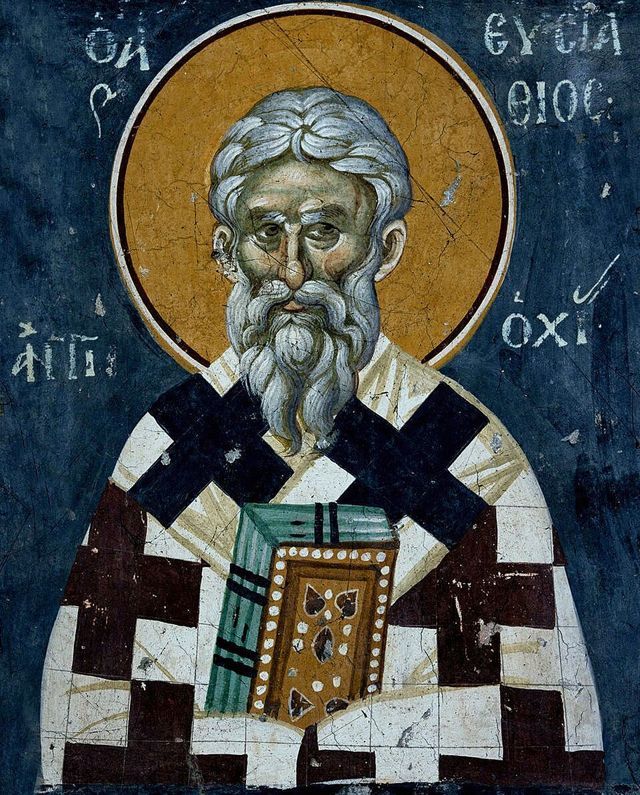
Image: Saint Eustathios of Antioch Fresco Peribleptos.jpg · Unknown authorUnknown author · Public domain, via Wikimedia Commons
From Sabine Baring-Gould, The Lives of the Saints, new edition in 16 vols. (London: John C. Nimmo, 1897–98); text from the Internet Archive scan (OCR, lightly cleaned; errors possible). Public domain.
Image: Unknown authorUnknown author, Wikimedia Commons (Public domain)
From Sabine Baring-Gould, The Lives of the Saints, new edition in 16 vols. (London: John C. Nimmo, 1897–98); text from the Internet Archive scan (OCR, lightly cleaned; errors possible). Public domain in the United States. Reproduced unedited, except for short bracketed notes in grey that we added to explain names and terms (“S.” is the old abbreviation for Saint). Some history and judgments reflect 19th-century scholarship.