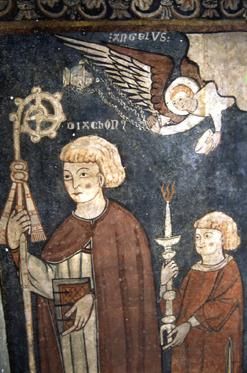
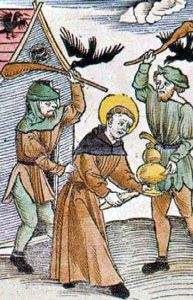
Baring-Gould’s sources: Roman Martyrology, those of Usuardus, Bede, Notker, Ado, &c. The perfectly genuine Acts, which are extant, were read in the Church on this day, as S. Augustine testifies in his sermon for their commemoration.
Valerian [Roman emperor 253–260, who persecuted bishops and clergy] and Gallienus being emperors, [100] Æmilian and Bassus consuls, on January 16th, being the Lord's-day, Fructuosus, the Bishop, Augurius and Eulogius, the deacons, were taken. Fructuosus was in bed, but hearing the tramp of the officers, he rose at once and went out barefoot. [101] To whom the soldiers said, "Come, the governor wants thee and thy deacons." Fructuosus said, "Let us go, but please, let me put on my shoes." The soldiers said, "As thou desirest, shoe thyself." As soon as they were come, they were put into prison. Fructuosus, certain and glorying in the crown of the Lord, to which he was called, prayed without ceasing. There were also with him some of the brethren, praying him to have them in remembrance. Next day, he baptized in the prison our brother Rogatian. And they were six days in prison, and then were brought forth. It was on the 21st January, and a Friday, that they were heard. Æmilian, the governor, said, "Let Fructuosus, the Bishop, Augurius and Eulogius be brought forward." According to custom it was said, "They are here." Æmilian, the governor, said to Fructuosus, the Bishop, "Hast thou heard what the Emperors have ordered!" Fructuosus, the Bishop, said, "I do not know what their orders are; I am a Christian." Æmilian said, "They have ordered that the gods be worshipped." Fructuosus said, "I worship one God, who made heaven and earth, the sea and all that therein is." Æmilian said, "Do you know that there are many gods?" The Bishop said, "No, I do not." "Then thou soon shalt," said the governor. Fructuosus, the Bishop, looked up to the Lord, and began to pray within himself. Æmilian said, "Who will be heard, who feared, who adored, if the gods and the countenance of the Emperor are despised?" Then he said to Augurius, the deacon, "Don't listen to the words of Fructuosus." Augurius answered, "I worship the Almighty God." Æmilian, the governor, said to Eulogius, the deacon, "Dost thou not worship Fructuosus?" "By no means," said Eulogius, "but I worship the same God as does Fructuosus." Æmilian said to Fructuosus, "Art thou a Bishop?" Fructuosus answered, "I am." "You were one," said the Governor, and he ordered them to be burnt alive.
And when Fructuosus, the Bishop, and his deacons, were led into the amphitheatre, the people began to mourn for Fructuosus, for he was greatly beloved, not by the brethren only, but also by the heathen. For he was a vessel of election and a teacher of the people. And when some, in brotherly charity, offered them a spiced cup to drink, he said, "The hour of breaking fast is not yet come." For it was the fourth hour, though indeed they had solemnly celebrated the station (fast) on the fourth day (Wednesday) in the prison. Therefore joyously on the sixth day (Friday) they hastened to conclude this station (fast) with prophets and martyrs in Paradise. And when they had come to the amphitheatre, one, named Augustalis, a lector, ran to him, with tears, beseeching him to suffer him to unloose his shoes. But the blessed martyr said, "Stand aside, I can put off my own shoes." And when he had done so, our brother and fellow-soldier, Felix, went up to him, and took his right hand, asking him to remember him. [102] To him S. Fructuosus replied in a clear voice, so that all heard, "It behoves me to hold in mind the whole Catholic Church, extending from east to west." Then, as he was in the gate of the amphitheatre, ready to advance to his unfading crown, rather than to his pains, as the officers saw, and the brethren heard, and the Holy Spirit urged and spake, Fructuosus the Bishop, exclaimed, "A pastor will not be lacking to you, nor will the love and promises of the Lord fail, now or hereafter. This which ye behold is the infirmity of one hour." And when the bands wherewith their hands were tied had been burnt through, rejoicing, they cast themselves on their knees, sure of the resurrection, and having formed the sign of victory, [103] they poured forth their souls, praying to the Lord.
The brethren, sad as if bereft of a shepherd, endured their solitude; not that they lamented Fructuosus, but rather they desired to be mindful of the faith and passion of each. When night came, they hastened to the amphitheatre with wine, with which to extinguish the charred bodies, which being done, they collected the ashes of the martyrs, and each carried away a portion. But neither in this did the marvellous works of the Lord fail; that the faith of the believers might be stimulated, and an example might be given to the little ones. After his passion, Fructuosus appeared to the brethren, and exhorted them to restore, without delay, what each had carried off of the ashes, out of love, that they might be laid altogether in one place. [104]
Fructuosus in Spanish Frutos , in French Fruteux .
Patron of Taragona.
Relics, in the Benedictine [monks following the Rule of St. Benedict] monastery, near the Porto Fino, at Genoa; some portions, however, in the church of S. Montana, at Barcelona.