Read Baring-Gould’s full account
Baring-Gould’s sources: Ado, Usuardus, Florus, Sarum, York, and Hereford, German and Modem Roman Martyrologies. Authority: — a Passion by Helinand of Froimont in the 13th cent.] The greatest confusion concerning these martyrs reigns in the ancient Martyrologies The names of the martyrs vary; there are Gereon, Cassius, Florentius, Victor, Agrippinus, Marusus, and on these names changes are rung. A vague tradition, floating down the stream of time, recorded that a portion of the Theban legion, quartered at Cologne and at Xanten, on the Rhine, had suffered about the same time as Maurice and his company at Agaunum, and the Martyrologies gave such names as were remembered. But of the facts nothing was known, till gradually legend grew round them, relics were discovered and attributed to them, imaginations worked, and in the 13th century the passion of the martyrs had been elaborated sufficiently for a monk of Froimont to commit it to writing. The number of martyrs was made 318 or 319, or even 330. It is almost a pity that imagination did not stretch a little further, and then there would have been one for each day in the year. When the church of Xanten was being enlarged, in 1284, the new foundations in the old burial-ground intersected graves, and many bones were found. These were eagerly assumed to have belonged to the Theban martyrs, and, as such, receive veneration there to this day.
In some ancient copies of the Martyrology of Jerome, the passion of 316 martyrs at Cologne is stated, “ whose names God only knows.”
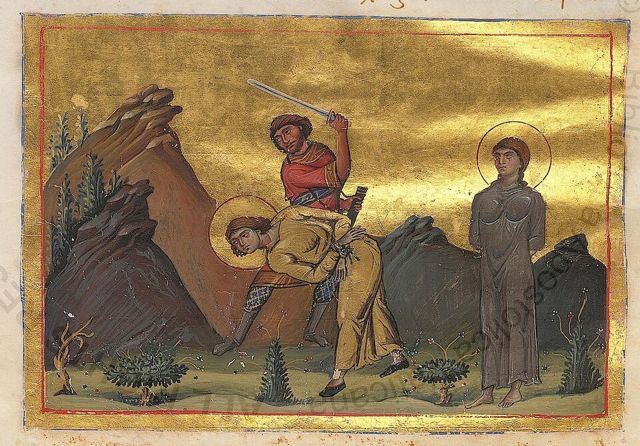
S. Helena is supposed also to have found the bodies of Oct. ia] SS. Eulampitis and Eulampia. the martyrs at Bonn, and to have erected churches there, and in Cologne, over their relics [the bodily remains of a saint, or objects they used, kept with honor]. This is the story of Helinand; it does not demand serious consideration. According to the same writer, Gereon suffered at Cologne with 318 companions, and Victor with 330 more, at Xanten; Cassius and Florentius, and others, numbers not recorded, at Bonn. To fill up the gaps made by this butchery, Maximian [Diocletian’s co-emperor in the West, 286–305] was obliged to send into Mauritania for some more soldiers; but these, on their arrival, were also found to be infected with Christian belief. Another decimation took place, and some 360 more were martyred, and their bones laid alongside of those of