Sts. German and Randoald

German was a native of Trier, the son of Optardus, a man of senatorial rank.

Read the essentials →
February 21 · Abbot, Martyrs

Sts. German and Randoald

Sts. German and Randoald

German was a native of Trier, the son of Optardus, a man of senatorial rank.

Traditional feast

February 21
1914 / pre-1969 calendar, per Baring-Gould (1897)

Current feast

February 21
Secondary source · Wikipedia

Represents

Abbot
Martyrs

Their story

Adapted in modern English from Baring-Gould (1897) · original text below

German was a native of Trier, the son of Optardus, a man of senatorial rank. His brother Opthomar became a favourite at the courts of King Dagobert and of St Sigebert of Austrasia. As a young boy German was entrusted to St Modoald, Bishop of Trier, for his education.

At seventeen he longed to give himself wholly to God as a monk. His parents were dead, so he asked his teacher's permission, but Modoald did not dare give it without the king's consent. German proved he was in earnest by disposing of all his possessions at once. With three like-minded boys he went to the holy bishop Arnulf, who was living as a hermit, and grew to manhood under his guidance. He sent for his little brother Numerian, then moved to Remiremont and on to the great abbey of Luxeuil, followed by many monks who had put themselves under his direction.

Abbot Waldebert of Luxeuil had him ordained priest and sent him to found a house in the Münsterthal (Val Moutier) in the Jura, on land given by a devout nobleman named Gundoin. German found the old Roman road through the gorge blocked by fallen rocks. He cleared it, widened the entrance to the gorge, and settled with his monks at what is now Moutier.

After Gundoin died, Duke Boniface Kattemund took over the land and crushed the poor with taxes, plundering anyone who would not pay. When he came into the valley, Abbot German and his prior Randoald went out to beg him to treat the people less harshly. Kattemund drove them off with insults and let ruffians from his escort attack them. While the two monks knelt praying in the church of St Maurice, the ruffians struck off Randoald's head and ran German through with a lance.
Early life

Selected sentences from the original account, unaltered.

S. German was a native of Trèves, son of a man of senatorial rank, named Optardus. His brother Opthomar became a favourite courtier of king Dagobert, and afterwards with the saintly Sigebert, King of Austrasia, (February 1st.) When German was quite young he was given to S. Modoald, bishop of Trèves, [61] that he might be educated in all the knowledge of the times. At the age of seventeen the boy longed to devote himself wholly to God, in the monastic life, and as his parents were dead, he asked permission of his preceptor, but Modoald answered that he dare not give him the requisite permission, without the consent of the king.

What they represent

How they teach us to live

Drawn from themes in the original account

Keep their day. Remember them on February 21 with a short prayer, and ask for their help.

Read more

The full original · 491 words

Read Baring-Gould’s full account

Baring-Gould’s sources: Commemorated as a double in the diocese of Basle. Not noticed in any other Kalendar. Authority:—A Life by a contemporary, Bobolen, Priest, at the request of the Monks of Münsterthal, who asked him to put in record what had taken place under their eyes.

S. German was a native of Trèves, son of a man of senatorial rank, named Optardus. His brother Opthomar became a favourite courtier of king Dagobert, and afterwards with the saintly Sigebert, King of Austrasia, (February 1st.) When German was quite young he was given to S. Modoald, bishop of Trèves, [61] that he might be educated in all the knowledge of the times. At the age of seventeen the boy longed to devote himself wholly to God, in the monastic life, and as his parents were dead, he asked permission of his preceptor, but Modoald answered that he dare not give him the requisite permission, without the consent of the king. The boy then evidenced his sincerity by at once disposing of all his possessions. With three other boys similarly disposed, he went to the blessed Arnulf, a holy bishop living as a hermit at Herenberg, and grew to man's estate, disciplining himself after the example, and by the advice, of his new preceptor. Then he sent two of his companions to Trèves to bring to him his little brother, Numerian, who was still quite a child; [62] and migrated first to Remiremont, and thence, followed by numerous monks who had placed themselves under his direction, to the famous abbey of Luxeuil, which was then ruled by S. Waldebert, (May 2nd), who had him ordained priest, and sent him to found a house in the valley of Münsterthal, or Val Moutier, in the Jura, which was given to him by a nobleman of great piety named Gundoin, the father of S. Salaberga, (September 22nd.) The Münsterthal is a grand and romantic defile, traversed by the Birs. The huge cleft through which the stream passes testifies to the mighty convulsion which has forced the horizontal strata to assume their present almost perpendicular position, resembling gigantic walls on either side of the old Roman road which passed through it, and served as the line of communication between Aventiacum (Avenches), the most important town of Helvetia, and Augusta Rauracorum (Rheinfelden.) German found the old road blocked up with fallen rocks, so as to be impassable. He cleared these away, and enlarged the entrance to the gorge, and settled with his monks at the present Moutier. On the death of his protector Gundoin, Duke Boniface Kattemund succeeded to the government of the land, and crushed the poor people with his taxes. He also traversed the country exacting large sums from all who could pay, and wasting the lands of those who refused. On his appearance in the valley, the abbot German and the prior Randoald went to meet him, to implore him to deal less harshly with the people; but Kattemund repulsed them with insolence, and allowed some ruffians of his suite to fall on the helpless monks, strike off the head of the prior, and transfix the abbot with a lance, whilst they were kneeling in prayer in the church of S. Maurice.

Feast days

Feast: February 21

Nine days · Free

Pray the novena
with us.

One short email a day for nine days. The day's prayer, a line from Sts. German and Randoald's story, and a nudge to keep going.

Also on February 21
Sts. Maurice, Photinus, Theodore and Companions

Sts. Maurice

February 21 · Martyrs
V

St. Vitalina

February 21 · Virgin
Z

St. Zacharias of…

February 21 · Patriarch
← All 1726 saints in the library
Sources & notes

Feast-day sources

Story sources

Sources

Credits

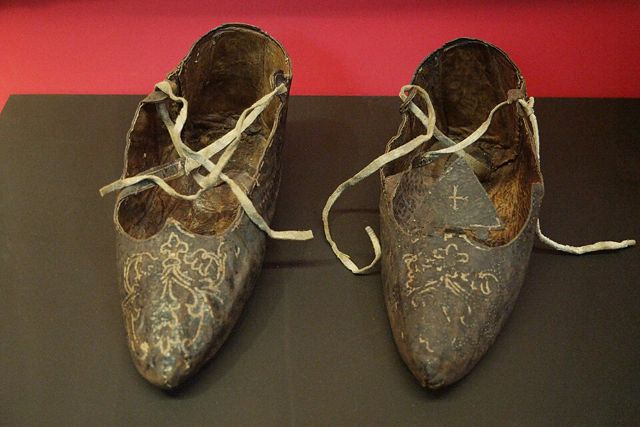
Image: Shoes of saint Germain.jpg · Fæ · CC BY-SA 4.0, via Wikimedia Commons

From Sabine Baring-Gould, The Lives of the Saints, new edition in 16 vols. (London: John C. Nimmo, 1897), digitized text from Project Gutenberg. Public domain.

Image: Fæ, Wikimedia Commons (CC BY-SA 4.0)

From Sabine Baring-Gould, The Lives of the Saints, new edition in 16 vols. (London: John C. Nimmo, 1897), digitized text from Project Gutenberg. Public domain in the United States. Reproduced unedited, except for short bracketed notes in grey that we added to explain names and terms (“S.” is the old abbreviation for Saint). Some history and judgments reflect 19th-century scholarship.