Baring-Gould’s sources: Roman Martyrology. That attributed to S. Jerome, and Latin Martyrologies. Authority: — The Acts which are certainly ancient, but not at all trustworthy. They pretend to have been written from the account of Terrentianus himself. But there are so many gross chronological blunders that this cannot be admitted. Gallicanus is said in the Acts to have been consul of Rome. In the consular lists appear Ovinius Gallicanus, and Septimius Bassus, in 318; and in 330, Gallicanus and Symmachus. The former is probably not the same as Ovinius. In the Life of S. Silvester, by Anastasius Bibliothecarius, we are told that Gallicanus gave to the church of SS. Peter and Paul, and S. John the Baptist at Ostia, which had been erected by Constantine, various costly gifts. So far the Acts can be confirmed; but no writer who was contemporary by a century, at least, would have made such blunders as the following: — He asserts that the Emperor Constantius was the nephew of Constantine the Great, and the successor of Constantine II. and Constans, whereas he was the son of Constantine the Great, and he divided the empire with his brothers Constantine II. and Constans. The Emperor Julian is represented as being at Rome, where he held a discussion with SS. John and Paul, whereas Julian, as emperor, was never at Rome at all. Gallicanus is said to have gone to the Scythian war as 1 His relics are preserved at S. Maur-des- Fosses over the high altar. His acts are fabulous.
…general of Constantine ihe Great, who is represented as reigning in Rome, whereas Constantine was only twice in Rome after his de eat oi Maxentius [rival emperor at Rome 306–312, defeated by Constantine], and then only for a very brief period. The author, who makes such mistakes, cannot be trusted when he says of S. Constantia, the daughter of Constantine: 11 We heard Constantia herself relate this, and indeed have seen it in h-r own writing, how Attica and Artemia (the daughters of Gallicanus) were converted." Higuera converted thise saints and S. Gallicanus into Spanish saints in his forged Chronicle of Dexter, and was followed by Tamayus Salazar. But the Portuguese Martyrologist, Cardosus, appropriates them to Portugal.] JHE following story must not be regarded as history, though possibly it is based on some tradition of events which really took place. The story, as it comes to us, is a deliberate forgery, pretending to be written by Terrentianus, or on his authority, whereas it cannot have been composed till long subsequent, and is repugnant to true history in many points.
When, says the story, the daughter of Constantine, the pious Constantia (Fek 18th) set up an establishment for herself at Rome, the emperor gave her John and Paul, two brothers, to be her household officers. John was steward, and Paul the master of the palace. Their virtue rendered them dear to their mistress, who had daily proof of their integrity.
The Persians having made an inroad into Syria in the reign of Constantine, his general, Gallicanus, marched against them and totally routed them,1 and on his return, asked the emperor as his reward, the hand of Constantia, his daughter.9 Constantine hesitated; when an irruption 1 1 am at a loss to know when this took place. Tbe Persians threatened, but there was no serious war, and no such victory in tbe reign of Constantine I. and afterwards to Gallns Cesar, and was so wicked that she was popularly called Megcra, Ammianus Marcellinus, Ub. xiv. It is, however, just possible thatj there may have been another daughter of the same name | but it is aot probable. Marcellinus tells ns that the wicked, licentious Constantia was bnried at Rome, so was the virgin saint, Constantia, a suspicious coincidence of Scythians into Thrace alarmed him, and he sent Gallicanus at the head of an army against them, and promised him, should he be victorious, that he would confer on him the honour of the consulate, and with it the hand of Constantia. John and Paul accompanied Gallicanus to the war, and in their places were left Attica and Artemia, the daughters of the widowed Gallicanus. The example and influence of the princess converted the sisters, and they were baptized, and renounced idols. Their father also was brought to the truth by means of John and Paul, who, when the Roman army was almost defeated, assured the general that if he were to make a vow to become a Christian, the fortune of the day would change. He immediately made the requisite vow, and a legion of angels having visibly interfered to protect the menaced flank of the Roman army, fortune declared for Gallicanus, and the barbarians fled.
On the return of the general to Rome, he was received with rapture by the emperor, and Gallicanus presented to him the king of the Scythians and his two sons, whom he had taken captive, and announced to him the entire subjugation of the whole Scythian race, and the liberation of Thrace from all apprehension of future inroads.1 Helena and her daughter Constantia2 met Gallicanus at the palace gates, and it was a mutual surprise and gratification for the father and daughters to learn that they had respectively embraced Christianity.
Gallicanus now learned that Constantia, to whose hand l It is true that the Sarmatians and Goths [Germanic peoples who invaded the Roman Empire, many of them Arian Christians] infested the neighbourhood of the Danube in this reign, but had this victory taken place, the panegyrists of Constantine would not have omitted to notice it. Constantine. Her daughter Constantia, the wife of Lidnius, was an Arian [followers of Arius, who taught that the Son is a created being, not fully God]. By his first wife, Minervina, Constantine had one son only, Crispus. By Fausta, the daughter of Maximian [Diocletian’s co-emperor in the West, 286–305], he had three daughters, of whom Constantia was one, and three sons.
jur.c he had aspired, had been greatly afflicted with scrofula, but having been cured at the tomb of S. Agnes, had resolved to dedicate her virginity to God. Gallicanus contented himself with the consulship, which he enjoyed in the year 330, and then retired to Ostia, where he liberally enriched a church1 built there by the emperor Constantine. There he resided tiU Julian had been made Caesar by Constantius, and when Julian published a decree forbidding Christians to retain any possessions, % the lands of Gallicanus were delivered over to pagans. But every pagan who put foot inside the boundaries, was seized with a devil, and every one who took the title-deeds became a leper. This astonishing fatality having been related to Julian, he consulted the oracle at Rome,8 and learned that if Gallicanus could be induced to sacrifice to the idols, die phenomenon would be at an end. Julian ordered Gallicanus to sacrifice, or to leave Italy. Gallicanus chose exile, and retired to Alexandria, where, as he refused to acquiesce in the restoration of idolatry, he was killed by the ‘Count* Rautianus, and with him suffered a faithful companion, named Hilarinus.
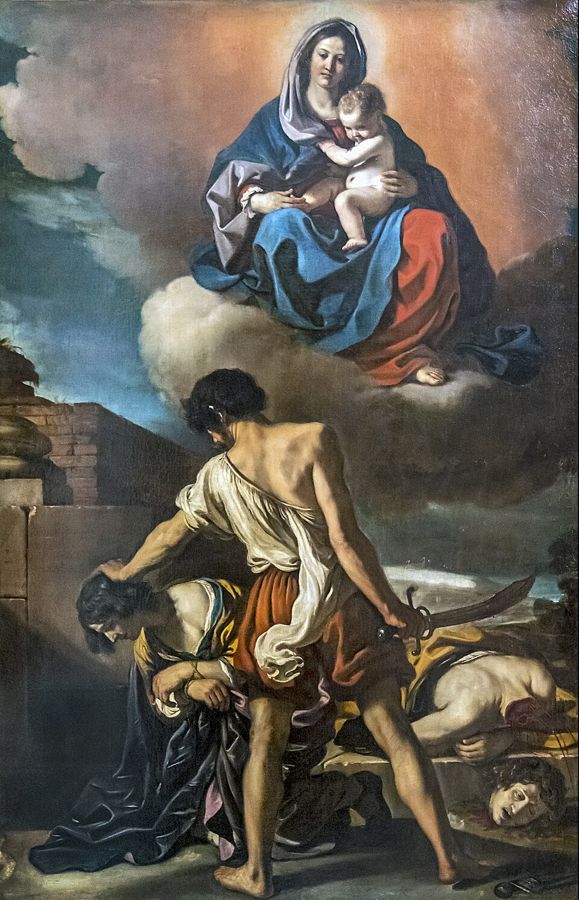
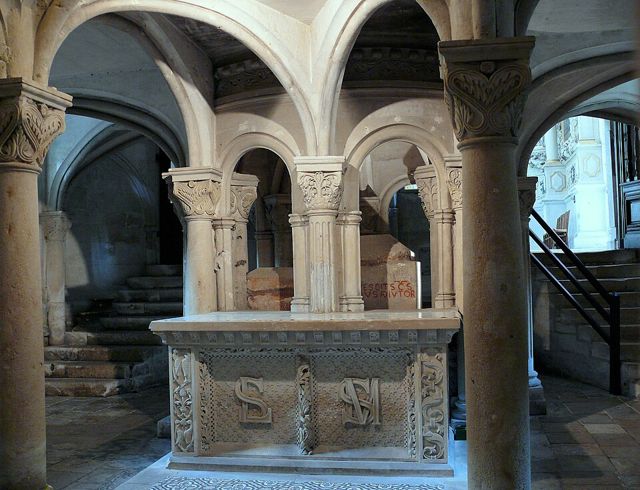
Julian next tried to bend John and Paul to apostasy, by depriving them of their wealth bequeathed to them by Constantia. The emperor summoned them before him, and having in vain tried persuasion and threats, he ordered them to be executed with the sword during the night, and spread a report that they had been sent into exile. But the son of Terentianus, the captain of the guard, who had been charged with the execution, was seized by a devil, and Terentianus, having been converted by the prodigy, 1 This is almost the only well authenticated fact in his history. He gave to the Church a silver crown m with dolphins,** weighing aolha, VOL. VL 24 was baptized, and suffered martyrdom for his faith the following year, after having given full information to the author of the acts of all the incidents of the martyrdom of John and PauL The emperor Jovian built a church on the site of the house of the martyred brothers, and the fame which they acquired is evidence that such a martyrdom really did take place; though the narrative which we have of the circumstances, is utterly devoid of historical value. The church of SS. John and Paul at Rome gives a title to a cardinal The relics [the bodily remains of a saint, or objects they used, kept with honor] of the saints are preserved in it SS. John and Paul are represented in military costume with palm and sword.