Sts. Jonas and Barachisius

Jonas and Barachisius were brothers who were martyred in Persia under king Sapor, in the eighteenth year of his persecution.

Read the essentials →
March 29 · Martyrs

Sts. Jonas and…

Sts. Jonas and Barachisius

Jonas and Barachisius were brothers who were martyred in Persia under king Sapor, in the eighteenth year of his persecution.

Traditional feast

March 29
1914 / pre-1969 calendar, per Baring-Gould (1897)

Current feast

March 29
Secondary source · Wikipedia

Represents

Martyrs

Their story

Adapted in modern English from Alban Butler's Lives of the Saints · Baring-Gould original below · little is known

Jonas and Barachisius were brothers who were martyred in Persia under king Sapor, in the eighteenth year of his persecution. They had gone to Beth-Asa to encourage Christians who were imprisoned there.

The Magians questioned them at night, because Jonas spoke so powerfully that they feared he would win converts if he spoke in public. Red-hot iron plates and hammers were applied under his arms. Their acts were written by Esaias, who was an eyewitness. Butler and Baring-Gould agree on 327.

Early life

The book says little or nothing about early life. This is how the account begins.

Thin entry · the 1897 book gives only 132 words. We have not filled the gap with invented detail.

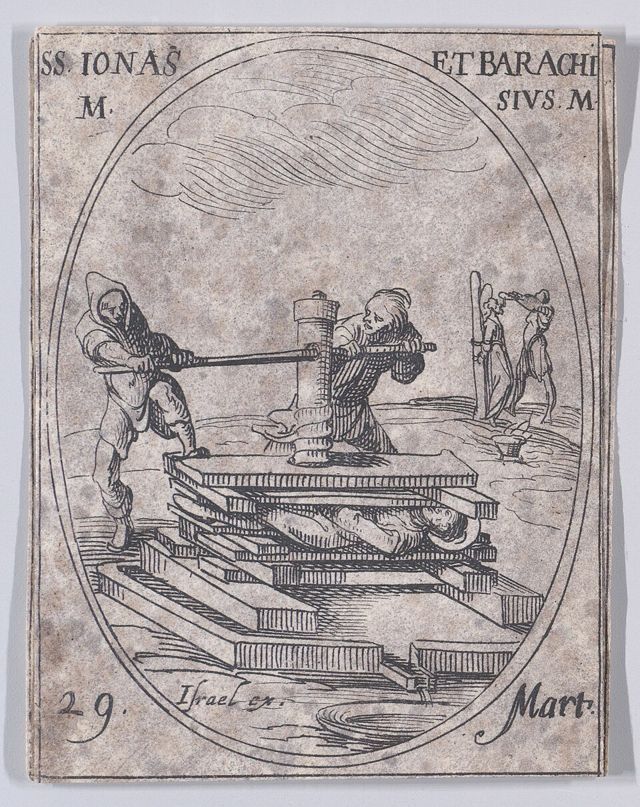
King Shapoor, or Sapor, of Persia, raised a savage persecution against the Christians in his realm, believing them to be in league with the Roman emperor. Amongst those who suffered were Jonas and Barachisius, because they refused to adore the sun and fire. Melted lead was poured down the nostrils of Jonas, and red-hot plates were placed under his arms, and he was hung up by one foot in his dungeon till he fainted.
What they represent

How they teach us to live

Drawn from themes in the original account

Stay faithful when it costs you. This account is about holding firm under pressure.

Keep their day. Remember them on March 29 with a short prayer, and ask for their help.

Read more

The full original · 132 words

Read Baring-Gould’s full account

Baring-Gould’s sources: Greek Menology of the emperor Basil the younger, and Roman Martyrology. Authority:—The Acts written by an eye-witness, Esaias, an Armenian knight in the troops of king Sapor, pub. in Chaldaic by Asseman. The Greek version in Metaphrastes has gone through much amplification.

King Shapoor, or Sapor, of Persia, raised a savage persecution against the Christians in his realm, believing them to be in league with the Roman emperor. Amongst those who suffered were Jonas and Barachisius, because they refused to adore the sun and fire. Melted lead was poured down the nostrils of Jonas, and red-hot plates were placed under his arms, and he was hung up by one foot in his dungeon till he fainted. His hands and feet were cut off, his tongue torn out, and he was pressed to death in a grape-crusher. Barachisius was treated with equal barbarity. Sharp splinters of reed were thrust into his flesh, all over his body, so that he resembled a porcupine, and he was then rolled on the ground to drive the spikes in.

Feast days

Feast: March 29

Nine days · Free

Pray the novena
with us.

One short email a day for nine days. The day's prayer, a line from Sts. Jonas and…'s story, and a nudge to keep going.

Also on March 29
M

Sts. Mark and Cyril

March 29 · Bishop, Confessor, Deacon, Martyr
A

Sts. Armogastes and…

March 29 · Martyrs
E

St. Eustace of Luxeuil

March 29 · Abbot
← All 1726 saints in the library
Sources & notes

Feast-day sources

Story sources

Sources

Credits

Image: St. Jonas and St. Barachisius Met DP890900.jpg · Jacques Callot · CC0, via Wikimedia Commons

From Sabine Baring-Gould, The Lives of the Saints, new edition in 16 vols. (London: John C. Nimmo, 1897), digitized text from Project Gutenberg. Public domain.

Image: Jacques Callot, Wikimedia Commons (CC0)

From Sabine Baring-Gould, The Lives of the Saints, new edition in 16 vols. (London: John C. Nimmo, 1897), digitized text from Project Gutenberg. Public domain in the United States. Reproduced unedited, except for short bracketed notes in grey that we added to explain names and terms (“S.” is the old abbreviation for Saint). Some history and judgments reflect 19th-century scholarship.