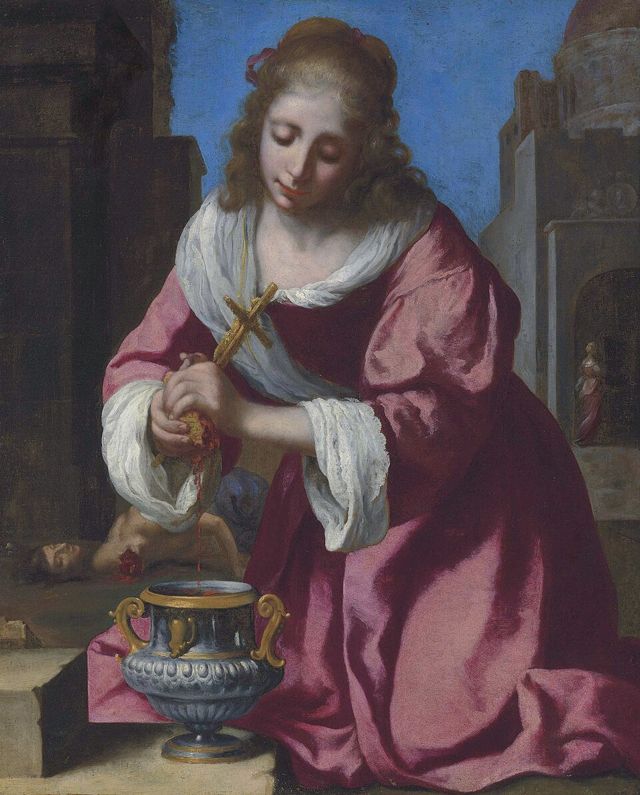
Faithfulness to Christ when it cost everything.
July 21
Not verified yet
Virgin
Martyr
The story is, that in one of the inroads of the Goths on Gaul, the barbarians carried off a young damsel named Julia, from her native place, Troyes.
Stay faithful when it costs you. This account is about holding firm under pressure.
Share your faith, in words and by example. Preaching and conversion are central here.
Learn from the kind of life it was. Faithfulness to Christ when it cost everything.
The story is, that in one of the inroads of the Goths [Germanic peoples who invaded the Roman Empire, many of them Arian Christians] on Gaul [roughly modern France and Belgium], the barbarians carried off a young damsel named Julia, from her native place, Troyes. The “emperor" of the Goths was named Claudius; he fell in love with the maiden, but she announced to him that she was a Christian and a consecrated virgin. Then he treated her with the ' utmost respect, and when he went to war visited her as an oracle, and obtained from her prophecies as to the event of his wars. She lived in a hut, or tent, he erected for her. At last she converted him and several other Gothic chiefs, and all returned together to Troyes, and submitted their necks to the executioner's sword by sentence of Eliclius, the prefect.
The relics [the bodily remains of a saint, or objects they used, kept with honor] of all these martyrs are shown at Troyes. It is observable that in transferring the story to Gaul, those who perpetrated the fraud of altering and adapting the acts of SS. Luceja and Aucejas were so ignorant that they did not give to one of the German martyrs (they were twenty-one in all) a simple name of Teutonic origin — all are either Latin or Greek.
Feast: July 21
One short email a day for nine days. The day's prayer, a line from Sts. Julia and Claudius's story, and a nudge to keep going.
From Sabine Baring-Gould, The Lives of the Saints, new edition in 16 vols. (London: John C. Nimmo, 1897–98); text from the Internet Archive scan (OCR, lightly cleaned; errors possible). Public domain.
From Sabine Baring-Gould, The Lives of the Saints, new edition in 16 vols. (London: John C. Nimmo, 1897–98); text from the Internet Archive scan (OCR, lightly cleaned; errors possible). Public domain in the United States. Reproduced unedited, except for short bracketed notes in grey that we added to explain names and terms (“S.” is the old abbreviation for Saint). Some history and judgments reflect 19th-century scholarship.