F
Sts. Fusca and Maura
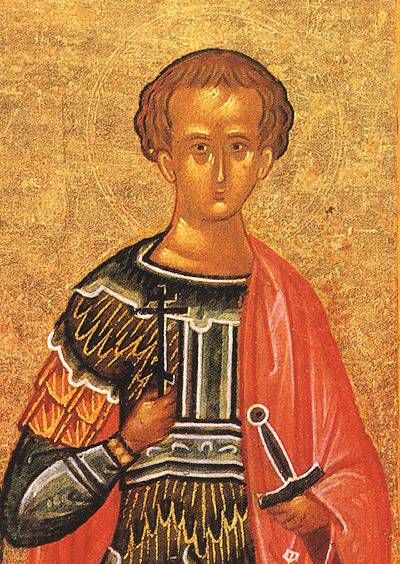
St. Polyeuctus
C
S. Loman is said to have been the son of Tigridia, sister of S. Patrick; his brothers Brochan and Mogenoch, were, like him, also bishops; and his cousins, Mel, Rioch and Mun, (Feb.
Read the essentials →S. Loman is said to have been the son of Tigridia, sister of S. Patrick; his brothers Brochan and Mogenoch, were, like him, also bishops; and his cousins, Mel, Rioch and Mun, (Feb.
February 13
Not verified yet
Feast
S. Loman is said to have been the son of Tigridia, sister of S. Patrick; his brothers Brochan and Mogenoch, were, like him, also bishops; and his cousins, Mel, Rioch and Mun, (Feb. 6th), sons of his aunt Darerca, were saints and prelates. And when one Fortchern, son of Fethlemid, chief of Trim, heard the sweet chanting of Loman on his boat, a great longing came over him to hear the doctrine which exhaled such sweetness.
Keep their day. Remember them on February 13 with a short prayer, and ask for their help.
S. Loman is said to have been the son of Tigridia, sister of S. Patrick [apostle of Ireland (5th century)]; his brothers Brochan and Mogenoch, were, like him, also bishops; and his cousins, Mel, Rioch and Mun, (Feb. 6th), sons of his aunt Darerca, were saints and prelates. S. Loman accompanied S. Patrick to Ireland, and when they landed at Temora, the great apostle left Loman in charge of the boat, ordering him to bring it up the river Boyne to Trim. And when one Fortchern, son of Fethlemid, chief of Trim, heard the sweet chanting of Loman on his boat, a great longing came over him to hear the doctrine which exhaled such sweetness. Therefore he came to him and received instruction out of the boat, and he sang with him the songs of Zion. Then came the mother of Fortchern, seeking her son, and she was a Scottish princess, and she saluted the priest of God reverently, and rejoiced that the Gospel of Christ was wafted to the shores of Ireland. And Fethlemid came also, and received instruction, and himself believed, and his whole house; and they were baptized; and he gave Antrim to the church as a possession. Then came Patrick and founded there a church, and placed Loman over it, as chief pastor. Jocelin, the writer of the life of S. Patrick, states that he used a life of the great apostle of the Irish, written by S. Loman, his nephew.
Now when Loman was dying, he called to him Fortchern, that he might consecrate him to be his successor in the See of Antrim, but he would not, "Lest," said he, "it should be thought that the government of this diocese was mine by hereditary right, for my father owned it till he gave it to God." Then Loman recognised this reason as fitting, and he was succeeded by one named Cathald.
Such is the legend, and a sad confusion of history and fable does it prove to be. These are Dr. Lanigan's judicious remarks: "The Tripartite Life makes S. Loman or Luman a nephew of S. Patrick, left in charge of the boat, and adds that, in consequence of the order of the saint, he sailed up against the current of the river as far as Trim. This was too good a story to be slightly passed over by Jocelin, who, to make it still more marvellous, subjoins that, the sails being hoisted, he went up, without the assistance of oars, notwithstanding furious blasts of wind in the direction opposite to its course. He might as well have said that it had been carried in the air; for the channel of the Boyne is so unfit for navigation, that it would be impossible for a boat to proceed as far as Trim, even were both the current and the winds favourable." [50]
There can be no doubt that Loman lived much later, and that he is no other than the bishop Loman of Trim, who lived in the 7th century, of whom nothing authentic is known. Dr. Lanigan carefully traces the fable of the donation of Antrim, and shows that it is partly blunder, partly wilful invention. Colgan patched up the Acts of S. Loman from the stories in the Tripartite Life of S. Patrick, and in Jocelin, who quotes from the Martyrologum Tamlachtense the following passage:—"Loman of Trim and his companions, who were (of the list two only are worth noting) Ossan and Fortchern." "If," says Dr. Lanigan, "by sociis suis we should understand disciples of Loman, Loman must be brought to much later times than those of S. Patrick, for Ossan was, in all appearance, the person of that name whose memory was revered at Rath-Ossan, near the west gate of Trim, and whose death is marked at a.d. 686. Some of them are placed by Colgan himself in still later times. It may be objected that Tirechan, who is supposed to have lived in the 7th century, speaks of Loman as being in S. Patrick's days. But if Tirechan lived so early, the account given of Loman is undoubtedly an interpolation thrust into his work. For no author of that country would have written certain nonsense therein contained, such as that prince Fethlemid, a son of king Leogaire, made a grant of all his territory, property, and family, to Saints Patrick and Loman, and thus to the Church of Trim. Such fables, relative to ecclesiastical endowments, did not appear in Ireland until a much later period." [51]
With regard to Fortchern the same difficulty exists. Notwithstanding that he is made the son of Fethlemid, prince of Trim, he is spoken of in the Tripartite Life as blacksmith to S. Patrick; and if he were a disciple of S. Loman, he must be moved from the 5th to the 7th century. Anyhow he is not to be confounded with Bishop Fortchern of Ross, as does the legend; if he was a bishop at all, it was of Trim.
Feast: February 13
One short email a day for nine days. The day's prayer, a line from Sts. Loman and Fortchern's story, and a nudge to keep going.
From Sabine Baring-Gould, The Lives of the Saints, new edition in 16 vols. (London: John C. Nimmo, 1897), digitized text from Project Gutenberg. Public domain.
From Sabine Baring-Gould, The Lives of the Saints, new edition in 16 vols. (London: John C. Nimmo, 1897), digitized text from Project Gutenberg. Public domain in the United States. Reproduced unedited, except for short bracketed notes in grey that we added to explain names and terms (“S.” is the old abbreviation for Saint). Some history and judgments reflect 19th-century scholarship.