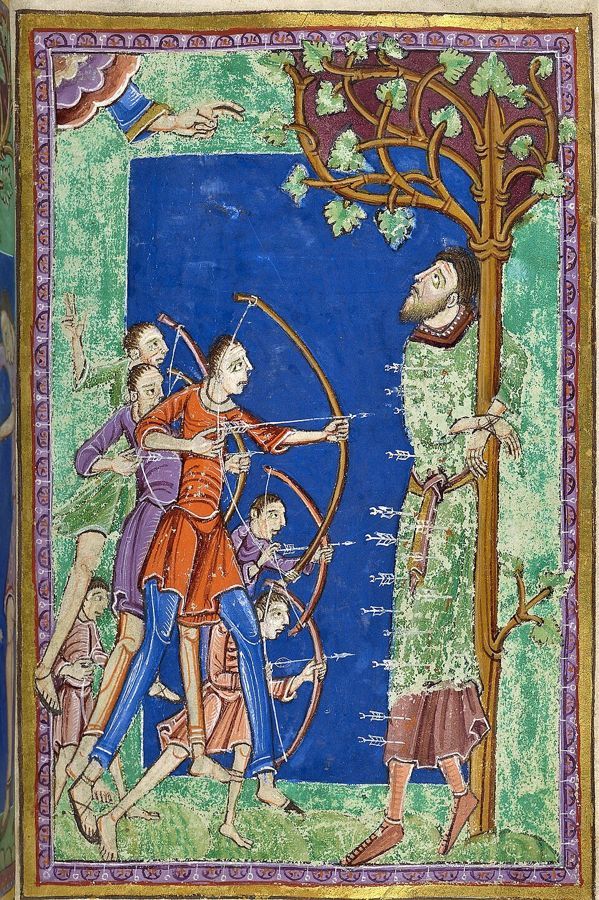
Baring-Gould’s sources: Roman Martyrology. Greek Menseas, Menology of Basil (Prologue). Authority: — The genuine Chaldee Acts, published by Assemani, Act. Mart. Orient, i. pp. 97 and 226.] Narses, bishop of Sgiarchadata, in the province of BethGarma, in Persia, was arrested in the persecution of Sapor II. Sgiarchadata was then the first see under the metropolitan chair of Beth-Seleucia. With Narses was arrested his disciple Joseph. When they were led before the king, he said to Narses, “ Your grey hairs and the bloom of your pupil’s youth incline me to favour you. Consult your safety, do homage to the sun, and I will confer on you rank and reward.” Narses answered, “I am fourscore years old, and have served my God from infancy, and how can I then desert Him to adore the creature of His hands ?” The king threatened him with death. Narses said, calmly, “ Not if I should have to suffer seven deaths would I yield to your will.”
Sapor then ordered them to execution. At the place where they were to suffer, Narses cast his eyes about on the crowd assembled to see him die, and Joseph said, “ See, my father, how the people are assembled looking for thee to dismiss them with thy blessing.” Narses embraced his disciple, and then both submitted their necks to the sword of the executioner.
Many others suffered about the same time. John, metropolitan [the archbishop who heads a group of dioceses] of Beth-Seleucia, sentenced by Ardschir. Isaac, priest of Hulsar, was stoned to death. Papas, priest of Herminum, suffered at Gabala. Uhanan, a young clerk, was stoned to death by some renegade women. Guhschiatazades, an 6". Maventia.
eunuch, was sentenced by Ardschir to be killed by the hand of Vartran, a Christian priest, who had shrunk from martyrdom, and had done sacrifice to the sun. There are other martyrs commemorated by the Greeks and named in the same Acts.
S. MAXENTIA, V.M. (date uncertain.) [At Beauvais on Nov. 20 and Oct. 24. Irish and Scottish MarAt Beauvais on October 24 is venerated S. Maxentia, who, it is pretended, was a Scottish (Irish) virgin, who settled there with S. Barbanus, her valet, and S. Rosebia, her maid, and there received the crown of martyrdom. They are purely apocryphal personages. However, Maxentia has been identified with Maxellenda, and Maxellenda with Mo-Easconn, an Irish saintly bishop.
Easconn is commemorated by ^Engus the Culdee, on November 19, as “ Maximus the great champion.” In the Felire of ^Engus on November 20, we have “ I invoke Escon with Froechan, a noble vessel with a fine mouth.” The note on Escon (/. e. the uncleansed) is to the effect that he was so called because he was unbaptized till aged thirty. The Scottish martyrologists, finding a Maximus on this day, and Maxentia on the same day at Senlis, adopted the Gallican story, and changed the sex of the old bishop.