…ties and impossibilities. 1 ] AULINUS, a clerk of Milan in the times of S. Ambrose [bishop of Milan (d. 397)] (a.d. 374-397), wrote a life of that great saint, and in that life he relates how that S. Ambrose found a dead body in a garden outside the city of Rome, and that, concluding it was that of a martyr, he translated it to the church of the Apostles in Milan. The body was fresh, with beard and hair, incorrupt, and the blood as though recently shed. “ When this martyr died,” says Paulinus, w to this day we have not been able to learn.” 3 After this body had been disposed of, another was found, 1 Here is one specimen. The wild beasts out of the menagerie of Nero burst into the garden of Nero and scratched his foot. 3 "Qui quando sit passus, usque in bodiernum diem scire non possnmns.** that of a boy, in the same garden; it was also taken to the church of the Apostles. Inquiry was made of the proprietors of the garden, if they knew anything about these bodies. They said that their ancestors had forbidden them to sell the ground, as a treasure was hidden it. The bodies of the saints were, no doubt, that treasure.
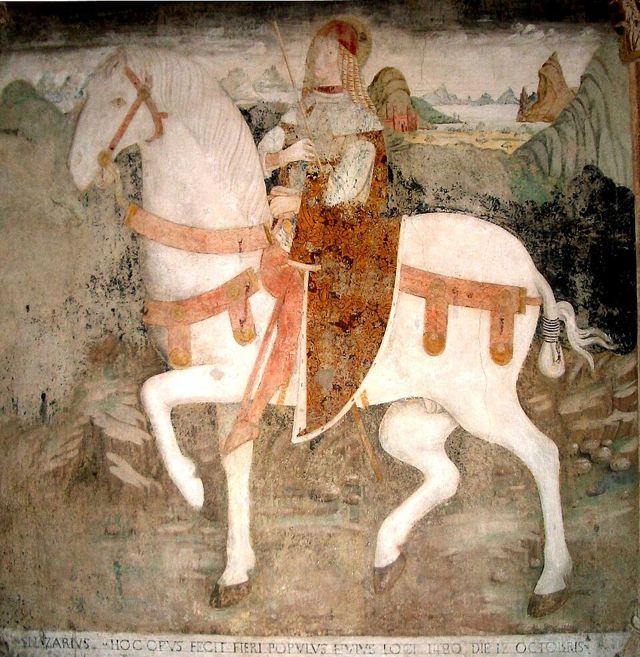
This invention took place, we are told, after the death of Theodosius [name of Roman emperors; Theodosius I (379–395) made Christianity the state religion] the Great (a.d. 395). S. Ambrose died a.d. 397, consequently the discovery took place about a.d. 396. S. Ambrose sent some of the relics [the bodily remains of a saint, or objects they used, kept with honor] of S. Nazar ius to S. Paulinus of Nola, as the latter tells us in a poem (xxiv). If the body was fresh, it is scarcely credible that the great archbishop should have amputated portions — the blood still liquid — to distribute among his friends. S. Gaudentius of Brescia also rejoiced, in years later, in 397, in possessing another piece of the corpse. 1 A sermon, falsely attributed to S. Ambrose, probably a composition of S. Maximus of Turin (5th cent.) on the martyrs Nazarius and Celsus, says: — “ Although the holy church of Milan retains the entire body of the blessed martyr Nazarius, yet she transmits it all to the whole world in benediction. This is the glory of these holy martyrs, that although their remains are dispersed throughout the whole world, yet the plenitude of their virtues remains entire.” Constantinople received relics of the two saints, so did the church in Africa, sent by pope Symmachus. Childebert I. obtained other portions of the relics, and built a church at Paris to contain them. The apocryphal Acts of SS. Nazarius and Celsus — of whom in S. Ambrose’s time nothing was known — contain the fullest details of their travels in Gaul [roughly modern France and Belgium].
1 In his sermon xvii. S. Victor. Their relics are shown at Embrun, Autun, Gap, and innumerable other places. It is perhaps necessary to give an outline of their fabulous story. Nazarius is said to have been the son of a heathen named Africanus, and a Christian mother, named Perpetua. He was baptized by S. Linus, and preached the Gospel at Milan, at Genoa, and then at Cimia, near Nice, where a lady entrusted to his care her child named Celsus, whom Nazarius at once adopted as his son. They visited the Alps of Dauphine, and preached at Embrun, Geneva, and Treves [Trier in Germany]. At the latter place they were imprisoned. According to another version, it was at Rome, by order of Nero, that this took place. They were put on a ship, they walked to land over the water. They returned to Milan, and were arrested by Anulinus, the governor, and their heads were struck off.