Their story
Nicasius, bishop of Rheims, was killed by barbarians who sacked the city in the fifth century. The deacon Florens and the lector Jocond died with him, and so did his sister Eutropia. Baring-Gould gives 407.
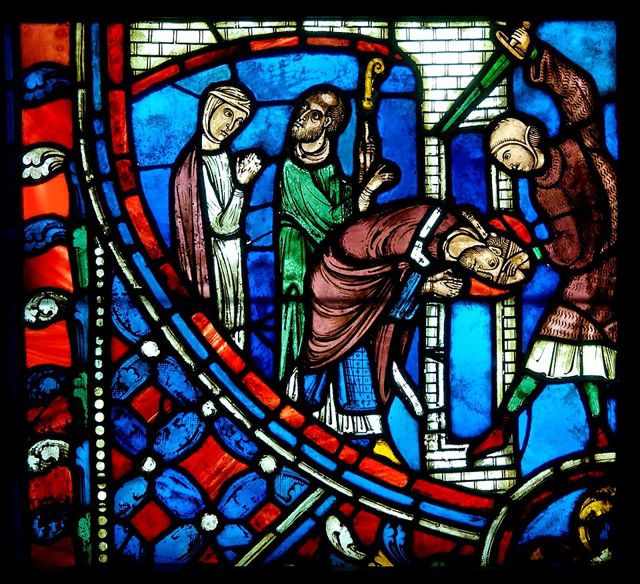
Nicasius, bishop of Rheims, was killed by barbarians who sacked the city in the fifth century.
Read the essentials →Nicasius, bishop of Rheims, was killed by barbarians who sacked the city in the fifth century.
December 14
December 14
Bishop
Martyr
Virgin
Nicasius, bishop of Rheims, was killed by barbarians who sacked the city in the fifth century. The deacon Florens and the lector Jocond died with him, and so did his sister Eutropia. Baring-Gould gives 407.
Thin entry · the 1897 book gives only 188 words. We have not filled the gap with invented detail.
In 407 a flood of Vandals and Alans poured over Gaul, entered Champagne, and besieged Rheims. The inhabitants defended their city with heroism. Their efforts were in vain: the invaders burst through the gates, and clambered the walls, and began a general pillage and massacre.
Keep their day. Remember them on December 14 with a short prayer, and ask for their help.
In 407 a flood of Vandals and Alans poured over Gaul [roughly modern France and Belgium], entered Champagne, and besieged Rheims. The inhabitants defended their city with heroism. Their efforts were in vain: the invaders burst through the gates, and clambered the walls, and began a general pillage and massacre. A Vandal cleft the skull of S. Nicasius at the door of his cathedral. Eutropia, the sister of the bishop, was reserved for another fate, but fearing this more than death, she boxed the ears of her captor, kicked and struggled, till he lost his temper, and cut her down. With Nicasius suffered his deacon Florentius, and his lector Jucundus. The relics [the bodily remains of a saint, or objects they used, kept with honor] of S. Nicasius and his sister were laid in the church of S. Agricola, called afterwards by his name. This church was pulled down in 1793.
Pec. x+ In the nave of the cathedral of Rheims is a marble slab marking the spot where stood the ancient gates of the church, and where S. Nicasius suffered martyrdom. Only a few fragments of the bones of the saint are preserved in the cathedral of Rheims, most having been lost at the Revolution.
Feast: December 14
One short email a day for nine days. The day's prayer, a line from Sts. Nicasius and…'s story, and a nudge to keep going.
Image: Nicasius maryrdom Louvre OA6119.jpg · Unknown artistUnknown artist · Public domain, via Wikimedia Commons
From Sabine Baring-Gould, The Lives of the Saints, new edition in 16 vols. (London: John C. Nimmo, 1897–98); text from the Internet Archive scan (OCR, lightly cleaned; errors possible). Public domain.
Image: Unknown artistUnknown artist, Wikimedia Commons (Public domain)
From Sabine Baring-Gould, The Lives of the Saints, new edition in 16 vols. (London: John C. Nimmo, 1897–98); text from the Internet Archive scan (OCR, lightly cleaned; errors possible). Public domain in the United States. Reproduced unedited, except for short bracketed notes in grey that we added to explain names and terms (“S.” is the old abbreviation for Saint). Some history and judgments reflect 19th-century scholarship.
