A whole community that stayed faithful to Christ when it cost everything.
Read the essentials →A whole community that stayed faithful to Christ when it cost everything.
Read the essentials →A whole community that stayed faithful to Christ when it cost everything.
October 5
October 5
Martyrs
In 1 1 15, when Peter the Deacon was Abbot of Monte Cassino, there appeared in Italy a certain Greek priest from Constantinople, named Simeon. He had visited Sicily, and from thence he made his way to Salerno. He produced a parchment written in Greek, containing a life and martyrdom of S. Placidus, purporting to have been written by one Gordian, monk of Monte Cassino, and companion of S. Placidus.
Feed your mind with Scripture and good books. Learning and the Scriptures matter in this life.
Learn from the kind of life it was. A whole community that stayed faithful to Christ when it cost everything.
In 1 1 15, when Peter the Deacon was Abbot of Monte Cassino, there appeared in Italy a certain Greek priest from Constantinople, named Simeon. He had visited Sicily, and from thence he made his way to Salerno. He produced a parchment written in Greek, containing a life and martyrdom of S. Placidus, purporting to have been written by one Gordian, monk of Monte Cassino, and companion of S. Placidus. Simeon pretended that after the martyrdom of Placidus, Gordian took refuge at Constantinople with the ancestors of Simeon; and that Justinian [Byzantine emperor 527–565], the emperor, hearing of his adventures, bade him write a record of the passion of the Benedictine [monks following the Rule of St. Benedict] martyrs in Sicily. This Gordian did, and he gave his original manuscript to his hosts, and it became a family heirloom, which descended to Simeon, and Simeon showed it to the Benedictines of Salerno. The monks, eager as they 1 The Epternacht Mart, of the 8th cent.: “ In Sicily the nativity of Eutychius and of other eight.” A Lucca Mart: “In Sicily, Placitus, Euticius, and other thirty.” Some copies of the Mart, of Jerome: “ In Sicily, Euticius and other eight, and thewJun Placitus and Baricius.” “In Sicily, Placentius and Placitus, Euticius and other thirty/* Morbach Mart, of 9th cent.: “ Placitus, at Valcntia Apollinaris, Euticius, Victorious.”
oct. 5.] SS. Placidus, Eutychius, and Others. 1 2 1 naturally were to hear glorious news of the heroism of some of the founders of their Order, admitted that there were no traditions in their society confirming this wonderful narrative, and they refused to give credence to it. Then the wily old Greek, laying his hand on a crucifix,' swore most solemnly by that sacred form that the manuscript was genuine, and really written by Gordian, and contained a true narrative. Some of the monks yielded credence to the story; but, as Peter, Abbot of Monte Cassino, informs us in his account of the affair, John, Provost of S. Lorenzo, never trusted the old rascal, but called him a Greek impostor. 1 There was present at Salerno, at the same time, a monk named John of Capua, who also regarded Simeon as a rogue, and the manuscript as a forgery; but after a time he consented to translate it into Latin, whether because he abandoned his suspicions, or because the Abbot of Monte Cassino wanted a translation, does not transpire. When the Acts, in Greek and Latin, reached the headquarters of the Order, they were generally regarded as apocryphal, and Peter Diaconus, as he tells us, at first treated them as a forgery. However, after a time perhaps he changed his mind, for in his twenty-third year he re-translated, or rather re-wrote, the life and martyrdom of S. Placidus and his companions. But he returned to his former disbelief in the genuineness of the document, for he composed, later in life, a book on the worthies of Monte Cassino, and he was careful not to say a word in that of the marvellous story of Gordian. However, that story seems to have found favour with others, and Stephen Anidensis wrote the life. 3 But his life 1 “ Dicens, ilium delusorem Constant inopolitanum esse." The letter of Peter of Monte Cassino, containing the account of Simeon, is to be found in Oct. Cajetan, De Sanctis Siculis, t. i. p. 183.
2 The Bollandists [Jesuit scholars who since the 1600s have critically studied the lives of the saints] say of him, “ Stephanus quidam Anidensis, auctor eastern ignotus.” There was Stephen, B. of Le Puy (Anicium) in X220, but it is hardly likely that he can have been the author.
is identical with that of Peter Diaconus, and it is thought that the abbot, not liking to stand godfather to the stoiy of Gordian, republished it under an assumed name. In after times, when the fabulous story became accepted, various letters were forged to substantiate it; these — letters from Tertullus, the father of S. Placidus, from the Sicilians after his martyrdom, and of Justinian and Pope Vigilius — were published along with the Chronicon Casinense, in I603. 1 Unfortunately the fraud was used to support the claims of the Benedictine monastery to certain lands, which they held by virtue of forged bequests by Tertullus to S. Benedict [father of Western monks (d. c. 547), author of the Rule]. In the year 1266, two monks at Messina, Raymund and Florellus, saw in vision S. Placidus, in Benedictine habit, who ordered them to revive the festival in his honour, observed anciently on October 5th, but which had fallen into neglect. According to their story, they had demurred to announcing to the people the celebration of the memorial of a man of whom nobody had heard anything. Thereupon the vision extended to them a book, containing an account of his life and martyrdom. The book was that of Gordian. 2 From this time, veneration for S. Placidus and his companions, monks and martyrs, became popular in Messina, and gradually infiltrated the whole Benedictine Order.
In 1588, Raynaldde Nare, knight of S. John of Jerusalem, began the rebuilding of the church of S. John at Messina. On digging the foundations, it was found that the old foundations of the church had been laid in the midst of a number of skeletons, cutting across ancient walls which had formerly enclosed them. Twenty-eight skeletons were discovered, together with urns containing ashes, lacrymatories, and 1 These letters bristle with anachronisms. That they are forgeries does not admit of the smallest doubt other objects usually accompanying ancient interments. Of these bodies four were enclosed in one cist — three with their feet to the north, one with feet to the south. Of the other skeletons, one lay with its feet to the west, four with feet to the east, seventeen with feet to the north, and two with feet to the south.
There had originally been a quadrangular wall enclosing the cist above mentioned, and nine of the other bodies, and probably more; but the apse of the old church had been built over the spot, irrespective of the sepulchre, and had broken through the surrounding wall, leaving it intact only on the south and west \ the cist touched the foundations of the apse at its north-east angle. It was at once most rashly concluded that these bodies belonged to the martyred monks, and those in the cist were supposed to be S. Placidus, his two brothers, and sister.
The discovery of these skeletons created a sensation in Messina; visions and miracles convinced the sceptical, and the Archbishop of Messina having appealed to Pope Sixtus V., the Pope gave judgment that the relics [the bodily remains of a saint, or objects they used, kept with honor] found at Messina were to receive sacred honours as those of martyrs, and that their invention should be celebrated on August 3. Pope Sixtus V. elevated the festival of SS. Placidus and his companions, monks and martyrs, on October 5, into a double, with lessons taken from the Life by Gordian, and the festival was, by his order, inserted in the Roman Martyrology and Kalendar. 1 ' In 1608, when excavations were made outside the apse, more skeletons were discovered, as indeed might have been predicted by anyone who had examined the place of the former discoveries. An account was at once sent to Pope 1 The Jesuit fathers say: “ Hsec quidem Sixtus V. ad promovendum S. Placidi et Sociorum in fideiibus cultum: verum satisne prudenter se gessit in hoc negotio Sixtus? Bailletus enim in Vids Sanctorum... Pontificem ilium, velut hac in re minus caute versatum, sugillare non veritus est " — Acta SS., Oct iii. p. 108. Paul V., and he granted sacred honours to the newly unearthed relics.
The story of S. Placidus is as follows: — Placidus was bom in 515, and at the age of seven was given by his father Tertullus to S. Benedict This is related by S. Gregory the Great in his Dialogues. One day the little Placidus went to the water-side with a crock to fetch water, but letting go the pitcher, it slipped in, and Placidus, in attempting to recover it, fell in also. S. Benedict at that moment was in his cell. He suddenly called to him his disciple Maurus, and said to him: “ Brother Maurus, run, for that boy who has gone to fetch water has fallen into the pond." Maurus asked a blessing and departed, and reaching the water-side he ran out upon the surface and caught the hair of the drowning child, and drew him safe to land; and then only did he perceive that he had walked on the face of the lake to reach him. This incident is related also by S. Gregory, and this is all that is really known of Placidus, whose name does not again occur in any authentic document.
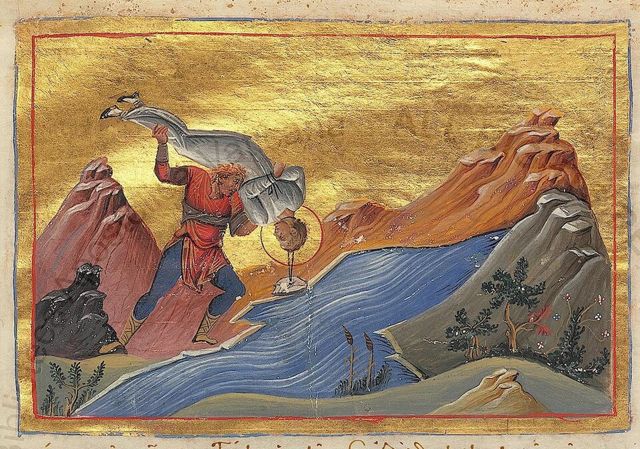
The forged Acts by the pseudo-Gordian, however, make him depart for Sicily, where he is martyred by the Saracens [medieval Christian name for Arab and Muslim peoples] along with his brothers Eutychius and Victorinus, and his sister Flavia, and thirty companions, because they would not worship Moloch and Remphan, the gods of the Saracen king, Abdallah. It is needless to point out that the Saracen invasion of Sicily did not occur till a.d. 832, when they were Mahomedans.
If the bodies found at Messina had been those of martyrs who had suffered in a Saracen invasion, they would not have had ums and lacrymatories at their sides. The pseudo-Gordian makes the Saracen invaders come from Spain, then, he says, in the hands of these pagans; but the Moorish occupation of Spain took place in 71 1-7 13, and •S'. Galla.
Abdallah, whom he makes their king in Spain, was either Abdallah of Toledo, a.d. 870, or the seventh Caliph, a.d. 880-905, or the eighth Caliph, a.d. 907-912, none of whom sent expeditions to Sicily. But the story does not deserve controverting, it carries its falsehood in its face. It is quite unnecessary to enter into the particulars of the invention of the crafty Greek Simeon. That there were martyrs in Sicily of the names of Placidus and Eutychius, Simeon had learned when at Messina, from the Martyrologies. That he had read S. Gregory’s Dialogues is also evident, for he incorporated the narrative of the rescue of Placidus from drowning and the name of his father, in his forged Acts. But all the rest is pure invention, and he was without the smallest justification for identifying the Placidus of Messina with the Placidus of Subiaco.
The Roman Martyrology needs revision in this matter, for it says on this day: “ At Messina, in Sicily, the nativity of S. Placidus, monk, disciple of S. Benedict, Abbot, and of SS. Eutychius and Victorinus, his brothers, of S. Flavia, virgin, their sister, and of SS. Donatus, Firmatus, Deacon, Faustus, and thirty other monks, all martyrs, who were massacred for Christ by the pirate Massucha, a.d. 541.”
Feast: October 5
One short email a day for nine days. The day's prayer, a line from Sts. Placidus's story, and a nudge to keep going.
Image: Pietro Perugino - Saint Placidus - WGA17312.jpg · Pietro Perugino · Public domain, via Wikimedia Commons
From Sabine Baring-Gould, The Lives of the Saints, new edition in 16 vols. (London: John C. Nimmo, 1897–98); text from the Internet Archive scan (OCR, lightly cleaned; errors possible). Public domain.
Image: Pietro Perugino, Wikimedia Commons (Public domain)
From Sabine Baring-Gould, The Lives of the Saints, new edition in 16 vols. (London: John C. Nimmo, 1897–98); text from the Internet Archive scan (OCR, lightly cleaned; errors possible). Public domain in the United States. Reproduced unedited, except for short bracketed notes in grey that we added to explain names and terms (“S.” is the old abbreviation for Saint). Some history and judgments reflect 19th-century scholarship.