A whole community that stayed faithful to Christ when it cost everything.
Read the essentials →A whole community that stayed faithful to Christ when it cost everything.
Read the essentials →A whole community that stayed faithful to Christ when it cost everything.
December 30
December 30
Bishop
Martyr
Martyrs
Venustianus was highly incensed, and ordered the hands of Sabinus to be cut off, and Marcellus and Exuperantius to be hung on the Little Horse before the eyes of their bishop, fire to be placed under them, and their sides to be tom with hooks and scrapers. The deacons died under torment Sabinus was then led back to prison. A fisherman-priest 1 took the bodies of the martyrs, and buried them on the third of the kalends of who had the care of Bishop Sabinus in prison, led to him / her son Prisdanus, who was blind.
Learn from the kind of life it was. A whole community that stayed faithful to Christ when it cost everything.
Keep their day. Remember them on December 30 with a short prayer, and ask for their help.
Venustianus was highly incensed, and ordered the hands of Sabinus to be cut off, and Marcellus and Exuperantius to be hung on the Little Horse before the eyes of their bishop, fire to be placed under them, and their sides to be tom with hooks and scrapers.
The deacons died under torment Sabinus was then led back to prison. A fisherman-priest 1 took the bodies of the martyrs, and buried them on the third of the kalends of who had the care of Bishop Sabinus in prison, led to him / her son Prisdanus, who was blind. The martyr raised his lopped arms towards the dark eyes, and scales fell from them, and Prisdanus saw plainly. Then those who were the fellow prisoners of the saint cast themselves at his feet, and besought baptism. Nine or ten were regenerated in the prison.
What had taken place was reported to Venustianus, who himself suffered from inflamed eyes, which prevented him from enjoying either food or sleep. He sent his wife to the prison to bring Sabinus to his house. And when Sabinus arrived, Venustianus and his wife and two sons prostrated themselves at his feet, and besought baptism, which Venustianus had now learned was good for sore eyes. On his issuing from the font his eyes were miraculously healed. When the emperor Maximian [Diocletian’s co-emperor in the West, 286–305] heard that the prefect of Tuscany believed in Christ, he sent his tribune Lucius to execute Venustianus, Sabinus, and the wife and sons of the governor. When all were executed at Assisi, Serena took their bodies to Spoleto, and there buried them, on Dec. 7. But she put the hands of the bishop in a glass bottle with aromatic herbs.
Relics at Spoleto and Faenza; but as there are many saints of the name of Sabinus, some of those scattered about Italy may be incorrectly attributed to the martyr of Assisi. & ANYSIA, V.M.
[Roman Martyrology, introduced from the Greek Menseas and Menologies by Baronius [Cardinal Baronius (d. 1607), church historian who edited the Roman Martyrology]. Authority: — The Greek Acts by Metaphrastes, in Latin in Surius. These have suffered from the mischievous rewriting by Metaphrastes, who has introduced long prayers and exhortations.] Anysia was a maiden of Thessalonica, bom of noble parents, brought up m the nurture and the admonition of the Lord. When her parents died, she was left with great wealth, a large house, and a crowd of slaves, male and female. She desired earnestly to be admitted to the full delights of Paradise, attained to only through stripes and celibacy.1 She accordingly sold her goods, and distributed Orahat, Domine Jesu Christe, praesta ne exdudar thalamo.” — Acta ap. Surium. S. Anysius.
the proceeds to the poor. One day, as she was going out of a gate of Thessalonica, a heathen, struck by her beauty, addressed her in tones of insolent familiarity. The modest girl in terror crossed herself. He saw at once that she was a Christian, and, drawing his sword, ran it into her side. She sank and bled to death on the spot.
The church of Thessalonica raised an oratory over the place of the martyrdom directly peace was established. There is no reason to doubt that the main facts of this martyrdom are true. No doubt Anysius, bishop of Thessalonica, received his baptismal name from the circumstance of her martyrdom being fresh in men’s memory when he was bom.
Feast: December 30
One short email a day for nine days. The day's prayer, a line from Sts. Sabinus and Others's story, and a nudge to keep going.
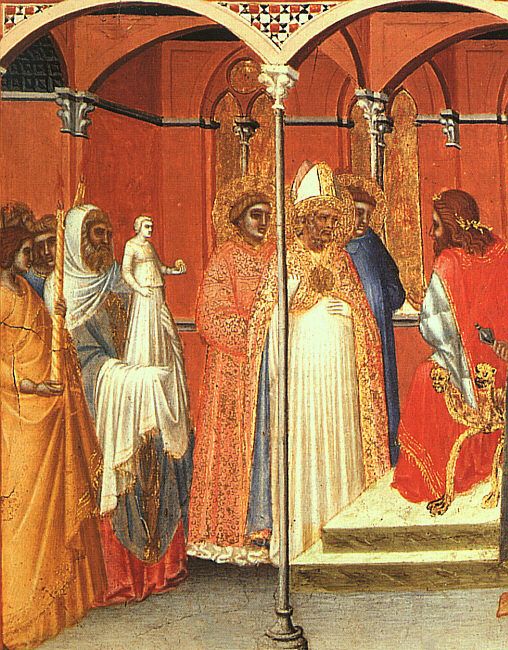
Image: Sabinus.jpg · en:Duccio Original uploader was Crowbait at en.wikipedia · Public domain, via Wikimedia Commons
From Sabine Baring-Gould, The Lives of the Saints, new edition in 16 vols. (London: John C. Nimmo, 1897–98); text from the Internet Archive scan (OCR, lightly cleaned; errors possible). Public domain.
Image: en:Duccio Original uploader was Crowbait at en.wikipedia, Wikimedia Commons (Public domain)
From Sabine Baring-Gould, The Lives of the Saints, new edition in 16 vols. (London: John C. Nimmo, 1897–98); text from the Internet Archive scan (OCR, lightly cleaned; errors possible). Public domain in the United States. Reproduced unedited, except for short bracketed notes in grey that we added to explain names and terms (“S.” is the old abbreviation for Saint). Some history and judgments reflect 19th-century scholarship.
