Sts. Sergius and Bacchus

Sergius and Bacchus were distinguished army officers who suffered cruel torments and death under Maximian at Rasaphe in Syria.

Read the essentials →
October 7 · Martyrs

Sts. Sergius and Bacchus

Sts. Sergius and Bacchus

Sergius and Bacchus were distinguished army officers who suffered cruel torments and death under Maximian at Rasaphe in Syria.

Traditional feast

October 7
1914 / pre-1969 calendar, per Baring-Gould (1897)

Current feast

October 7
Secondary source · Wikipedia

Represents

Martyrs

Their story

Adapted in modern English from Alban Butler's Lives of the Saints · little is known

Sergius and Bacchus were distinguished army officers who suffered cruel torments and death under Maximian at Rasaphe in Syria. Theodoret (5th-century bishop and church historian), Evagrius, Gregory of Tours and Bede (the English monk-historian, d. 735) all mention them.

In 431 Alexander, bishop of Hierapolis, built a church over their tomb. Justinian fortified the town and renamed it Sergiopolis. Butler notes that no authentic acts of their martyrdom survive.
Early life

The book says little or nothing about early life. This is how the account begins.

Thin entry · the 1897 book gives only 0 words. We have not filled the gap with invented detail.

What they represent

How they teach us to live

Drawn from themes in the original account

Keep their day. Remember them on October 7 with a short prayer, and ask for their help.

Read more

The full original · 0 words

Read Baring-Gould’s full account

Baring-Gould’s sources: Martyrology of Jerome. Roman and most Latin Martyrologies. Hereford Kalendar. By the Greeks, and Russians, and Copts on the same day. The Syriac Church on Dec. 9 and Aug. 21. Authorities: — The Acts in Greek and Latin, not contemporary, and not wholly trustworthy.] In 431, the church built over these martyrs' bodies at Rasaphe, in Syria, was falling with age, and it was restored by Alexander, the bishop. Evagrius describes the tomb in the church as plated with silver, in the middle of the 6th century. The Emperor Justinian and the Empress Theodora gave a gold cross to the church in honour of the martyrs. Sergius and Bacchus were two officers in the household of the Emperor Maximian. One day, when the Emperor went into the temple of Jupiter to offer sacrifice, he noticed that his two officers had remained outside. Suspecting the reason, he sent for them and ordered them to unite with him in adoring the great god J upiter. They refused, and Maximian ordered them to have their military insignia plucked off, and that they should be dressed in women's clothes, and so conducted through the streets of the city. They bore this indignity with great firmness. Then Maximian sent them to Antiochus, governor of the province of Augusta Euphratorum, to Rasaphe, and there Bacchus was scourged till he died; and Sergius, after having been made to walk in boots with nails in the soles so as to tear his feet, was executed by the sword. There is a church at Rome dedicated to these saints.

Feast days

Feast: October 7

Nine days · Free

Pray the novena
with us.

One short email a day for nine days. The day's prayer, a line from Sts. Sergius and Bacchus's story, and a nudge to keep going.

Also on October 7
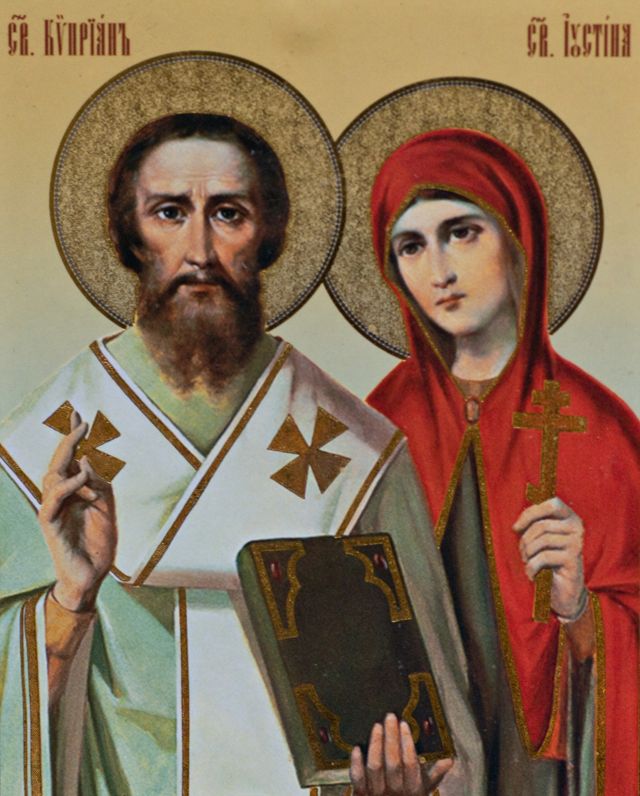
St. Justina

St. Justina

October 7 · Virgin, Martyr
M

Sts. Marcellus and…

October 7 · Martyrs
P

St. Palladius of Saintes

October 7 · Bishop
← All 1726 saints in the library
Sources & notes

Feast-day sources

Story sources

Sources

Credits

Image: Sergebac7thcentury.jpg · Unknown · Public domain, via Wikimedia Commons

From Sabine Baring-Gould, The Lives of the Saints, new edition in 16 vols. (London: John C. Nimmo, 1897–98); text from the Internet Archive scan (OCR, lightly cleaned; errors possible). Public domain.

Image: Unknown, Wikimedia Commons (Public domain)

From Sabine Baring-Gould, The Lives of the Saints, new edition in 16 vols. (London: John C. Nimmo, 1897–98); text from the Internet Archive scan (OCR, lightly cleaned; errors possible). Public domain in the United States. Reproduced unedited, except for short bracketed notes in grey that we added to explain names and terms (“S.” is the old abbreviation for Saint). Some history and judgments reflect 19th-century scholarship.