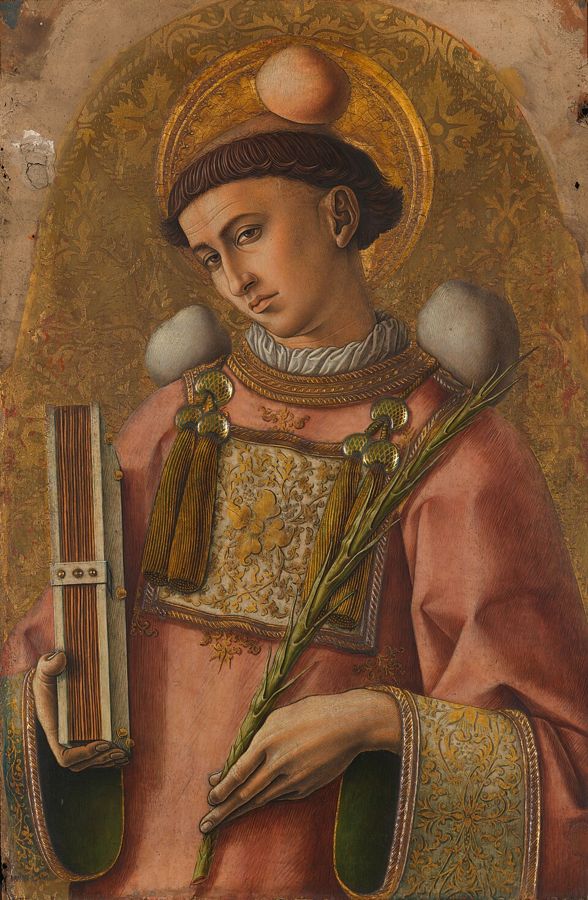
Sts. Stephen and Companions

A whole community that stayed faithful to Christ when it cost everything.

Read the essentials →
July 5 · Bishop, Martyrs

Sts. Stephen and…

Sts. Stephen and Companions

A whole community that stayed faithful to Christ when it cost everything.

Traditional feast

July 5
1914 / pre-1969 calendar, per Baring-Gould (1897)

Current feast

December 26
Verified · General Roman Calendar

Represents

Bishop
Martyrs

Their story

Adapted in modern English from Baring-Gould (1897–98) · original text below

(The surviving account on this page begins partway through the story.)

The people of Reggio (Rhegium) learned only in the 17th century that they had a martyr bishop, Stephen, and the story grew. One tale says that when St. Paul landed, the people believed only after his candle lit itself and set a marble pillar burning. Writers such as Politi printed this as fact.

Baring-Gould doubts Paul even preached there: the Acts of the Apostles say he stayed only one day. The Bollandist Janning called the candle story a fable from some idle brain. The martyr Agnes listed with Stephen seems borrowed from a Greek calendar, and Felicitas and Perpetua were probably transferred from Africa. In 1622 the archbishop of Reggio, Annibal de Afflictis, received permission for altars and Masses in their honour.

In the candle story, the falling wick set the pillar alight and it burned down to its base. Paul's voyage went from Syracuse to Rhegium, then after one day on to Puteoli and Rome. Several local historians, such as Marafioti and Ughelli, repeated the tales. The Sacred Congregation of Rites granted the archbishop's request.
Early life

The book says little or nothing about early life. This is how the account begins.

Since the 17th century, when the good people of Reggio were first made aware that they had a martyr bishop, their lively imaginations have filled out the story. When S. Paul landed there, the citizens would not believe him, till an end of candle he held in his hand caught fire spontaneously. Then he placed the candle on a marble pillar, and when the wick of the candle fell over, it set the marble on fire, and the pillar burnt down to its socket.

What they represent

How they teach us to live

Drawn from themes in the original account

Learn from the kind of life it was. A whole community that stayed faithful to Christ when it cost everything.

Keep their day. Remember them on July 5 with a short prayer, and ask for their help.

Read more

The full original · 349 words

Read Baring-Gould’s full account

Baring-Gould’s sources: Greek Meuaea. Cultus at Reggio in Calabria on this day, sanctioned by the Congregation of Sacred Rites in 1632. Authority: — A late account in Greek, probably by Metaphrastes, of most questionable authority. Certain it is that nothing was known at Reggio of there having been a bishop and martyrs there, before the 17th cent., when they were made acquainted with it through the Greek Menma; and at once popular invention added particulars.] ^^^^CCORDING to the Greek story, S. Paul on gnKS 0 his way to Rome in the ship, tarried at £ pj Rhegium, after leaving Syracuse, sufficient time to preach to the people, and convert many thousands. Not only so, but he ordained one Stephen to be their archbishop. After seventeen years, persecution broke out under Hieracos the governor, and Stephen, another bishop, named Sueras, and three women, Agnes, Felicitas and Perpetua were put to death with the sword.

Since the 17th century, when the good people of Reggio were first made aware that they had a martyr bishop, their lively imaginations have filled out the story. When S. Paul landed there, the citizens would not believe him, till an end of candle he held in his hand caught fire spontaneously. Then he placed the candle on a marble pillar, and when the wick of the candle fell over, it set the marble on fire, and the pillar burnt down to its socket. This story has been gravely inserted as fact by Marco Antonio Politi in his Chronicon Regiense, and many others. 1 It is of course most questionable whether S. Paul preached at Rhegium. In Acts xviii. 13, it is said that he only tarried one day there, and probably he did not even disembark. “Landing at Syracuse, we tarried there three days. And from thence we fetched a compass, and came to Rhegium: and after one day the south wind blew, and we came the next day to Puteoli: where we found brethren, and were desired to tarry with them seven days: and so we went towards Rome.” The fable of the candle, says Janning the Bollandist, must have grown up among the vulgar, the product of some idle brain, till it made its way into the writings of serious authors. The martyr Agnes is derived from the Greek Menology, which commemorates one of this name on July 5th, without saying where she suffered, but giving a story which bears a strong resemblance to that of S. Agnes of Rome. Felicitas and Perpetua occur together in suspicious proximity, and have probably been translated from Africa, and anti -dated by rather more than a century. In 1622, Annibal de Afflictis, archbishop of Reggio, requested permission to erect altars and set up images, and institute mass and other devotions in honour of these martyrs. The Sacred Congregation of Rites gave the faculty desired. 1 Marafioti in his Chronicon Calabriae. Ughelli in his History of the Bishops of Reggio; and Paolo Gaulteri in his Saints of Calabria. S. Zoe.

Feast days

Feast: December 26
Traditional: July 5

Nine days · Free

Pray the novena
with us.

One short email a day for nine days. The day's prayer, a line from Sts. Stephen and…'s story, and a nudge to keep going.

Also on July 5
St. Zoe

St. Zoe

July 5 · Martyr
A

St. Athanasius

July 5 · Martyr
← All 1726 saints in the library
Sources & notes

Feast-day sources

Story sources

Sources

Credits

Image: Saint Stephen (Carlo Crivelli).jpg · Carlo Crivelli · Public domain, via Wikimedia Commons

From Sabine Baring-Gould, The Lives of the Saints, new edition in 16 vols. (London: John C. Nimmo, 1897–98); text from the Internet Archive scan (OCR, lightly cleaned; errors possible). Public domain.

Image: Carlo Crivelli, Wikimedia Commons (Public domain)

From Sabine Baring-Gould, The Lives of the Saints, new edition in 16 vols. (London: John C. Nimmo, 1897–98); text from the Internet Archive scan (OCR, lightly cleaned; errors possible). Public domain in the United States. Reproduced unedited, except for short bracketed notes in grey that we added to explain names and terms (“S.” is the old abbreviation for Saint). Some history and judgments reflect 19th-century scholarship.