Baring-Gould’s sources: Roman Martyrology, inserted by Daronius with unpardonable want of caution. These martyrs are not mentioned in any martyrologies before that of Peter de Natalibus, A D. 1371. De Natalibus was followed by Bellinus, 1498. Greven, Maurolycus, Felicius. Galesinius, and Canisius. These martyrs are utterly unknown to the Greeks, Copts, and even to the Armenians. Surius omitted them in the first and second edition of his "Vitae Sanctorum.*’ Henschenius the Bollandist wished to relegate their acts as fabulous to an appendix,and Papebroeck only admitted these saints into the body of the Acta Sanctorum because of the mention of them in the Modern Roman Martyrology. Radulph de Rivo, dean ot Tongres, at the close of the 14th cent., writes of them, when mentioning various apocryphal acts not read in the church: — Such are those of Ten Thousand Martyrs who arc pretended to have suffered the same sort of death as did Christ on Mount Ararat near Alexandria. But their passion is not inscribed in any authentic Martyrology, nor have I been able to find them in any Kalendar at Rome.” The Acts of these martyrs pretend to have been translated from the Greek by Athanasius the librarian ol the popes, and dedicated to Peter, bishop of Sabina. There never was an Athanasius, librarian, though there was an Annstasius (a.d. 886). but hese Acts are totally different in style from his writings. Nor was there a Peter, bishop of Sabina, earlier than the year 1216. That it was translated from the Greek is most improbable— no Greek Acts exist, and the saints are unknown to the Greek Men sea, Menologium and Horology. [Jane n The Acts are full of absurdities. The emperors Hadrian and Antoninus reign conjointly. A great victory is gained by them which is unknown to history. Ararat is five hundred stadia from Alexandria— of course that in Syria. The emperors march an army of 5,000,000 men against seven thousand men who were on the icy peak of Mount Ararat 1] The following story is pure romance, and it will be difficult to discover a minute particle of fact in it after we have washed all the fable out.
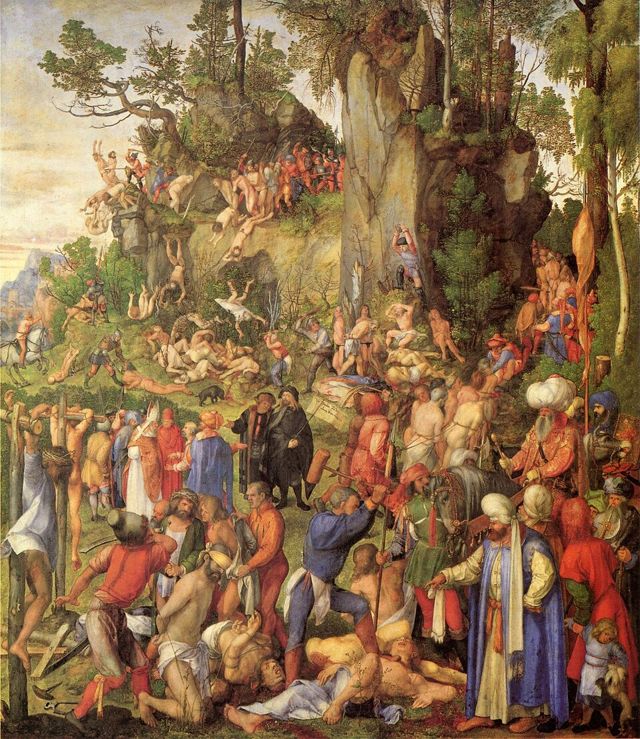
In the reign of the Emperors Hadran and Antoninus1 the Gadarenes and people of Euphrates revolted; whereupon the two emperors marched at the head of nine thousand men against the insurgents, but when the Roman emperors discovered that the rebels outnumbered them by a thousand men, they ran away with seven men.2 But the nine thousand said to themselves, “We will sacrifice to our Gods and then fight the enemy.” But suddenly an angel appeared and said to the officers Achatius, Eliades, Theodore and Carterius, “ Hearken to me and prove the God of the Christians, He will give you victory.” So then Achatius turned to Eliades and the rest and asked, “ What say you, my brothers ?” Then they all exclaimed, “We believe in the God of the Christians.” And with a shout they rushed upon the enemy and put them to flight. The rebels fell into the lake, and down precipices, and not one survived. But it was necessary that Achatius and his companions should receive further instruction, so the angel carried off the nine thousand to the top of Mount Ararat, and seating himself on the perennial snow, began to instruct them. To facilitate the labours of the angel and expedite the conversion of the nine thousand neo1 Antoninus [Antoninus Pius, Roman emperor 138–161] was the adopted son of Hadrian. Hadrian adopted him in 13&, the year before he died. That year Hadrian was ill with dropsy(and could not have gone to war. Moreover this war is all pure fiction. Ten Thousand Martyrs.
phytes, the heavens opened, and seven more blessed spirits descended to give the necessary Christian instruction. When the lesson was over the angels vanished. Three days having elasped, the emperors began to enquire 4 4 What has become of those soldiers who did not run away; for we, who ran off, prevailed naught.”1 So they sent out scouts to see, and these, reaching the foot of Mount Ararat, saw nine thousand black specks on the snow at the top, and called to them,* and the nine thousand newly converted Christians came down and defied the emperors. The scouts were so shocked, that they put ashes on their heads, and for five days drank nothing, but cried incessantly. Then they thought they had better return to the emperors, and inform them of the change which had taken place in the sentiments of the valiant nine thousand. The emperors were stupefied at first, but gradually recovering, sent messengers to five tributary kings — their kingdoms are not specified — with a letter couched in these terms, 44 To the unconquered kings Sagor, Maximus, Hadrian, Tiberian, Maximian [Diocletian’s co-emperor in the West, 286–305], we the most august emperors of the Romans, Hadrian and Antoninus send greeting: We have intimated to you how that we engaged in war with the Gadarenes and Euphratesites, having a force of nine thousand men. But when we bejield the multitude of the adversaries, we were dreadfully frightened, and ran away with seven men, but nine thousand soldiers remained in the camp, and engaging in battle, and what is marvellous to relate, they overcame ten thousand men of the enemy, and gained the victory. Hearing this, we offered sacrifice to our gods, for we were highly de1 “ Nos fugientes nullo modo pnevaluimus.” Not a brilliant remark. limit is at 14,000 feet.
[June ax lighted with this victory, but afterwards we fell into the worst difficulties, for we heard that these men had become Christians, and had taken refuge on a very high mountain, which towers above all the mountains of Armenia. Come therefore to us, and we will then consult what is to be done. Farewell.” On receiving this letter, the five kings first sacrificed to their gods, then dined,1 and set off to the extirpation of the Christians, at the head of 5,000,000 men. Messengers were despatched up Ararat to summon the nine thousand Christians before the emperors. They descended, and being conducted before Hadrian and Antoninus, Hadrian at the sight of them began to weep. When he had dried his eyes and recovered his composure, he urged the confessors to sacrifice and return to their allegiance; but they refused. Then all the hosts, five million strong together with seven kings, ten prefects, fifty patricians, and two hundred counts and tribunes, shouted against them, “ Away with these men.” Then Hadrian asked, “ Did you hear these men shouting against you ?” And when Achatius admitted that he had heard the cry, the emperor again urged him to sacrifice. Then Achatius said, “ I saw in vision nine thousand eagles, and before them all the birds fled and cowered away, and whithersoever tljpy fled, the eagles followed and tore them.”
“Oh what a sad set of fellows!” exclaimed the kings, “ who dare to liken us kings, — not to foxes, but to barndoor fowls !”
Then the emperor said, “ Stone these men.” Whereupon the soldiers took up stones and pelted the confessors, but the stones, instead of hurting the Christians, bounded back and struck the servants of the emperors 1 “Pcstea praosi sunt, at deinde novos militos Christi perquirere satagebant." on the head. The sight of this miracle so astonished the soldiers, that a thousand of them were converted on the spot, and joined the Christian band, which thus made up the number of ten thousand. And then the emperors ordered them to be crucified on the top of Mount Ararat. Among the martyrs were one duke, four chief captains, five counts, nine tribunes, eleven princes, two pioneers (campiductores), and twenty trumpeters. All these were rapidly instructed in the Christian faith before they were executed. And as they were crucified, they prayed that whosoever should keep the memorial of their martyrdom in silence and fasting, should obtain health of body and vigour of soul, and prosperity in their business. On this account the martyrs are called the Holy Assisters, Sancti Adju tores.1 The bodies of the martyrs were taken down and buried by angels each in a separate grave. The relics [the bodily remains of a saint, or objects they used, kept with honor] of these fabulous martyrs are preserved in the church of S. Vitus at Prague, at Vienne, Scutari in 1 Giry and Guerin *ay in the A'im da Saintt " The Church has always recognized and honoured these admirable soldiers of Christ; and, indeed, formerly at Rome the anniversary of their martyrdom was one of those festivals on which no law suits were carried on. Radulph, dean of Tongres, in his book on the observance of the canons finds several difficulties in the history of these blessed martyrs, and declares that he could hardly believe it if it were not supported by ecclesiastical authority. That authority existed in his day as in ours, for the Roman Martyrology, and Greek Menology mention the ten thousand martyrs crucified on Ararat. As to the difficulties, Cardinal Baronius [Cardinal Baronius (d. 1607), church historian who edited the Roman Martyrology] has so perfectly met them, that they need no longer embarrass any one." Every sentence in this passage contains a deliberate falsehood. The Church did not recognize these martyrs till Baronius drew up the modern Roman Martyrology, in the x6th cent. What Radulph of Tongres says is not what Giry and Guerin put into his mouth; he says that the stoiy is fabulous, and that he found no mention of the nine thousand in any authentic martyrology, even at Rome. The Greek Menology makes no mention of these martyrs. Baronius was misled in saying that it did so, and as for the arguments of Baronius, Papebroeck has completely demolished them in his introduction to the Acts, in the Acta Sanctorum [the Bollandists’ huge collection of saints’ lives]. That Giry and Guerin should dare to make these statements with the commentary of the Bollandist before their eyes, shows a reckless indifference to truth as shocking as it is surprising.
Sicily, at Avila and Cuenga in Spain, at Lisbon and Coimbra in Portugal. The Spaniards, on the authority of the notorious forgery, the chronicle of Flavius Dexter, have made these martyrs into Spaniards, and in some of their Breviaries the lections for the festival are taken from the apocryphal acts. The Compostella Breviary says that ten thousand were baptized by S. Hermolaus, bishop of Toledo. Tamayus Salazar turns the angel into S. Hermolaus, and makes Auden tius, bishop of Toledo, go into Armenia and bring thence the relics. Nothing was heard of these relics till the 15th or 16th century.