Their story
Adapted in modern English from Baring-Gould (1897) · original text below · little is known
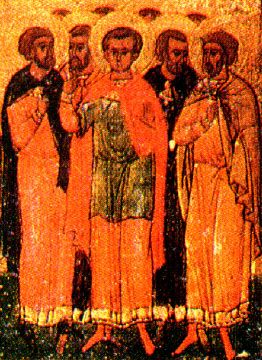
Eusebius (bishop of Caesarea, d. c. 339, the first historian of the Church) tells that at Cæsarea, in the persecution of Dioclesian, when condemned prisoners were to fight beasts at the games, six young men tied their own hands and hurried to the governor Urbanus to offer themselves for martyrdom: Timolaus, Dionysius, Romulus, two named Alexander, and another.
They were jailed, and two more joined them: Agapius, who had confessed his faith under torture several times, and another Dionysius, who brought them food. All eight were beheaded on one day at Cæsarea, on 24 March by our reckoning (the ninth day before the Kalends of April, in the Roman calendar).
Early life
Selected sentences from the original account, unaltered.
Thin entry · the 1897 book gives only 220 words. We have not filled the gap with invented detail.
This report having gained ground, there were six young men, who, first binding their hands, hastened to Urbanus (the governor of the province), to prove their readiness to endure martyrdom, as he was on his way to the amphitheatre. Their names were Timolaus, a native of Pontus, Dionysius of Tripolis in Phœnice, Romulus, a subdeacon of the church at Diospolis Paesis, and Alexander, both Egyptians; and another Alexander from Gaza.