P
St. Priscus
F
St. Firminus of Amiens
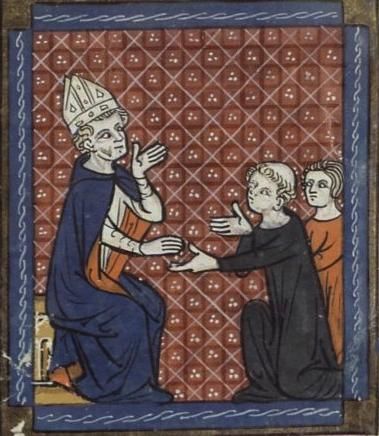
A whole community that stayed faithful to Christ when it cost everything.
Read the essentials →A whole community that stayed faithful to Christ when it cost everything.
September 1
Not verified yet
Martyrs
The Acts are not trustworthy.] S. Verena, according to legend, was an Egyptian damsel, daughter of Chseremon, who came to Milan, when hearing of the martyrdom of the blessed Maurice and his com1 It is improbable that there were two brothers of the same name, Felix.
Learn from the kind of life it was. A whole community that stayed faithful to Christ when it cost everything.
Keep their day. Remember them on September 1 with a short prayer, and ask for their help.
(date uncertain.) [Roman Martyrology. Some copies of Usuardus [a 9th-century monk of Paris who compiled a list of saints for each day], Notker, and Wandelbert. The Acts are not trustworthy.] S. Verena, according to legend, was an Egyptian damsel, daughter of Chseremon, who came to Milan, when hearing of the martyrdom of the blessed Maurice and his com1 It is improbable that there were two brothers of the same name, Felix. Probably these martyrs were brothers in the Faith and not in blood. sept.,.) Vcrena. 3 panions at Agaunum, she crossed the Alps to visit the spot watered by their blood, and to collect relics [the bodily remains of a saint, or objects they used, kept with honor]. She wandered north into Solothurn, and settled in a grotto in the face of a rock. The cave became afterwards the favourite resort of hermits, a chapel was built there in 1426, and renovated in 1555 and 1575. The spot is not one of the least impressive in Switzerland. It lies at the end of a pretty valley, hemmed in by rocks of gneiss embowered in trees, about two miles north-east of Solothurn. It is reached by paths, originally formed by the French e'migre's, who, at the outbreak of the French Revolution, sought an asylum here. The valley abounds in caves and grottoes, partly natural, partly artificial, and at its further extremity, within a natural shelf of over-arching cliff, stands the little chapel of S. Verena. Behind the altar a small cave has been cut in the rock, and now contains a representation of the Holy Sepulchre. In this cave the pious maiden lived, spending her time m prayer and in ministering to the cleanliness of soul and body of the peasantry of the neighbourhood. Being possessed of a comb, she visited their cottages, and paid a not unnecessary attention to their heads. In commemoration of this a Latin inscription was cut on the rock • — “ Pectore dum Christo, dum pectine servit egenis, Hoc latuit quondam Sancta Verena cavo.”
The devil, enraged at the transformation wrought by her solicitude in the heads and hearts of the peasants, tried to drag her away from the cave and dash her over the rocks; but she saved herself by clinging fast to the stone, and the holes made by her finger-nails are shown to this day. After awhile Verena resumed her pilgrim’s staff and journeyed to Coblenz, and from thence to Zurzach in Canton Aargau, where she died. The body lies in an ancient crypt under the collegiate church of Zurzach. Over [Sept.
it is erected a monument representing the saint lying with her comb in one hand and a porringer in the other; and a wreath of roses round her head.
It is probable that S. Verena lived much later than the date generally attributed to her, and that her visit to Agaunum has led to her having been supposed a contemporary of S. Maurice.
Feast: September 1
One short email a day for nine days. The day's prayer, a line from Sts. Twelve Brothers's story, and a nudge to keep going.
From Sabine Baring-Gould, The Lives of the Saints, new edition in 16 vols. (London: John C. Nimmo, 1897–98); text from the Internet Archive scan (OCR, lightly cleaned; errors possible). Public domain.
From Sabine Baring-Gould, The Lives of the Saints, new edition in 16 vols. (London: John C. Nimmo, 1897–98); text from the Internet Archive scan (OCR, lightly cleaned; errors possible). Public domain in the United States. Reproduced unedited, except for short bracketed notes in grey that we added to explain names and terms (“S.” is the old abbreviation for Saint). Some history and judgments reflect 19th-century scholarship.