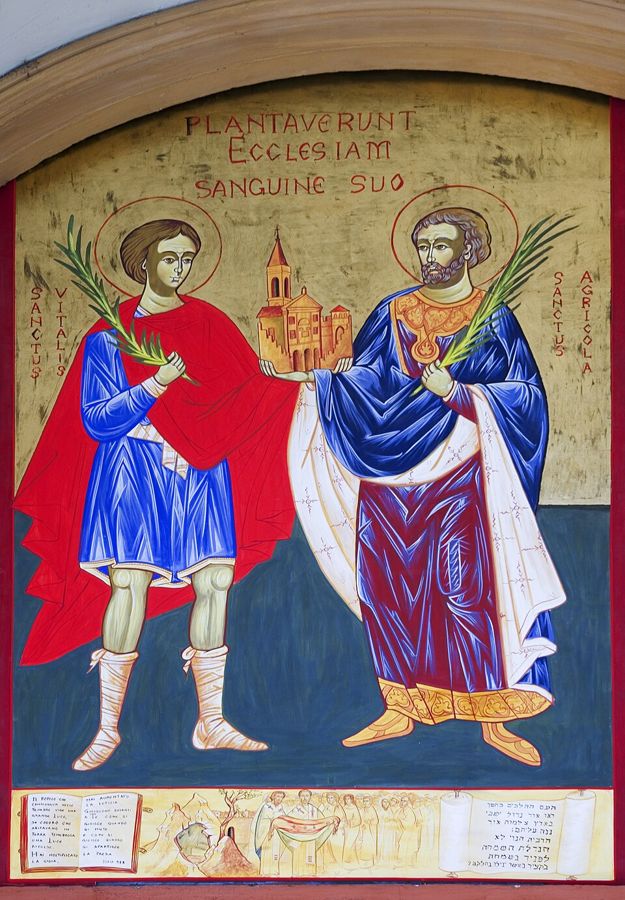
Sts. Vitalis and Agricola

St. Ambrose relates that Agricola was a gentleman of Bologna and that his slave Vitalis learned the faith from him and was martyred first.

Read the essentials →
November 9 · Martyrs

Sts. Vitalis and Agricola

Sts. Vitalis and Agricola

St. Ambrose relates that Agricola was a gentleman of Bologna and that his slave Vitalis learned the faith from him and was martyred first.

Traditional feast

November 9
1914 / pre-1969 calendar, per Baring-Gould (1897)

Current feast

November 4
Secondary source · Wikipedia

Represents

Martyrs

Their story

Adapted in modern English from Alban Butler's Lives of the Saints · little is known

St. Ambrose relates that Agricola was a gentleman of Bologna and that his slave Vitalis learned the faith from him and was martyred first. Vitalis praised God as long as he could speak, then prayed Christ to receive his soul.

Agricola was then nailed to a cross. In 393 St. Ambrose found their relics in the Jewish burial ground at Bologna, together with the nails and cross of Agricola's martyrdom. Butler places their arrest probably in 304; Baring-Gould gives the fourth century.
Early life

The book says little or nothing about early life. This is how the account begins.

Thin entry · the 1897 book gives only 0 words. We have not filled the gap with invented detail.

What they represent

How they teach us to live

Drawn from themes in the original account

Keep their day. Remember them on November 9 with a short prayer, and ask for their help.

Read more

The full original · 0 words

Read Baring-Gould’s full account

Baring-Gould’s sources: Usuardus, Roman Martyrology. Authorities: — S. Ambrose, Ad Virgin., and Gregory of Tours, De Gloria Martyr, c. 43.] Agricola was a member of a noble family at Bologna. Having embraced Christianity, he converted S. Vitalis, his servant. The gentleness of his character, his amiable qualities, and his virtues, made him to be generally beloved, even among the heathen. He was arrested, along with his slave, Vitalis, probably in 304, and he had the pain as well as satisfaction of seeing his servant martyred before his eyes. It was hoped that he would be intimidated by the sight of the sufferings of Vitalis, but, on the contrary, he was nerved to follow him. He was attached to a cross and pierced with several nails. When dead he was buried with S. Vitalis in the Jews' cemetery. S. Ambrose having discovered their place of sepulture in 393, obtained from it some of the nails and blood. He placed them in a church which he dedicated at Florence.

Feast days

Feast: November 4
Traditional: November 9

Nine days · Free

Pray the novena
with us.

One short email a day for nine days. The day's prayer, a line from Sts. Vitalis and Agricola's story, and a nudge to keep going.

Also on November 9
S

St. Salaun

November 9 · Confessor
St. Victorinus

St. Victorinus

November 9 · Bishop, Martyr
T

St. Theodotus of Laodicea

November 9 · Bishop
← All 1726 saints in the library
Sources & notes

Feast-day sources

Story sources

Sources

Credits

Image: Saints Vitalis and Agricola.jpg · Petr Vodička · CC BY-SA 4.0, via Wikimedia Commons

From Sabine Baring-Gould, The Lives of the Saints, new edition in 16 vols. (London: John C. Nimmo, 1897–98); text from the Internet Archive scan (OCR, lightly cleaned; errors possible). Public domain.

Image: Petr Vodička, Wikimedia Commons (CC BY-SA 4.0)

From Sabine Baring-Gould, The Lives of the Saints, new edition in 16 vols. (London: John C. Nimmo, 1897–98); text from the Internet Archive scan (OCR, lightly cleaned; errors possible). Public domain in the United States. Reproduced unedited, except for short bracketed notes in grey that we added to explain names and terms (“S.” is the old abbreviation for Saint). Some history and judgments reflect 19th-century scholarship.