Read Baring-Gould’s full account
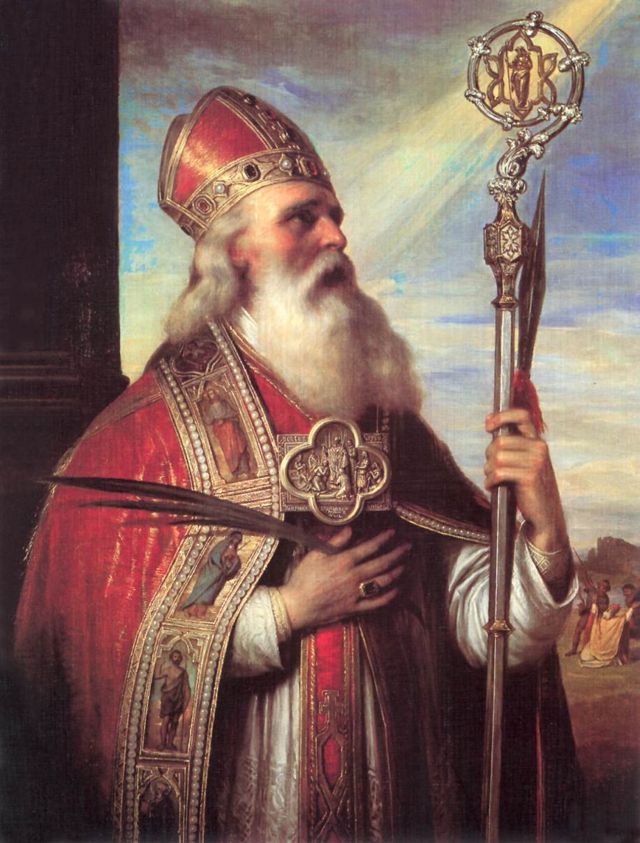
Baring-Gould’s sources: Roman and German Martyrologies. In a Cologne and Lubeck Martyrology, printed in 1490, Aug. 35th was set down as the feast of his translation. Authorities: — A life by a contemporary, a Roman monk, another life written later, but by a contemporary also, a German or Bohemian monk. Also mention in the Ermland Annals, " Annales Varmienses also the Bohemian Annals quoted by Hagek.] Adalbert of Prag was bora about the year 956, of one of the most illustrious families of Bohemia, that of Stamnitz of Iibitz. His heathen name was Wojtisch. 1 He was entrusted to the care of Adalbert, bishop of Magdeburg, who gave him his own name in confirmation. On the death of the archbishop in 981, Adalbert returned to Bohemia, and lived in thoughtlessness and youthful amusements, exercising the profession of arms. But the bishop of Prag dying, he was appointed to the vacant see by the Emperor Otho II., on his election by the people and clergy, giving him the pastoral staff, and commanding S. Willigis, archbishop of Mainz, to consecrate him; he was ordained on June 28th, 982, and he never after smiled, so impressed was he with the responsibility laid upon him. Pope John XIV. had been assassinated by orders ot Crescentius the Consul, who had also made away with Benedict VII.; and John XV. was expelled Rome. An extraordinary council was convoked by the pope at Rheims (ad. 995). Hugh Capet, the new French monarch, who planned the foundation of a Gallican church, independent of that of Rome, had deposed Amulf, archbishop of Rheims. The German bishops and the pope, enraged at this conduct, unanimously condemned Hugh at Rheims, and he was compelled to yield. The pope expired during the following 1 Wqjtlsch is used now to represent Albert in Bohemian, and he is constantly called S. Wojtisch. He had six brothers, the youngest of whom, Radim, was his constant attendant year, and the emperor marched into Italy for the purpose of regulating the affairs of the Church. Crescentius was speedily overcome and pardoned. Otho, fired by youthful enthusiasm, imagined that the future happiness of the world was to be secured by a closer union of the imperial with the papal power, and with his own hand, although himself scarcely out of his boyhood, placed the tiara on the head of Bruno, son of Otho of Carinthia, who was then in his four-and-twentielh year, and who received the name of Gregory V. S. Adalbert, who had come from Prag (a.d. 996), in order to witness the ceremony, was enraptured at the sight of these two noble youths. By his side stood Gerbert, Otho's preceptor, one of the most profound reasoners of the age, and the energetic Bishop Notker of Ltege, both of whom earnestly sought to re-establish the fallen power of the Church, whilst the youthful pope, strong in his native purity, caused even the Italians, in despite of their moral depravity, to foresee the height to which the Church might attain if governed by German virtue. S. Adalbert was sick at heart with disappointment in Bohemia, his efforts at reformation of the barbarous manners of his people and to enforce celibacy on the clergy had been fruitless, and he resigned his see and retired into cloistral peace at Rome. But Gregory V. would not suffer Adalbert thus to shrink from his charge, and he insisted on his returning to Prag. Adalbert started. The Bohemians hearing that he was coming back, and disliking his strictness, massacred his family and burnt their castles, and sent an ironical message to tell him that they were so bad that they could not endure a good bishop. The saint finding it impossible to re-enter Prag, went north to preach to the heathen in Prussia, and there he met his death, being set upon by a party of Wends near Danzic, and thrust through with their spears. His relics are venerated in the cathedral of Gniesen. April ty.) S. John of Holar.