St. Adalbert of Prag

Faithfulness to Christ when it cost everything.

Read the essentials →
April 28 · Bishop, Martyr

St. Adalbert of Prag

St. Adalbert of Prag

Faithfulness to Christ when it cost everything.

Traditional feast

April 28
1914 / pre-1969 calendar, per Baring-Gould (1897)

Current feast

April 23
Verified · General Roman Calendar

Represents

Bishop
Martyr

Their story

Vojtěch, born around 956 into the powerful Slavník family of Bohemia, was healed of a childhood illness and dedicated to the Church. He took the name Adalbert at his confirmation by Archbishop Adalbert of Magdeburg, under whom he studied. In 982 he became the first native bishop of Prague.

He struggled with a half-pagan nobility, slavery and clergy marriage, and twice left his see for the monastery of Sts. Boniface and Alexius in Rome. In 995 his family was massacred by the rival Přemyslids. In 997, with the support of Duke Bolesław of Poland, he went to preach to the pagan Prussians, and they killed him near the Baltic coast on April 23.

Bolesław ransomed his body for its weight in gold and enshrined it at Gniezno. He was canonized (officially declared a saint by the pope) in 999. In 1000 Emperor Otto III made a pilgrimage to his tomb and founded the archdiocese of Gniezno there.

Why they’re the patron of…

  • Poland, Bohemia and Prussia ·
    He was a bishop of Prague and martyr-missionary to the Prussians, and is enshrined at Gniezno.

Early life

The book says little or nothing about early life. This is how the account begins.

Thin entry · the 1897 book gives only 0 words. We have not filled the gap with invented detail.

What they represent

How they teach us to live

Drawn from themes in the original account

Learn from the kind of life it was. Faithfulness to Christ when it cost everything.

Keep their day. Remember them on April 28 with a short prayer, and ask for their help.

From the Catholic Encyclopedia

1913 · 265 words

​Adalbert, Saint, b. 939 of a noble Bohemian family; d. 997. He assumed the name of the Archbishop Adalbert (his name had been Wojtech). under whom he studied at Magdeburg. He became Bishop of Prague, whence he was obliged to flee on account of the enmity he had aroused by his efforts to reform the clergy of his diocese. He betook himself to Rome, and when released by Pope John XV from his episcopal obligations, withdrew to a monastery and occupied himself in the most humble duties of the house. Recalled by his people, who received him with great demonstrations of joy, he was nevertheless expelled a second time and returned to Rome. The people of Hungary were just then turning towards Christianity. Adalbert went among them as a missionary and probably baptized King Geysa and his family, and King Stephen. He afterwards evangelized the Poles, and was made Archbishop of Gnesen. But he again relinquished his see, and set out to preach to the idolatrous inhabitants of what is now the Kingdom of Prussia. Success attended his efforts at first, but his imperious manner in commanding them to abandon paganism irritated them, and at the instigation of one of the pagan priests he was killed. This was in the year 997. His feast is celebrated 23 April, and he is called the Apostle of Prussia. Boleslas I. Prince of Poland, is said to have ransomed his body for an equivalent weight of gold. He is thought to be the author of the war-song, "Boga-Rodzica", which the Poles used to sing when going to battle.

Read more

The full original · 0 words

Read Baring-Gould’s full account

Baring-Gould’s sources: Roman and German Martyrologies. In a Cologne and Lubeck Martyrology, printed in 1490, Aug. 35th was set down as the feast of his translation. Authorities: — A life by a contemporary, a Roman monk, another life written later, but by a contemporary also, a German or Bohemian monk. Also mention in the Ermland Annals, " Annales Varmienses also the Bohemian Annals quoted by Hagek.] Adalbert of Prag was bora about the year 956, of one of the most illustrious families of Bohemia, that of Stamnitz of Iibitz. His heathen name was Wojtisch. 1 He was entrusted to the care of Adalbert, bishop of Magdeburg, who gave him his own name in confirmation. On the death of the archbishop in 981, Adalbert returned to Bohemia, and lived in thoughtlessness and youthful amusements, exercising the profession of arms. But the bishop of Prag dying, he was appointed to the vacant see by the Emperor Otho II., on his election by the people and clergy, giving him the pastoral staff, and commanding S. Willigis, archbishop of Mainz, to consecrate him; he was ordained on June 28th, 982, and he never after smiled, so impressed was he with the responsibility laid upon him. Pope John XIV. had been assassinated by orders ot Crescentius the Consul, who had also made away with Benedict VII.; and John XV. was expelled Rome. An extraordinary council was convoked by the pope at Rheims (ad. 995). Hugh Capet, the new French monarch, who planned the foundation of a Gallican church, independent of that of Rome, had deposed Amulf, archbishop of Rheims. The German bishops and the pope, enraged at this conduct, unanimously condemned Hugh at Rheims, and he was compelled to yield. The pope expired during the following 1 Wqjtlsch is used now to represent Albert in Bohemian, and he is constantly called S. Wojtisch. He had six brothers, the youngest of whom, Radim, was his constant attendant year, and the emperor marched into Italy for the purpose of regulating the affairs of the Church. Crescentius was speedily overcome and pardoned. Otho, fired by youthful enthusiasm, imagined that the future happiness of the world was to be secured by a closer union of the imperial with the papal power, and with his own hand, although himself scarcely out of his boyhood, placed the tiara on the head of Bruno, son of Otho of Carinthia, who was then in his four-and-twentielh year, and who received the name of Gregory V. S. Adalbert, who had come from Prag (a.d. 996), in order to witness the ceremony, was enraptured at the sight of these two noble youths. By his side stood Gerbert, Otho's preceptor, one of the most profound reasoners of the age, and the energetic Bishop Notker of Ltege, both of whom earnestly sought to re-establish the fallen power of the Church, whilst the youthful pope, strong in his native purity, caused even the Italians, in despite of their moral depravity, to foresee the height to which the Church might attain if governed by German virtue. S. Adalbert was sick at heart with disappointment in Bohemia, his efforts at reformation of the barbarous manners of his people and to enforce celibacy on the clergy had been fruitless, and he resigned his see and retired into cloistral peace at Rome. But Gregory V. would not suffer Adalbert thus to shrink from his charge, and he insisted on his returning to Prag. Adalbert started. The Bohemians hearing that he was coming back, and disliking his strictness, massacred his family and burnt their castles, and sent an ironical message to tell him that they were so bad that they could not endure a good bishop. The saint finding it impossible to re-enter Prag, went north to preach to the heathen in Prussia, and there he met his death, being set upon by a party of Wends near Danzic, and thrust through with their spears. His relics are venerated in the cathedral of Gniesen. April ty.) S. John of Holar.
Feast days

Feast: April 23
Traditional: April 28

Nine days · Free

Pray the novena
with us.

One short email a day for nine days. The day's prayer, a line from St. Adalbert of Prag's story, and a nudge to keep going.

Also on April 28
Sts. Felix, Fortunatus and Achilles

Sts. Felix

April 28 · Martyrs
G

St. George

April 28 · Martyr
I

St. Ibar of Begery

April 28 · Bishop
← All 1727 saints in the library
Sources & notes

Feast-day sources

Story sources

Sources

Credits

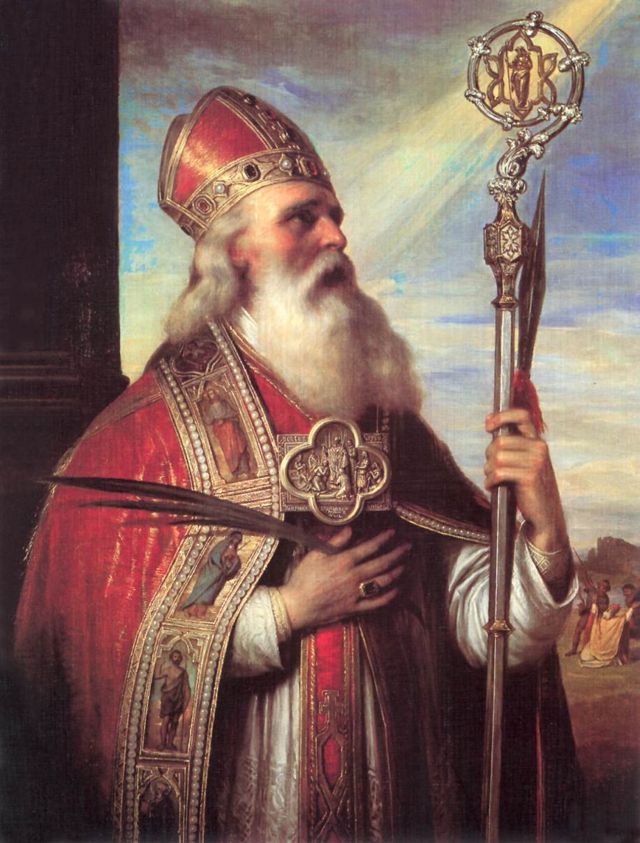
Image: Szt-adalbert.jpg · Mihály Kovács · Public domain, via Wikimedia Commons

From Sabine Baring-Gould, The Lives of the Saints, new edition in 16 vols. (London: John C. Nimmo, 1897–98); text from the Internet Archive scan (OCR, lightly cleaned; errors possible). Public domain.

Image: Mihály Kovács, Wikimedia Commons (Public domain)

From “Catholic Encyclopedia (1913)/St. Adalbert (of Bohemia),” The Catholic Encyclopedia (New York: Robert Appleton Company, 1907–1914), via Wikisource. Public domain. Matched by name and feast date; text unedited except for our bracketed notes in grey.

From Sabine Baring-Gould, The Lives of the Saints, new edition in 16 vols. (London: John C. Nimmo, 1897–98); text from the Internet Archive scan (OCR, lightly cleaned; errors possible). Public domain in the United States. Reproduced unedited, except for short bracketed notes in grey that we added to explain names and terms (“S.” is the old abbreviation for Saint). Some history and judgments reflect 19th-century scholarship.

Notes

Story retold in our own words from the cited sources.