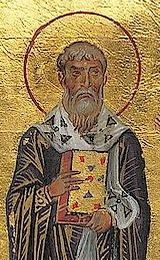
Baring-Gould’s sources: Roman Martyrologv, Irish Martyrology, Scottish Menology and Kalendars. Not to be confused with Adamnan of Coldingham, Jan. 31, nor with another Adamnan, a bishop at Melrose, commemorated by Dempster on Sept. 22. Adamnan, given by Camerarius on the authority of Boethius, on Jan. 23, as councillor of Eugenius IV. in his treaty with Brudeus, King of the Piets, is probably the same as Adamnan, Abbot of Iona. Fordun, describing lnchkeith, which is probably the Urbs Giudi of Bede, says that an Abbot Adamnan presided in it, who honourably received S. Serf with bis companions in the island at his first arrival in Scotland. Authorities: — Bede in his Eccl. Hist., and Irish Lives.] According to Irish authorities, S. Adamnan was of the noble race of Ciual, the son of Ronan and Ronnat. The Ulster annals give a.d. 624 (623) as the date of his birth. In his youth he had relations with Finnachta the Festive, King of Ireland, and eventually became his “ soul’s friend,” or confessor. He became Abbot of Raphoe, after having received his monastic education at Iona, or in some other monastery of the Columbian institutions. Raphoe was probably founded by him, and he is commemorated there under the name of Eunan, on the same day, Sept. 23, but is incorrectly called first bishop of Raphoe, instead of first abbot. The first bishop of Raphoe was Malduin MacKinfalaid, who died about a.d. 930.
The only event recorded of his monastic life is a voyage to obtain timber for the monastery of Hy or Iona. In 679 he was chosen abbot of the island-metropolis of monks, at the age of fifty-five or six.
He was sent by his countrymen on an embassy to King Aldfrid of Northumbria [the Anglo-Saxon kingdom of northern England and south-east Scotland] in 688, to negotiate the exchange of some Irish captives. He was probably chosen for this mission because he had previously enjoyed the king’s friendship, who had spent his youth in study among the Irish ^9. Adamnan.
when forced to fly his native country on the accession of Egfrid in a.d. 670. Adamnan remained some time in Northumbria with the king, and was converted to the Roman doctrine concerning the time of celebrating Easter, and the tonsure [shaving part of the head as a sign of entering the clergy or monastic life], by Ceolfrid, Abbot of Wearmouth, with whom Adamnan for a while lodged. On his return to Iona, the abbot attempted to convert his monks, but finding them unwilling to desert the customs of their forefathers, and disgusted with their obstinacy, he left the monastery and passed over to Ireland. There his endeavours were more successful, and his zeal for the Roman cut of the hair and time of celebrating the Paschal festival converted many of the Irish, the only Churches which remained obstinately opposed to the innovations being those immediately under the control of the monastery of Iona.
Adamnan remained in Ireland until the Easter of 704, which he celebrated at the time prescribed by the Roman cycle. Encouraged by this success, Adamnan again returned to his own monks, who, however, continued deaf to his exhortations; and the abbot, worn out with mortification and regret, died before the arrival of the Easter of the following year, and, as Bede [English monk and historian (d. 735)] observes, was thus saved from the collision which must have been the result of his giving orders, as their superior, which his monks in their consciences would feel obliged to disobey. Both Bede and Ceolfrid, Abbot of Wearmouth, bear testimony to the goodness and humility of Adamnan’s character, and to his intimate acquaintance with the Holy Scriptures. As a writer he holds the remarkable position of being probably the first native of our islands who incited Anglo-Saxons to that long pilgrimage which had afterwards such an important influence on the civilization of the world, by publishing a description of the Holy Land. In the latter part of the seventh century a Frankish bishop, named Arculf, had visited Jerusalem, and from thence had wandered to Alexandria and to Constantinople. On his way home he witnessed a volcanic eruption in the isle of Vulcan, off the coast of Sicily. The vessel in which he was embarked was afterwards carried out to sea by a violent tempest, which threw it on the western coast of Britain. Thus shipwrecked, Arculf, after many wanderings, arrived at Iona, where he was hospitably received by Adamnan. who listened with pleasure to the recital of his adventures. The Abbot of Iona committed this narrative to writing in a book which is still preserved, and which was once very popular. When he had completed this book, he carried it as an offering to King Aldfrid, who allowed copies to be made for the use of his subjects, and sent the author home loaded with presents. It seems certain that this visit preceded his mission to the Irish. Adamnan is also known as the writer of the life of S. Columba [Irish abbot of Iona (d. 597), apostle of Scotland], which he says he wrote at the solicitation of the brethren of his monastery, and therefore before the time of his visit to England, and his difference with the monks on the subject of Easter. The Irish life of Adamnan, from which the biography in the Aberdeen Breviary is taken, says, that one day Adamnan did not appear at the divine office, and when the brethren sought him, they found him in his cell lost in an ecstasy before the apparition of the child Jesus, surrounded by dazzling light. This vision is related also in the Martyrology of Donegal; which adds, moreover, that the glory of heaven and the pains of hell were revealed to him, and that these revelations compose a book called the Vision of Adamnan.