Baring-Gould’s sources: Benedictine Martyrology and those of Menardus, Ferrarius, &c. Authority:—An ancient, apparently authentic, life by an anonymous writer, published by Bollandus.
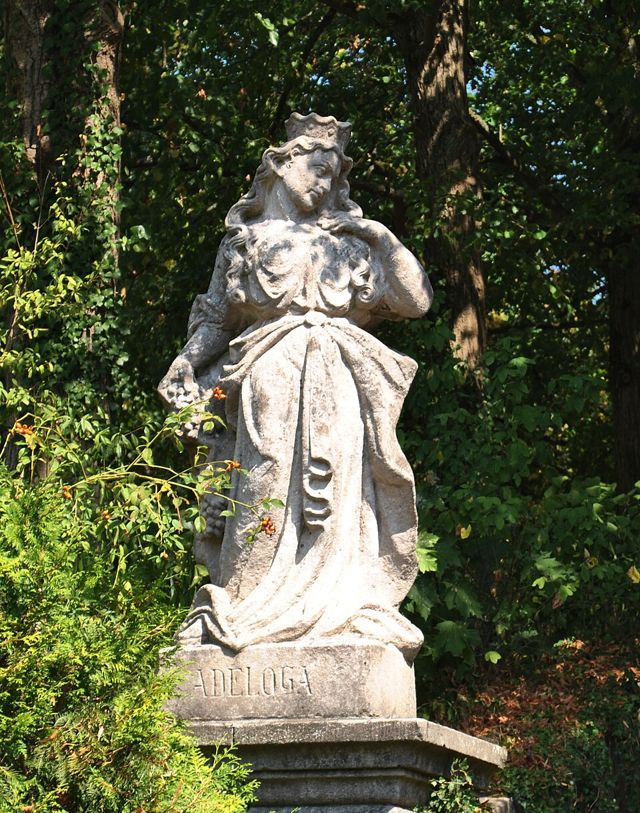
The blessed Adeloga was a daughter of Charles Martel, son of Pepin l'Heristal, by Kunehilda, whether his wife or concubine is uncertain. Adeloga was of singular beauty, so that she was greatly sought in marriage, but she constantly refused all offers, having given her heart wholly to her heavenly Spouse. Her father, greatly exasperated against her, on this account, treated her with studied brutality, subjecting her to public insult; and observing that the bruised spirit of his child sought refuge and comfort in the advice of her director, his private chaplain, he was filled with bitterness, and said, "Hearken, my daughter, you have refused kings, dukes, and peers to anger me, that you might wanton with a curate." Then calling to him one of his knights, who stood by, as he thus insulted his daughter, he bade him "Go and tell the chaplain to be off, he and his woman here, or they shall both be driven forth with contumely, to-morrow morning."
Hearing this, the priest groaned in spirit, and said, "O God of heaven and earth, who searchest the secrets of all hearts, and every thought of man, Thou knowest my innocence in this matter. But, although my lord has exercised his anger upon me, I will not desert my lady and mistress, but for Christ's sake will wait upon her with all reverence."
Then Adeloga went forth, and the priest with her, and they journeyed till they came to a wild and desert place, and there they built a convent. The name of the place was Kitzingen.
To her came many virgins, and the priest gave her the veil, and made her abbess, enjoining her to adopt the rule of SS. Benedict and Scholastica. He, himself, attended to the temporal affairs of the convent, till he was summoned to his rest.
The story is told that after his death, a young nun, having fallen in love with a youth, resolved to fly the convent. She waited till night, and then, when all were asleep, stole to the gates, but there she saw the form of the white-haired chaplain beckoning her back, and with a gentle voice addressing her, "Go back, dear virgin! A heavenly Spouse calleth thee, and no earthly lover! Return to him, my child. I watch without over this sacred house, and the abbess keeps ward within." And not many days after, the girl sickened and died.
There was another nun who was also smitten with passion for a young noble, and harboured in her mind the thought of escaping from her monastery, and flying to his arms. But in the night, as she slept, she saw the holy abbess, Adeloga, pass before her with a lamp in her hand, who turned and looked on her and said, "Lo, Christ cometh, prepare to meet Him. Awake, the Bridegroom cometh, go forth and trim thy light." Then she started from sleep, and was moved with compunction, and never after yielded to sensual thoughts.
Now it fell out that in after years Charles Martel was reconciled to his daughter, and endowed her monastery with lands, and visited her. Then, in the night, there stood before him, in vision, the old chaplain, who said to him, "The Eternal King hath sent me unto thee, to declare to thee my innocence in that thing whereof thou didst once accuse me. And if thou believest me not now, then will I cite thee to appear, and hear me plead my cause, before the just judgment seat of God." And when Charles awoke, he called to him his daughter, and said, "Pray for me, my dearest child, that the Lord lay not this sin to my charge, that once in wrath I spoke falsely against thee and my chaplain, thy director."
It is related that among the retainers of the abbey was a noble youth very fond of dogs, and above all, he loved one hound, which was with him in the field and forest by day, and slept at the foot of his bed at night. One day that he was in the wood, a couple of ruffians fell upon him, and murdered him for the sake of his clothes and purse, and left the body naked under the trees. For three days the faithful hound kept guard, and then it sought the abbey, and whined at the door of the lady Adeloga, and when she came forth, plucked at her dress, as though to lead her into the forest. Suspecting something was amiss, she called to her some servants, and they followed the dog to where his master lay slain. The abbess was determined to discover who were the murderers. She therefore summoned before her all the retainers and serfs on the land, and questioned them closely, but could obtain no confession. Then she solemnly warned the culprits to beware how they left the matter to the judgment of God, and she bade them, for the last time, confess. When all were silent, the hound of the murdered man was introduced, and it flew at the throats of the culprits and tore them so fearfully that one died.
The historian of the life of S. Adeloga, concludes with the following prayer. "We pray thee, most holy and gentle mother, that, as thou hast encouraged us in this life with thy good example and virtuous acts, so mayest thou deign to assist us with God in life eternal; that as we rejoice in thy commemoration on earth, so may we merit to be strengthened by thy intercession in heaven; for the sake of Christ Jesus, our Lord, who of all Saints is the reward, the glory, joy, and crown, through ages of ages, Amen."