St. Aelred of Rievaulx

St. Aelred of Rievaulx (1110–1167) was a Cistercian abbot in England, famous for his book Spiritual Friendship.

Read the essentials →
January 12 · Abbot

St. Aelred of Rievaulx

St. Aelred of Rievaulx

St. Aelred of Rievaulx (1110–1167) was a Cistercian abbot in England, famous for his book Spiritual Friendship.

Traditional feast

January 12
1914 / pre-1969 calendar, per Baring-Gould (1914)

Current feast

January 12
Secondary source · Wikipedia

Represents

Abbot

Their story

Adapted in modern English from the Catholic Encyclopedia (1913) · original text below

Aelred (also written Ailred, Æthelred and Ethelred) was born at Hexham in 1109, the son of one of the married priests then common in England. As a young man he served at the court of David, St Margaret's youngest son and soon King of Scotland, as a kind of page or companion to Prince Henry. King David loved the devout English youth, promoted him and wanted to make him a bishop, but Aelred chose instead to become a Cistercian (a strict reform of Benedictine monks begun at Cîteaux in 1098) monk at the newly founded abbey of Rievaulx in Yorkshire.

He was soon made master of novices and was long remembered for his extraordinary tenderness and patience with them. In 1143 he was sent with twelve monks to found a new abbey at Revesby in Lincolnshire, and in 1146 he was elected Abbot of Rievaulx. There he ruled 300 monks and headed all the Cistercian abbots in England. He seems to have had considerable influence over Henry II. He was present in Westminster Abbey at the translation of St Edward the Confessor in 1163, for which he wrote a Life of Edward. The next year he went on a mission to the Picts (the ancient people of northern Scotland) of Galloway, whose chief is said to have been so moved that he became a monk.

For his sermons he was called the English St Bernard, and he wrote treatises including the 'Mirror of Charity' and 'On Spiritual Friendship', as well as historical works. In his last years he was an example of heroic patience under one painful illness after another, and he ate so little that he was described as 'more like a ghost than a man'. His death is generally dated 12 January 1166, though the source notes that it may have been 1167.

Early life

Selected sentences from the original account, unaltered.

He was of noble descent, and was born in the north of England, in 1109. Being educated in learning and piety, he was invited by David, the pious King of Scotland, to his court, made master of his household, and highly esteemed both by him and the courtiers.

What they represent

How they teach us to live

Drawn from themes in the original account

Practise small acts of self-denial. The account dwells on fasting and penance; a skipped snack or a phone-free hour is a start.

Choose mercy. Forgiveness and mercy are part of this story.

Pray a little every day. Prayer runs all through this account.

Learn from the kind of life it was. He took friendship seriously as a path to God.

From the Catholic Encyclopedia

1913 · 795 words

​Ælred, Saint, Abbot of Rievaulx, homilist and historian (1109–66). St. Ælred, whose name is also written Ailred, Æthelred, and Ethelred, was the son of one of those married priests of whom many were found in England in the eleventh and twelfth centuries. He was born at Hexham, but at an early age made the acquaintance of David, St. Margaret's youngest son, shortly afterwards King of Scotland, at whose court he apparently acted for some years as a sort of page, or companion to the young Prince Henry. King David loved the pious English youth, promoted him in his household, and wished to make him bishop, but Ælred decided to become a Cistercian [strict Benedictine reform begun at Cîteaux in 1098] monk, in the recently founded abbey of Rievaulx in Yorkshire. Soon he was appointed master of novices, and was long remembered for his extraordinary tenderness and patience towards those under his charge. In 1143 when William, Earl of Lincoln, founded a new Cistercian abbey upon his estates at Revesby in Lincolnshire, St. Ælred was sent with twelve monks to take possession of the new foundation. His stay at Revesby, where he seems to have met St. Gilbert of Sempringham, was not of long duration, for in 1146 he was elected abbot of Rievaulx. In this position the saint was not only superior of a community of 300 monks, but he was head of all the Cistercian abbots in England. Causes were referred to him, and often he had to undertake considerable journeys to visit the monasteries of his order. Such a journey in 1153 took him to Scotland, and there meeting King David, for the last time, he wrote on his return to Rievaulx, where the news of David's death reached him shortly afterwards, a sympathetic sketch of the character of the late king. He seems to have exercised considerable influence over Henry II, in the early years of his reign, and to have persuaded him to join Louis VII of France in meeting Pope Alexander III, at Touci, in 1162. Although suffering from a complication of most painful maladies, he journeyed to France to attend the general chapter of his Order. He was present in Westminster Abbey, at the translation [the solemn moving of a saint’s relics to a new shrine] of St. Edward the Confessor, in 1163, and, in view of this event, he both wrote a life of the saintly king and preached a homily in his praise. The next year Ælred undertook a mission to the barbarous Pictish tribes of Galloway, where their chief is said to have been so deeply moved by his exhortations that he became a monk. Throughout his last years Ælred gave an extraordinary example of heroic patience under a succession of infirmities. He was, moreover, so abstemious that he is described as being "more like a ghost than a man." His death is generally supposed to have occurred 12 January, 1166, although there are reasons for thinking that the true year may be 1167. St. Ælred left a considerable collection of sermons, the remarkable eloquence of which has earned for him the title of the English St. Bernard. He was the author of several ascetical treatises, notably the "Speculum Charitatis," also a compendium of the same (really a rough draught from which the larger work was developed), a treatise "De Spirituali Amicitiâ," and a certain letter to an anchoress. All these, together with a fragment of his historical work, were collected and published by Richard Gibbons, S.J., at Douai, in 1631. A fuller and better edition is contained in the fifth volume of the "Bibliotheca Cisterciensis" of Tissier, 1662, from which they have been printed in P. L., vol. CXCV. The historical works include a "Life of St. Edward," an important account of the "Battle of the Standard" (1138), an incomplete work on the genealogy of the kings of England, a tractate "De Sanctimoniali de Watton" (About the Nun of Watton), a "Life of St. Ninian," a work on the "Miracles of the Church of Hexham," an account of the foundations of St. Mary of York and Fountains Abbey, as well as some that are lost. No complete edition of Ælred's historical opuscula has ever been published. A few were printed by Twysden in his "Decem Scriptores," others must be sought in the Rolls Series or in Raine's "Priory of Hexham" (Surtees Society, Durham, 1864).

An anonymous Latin Life of St. Ælred is printed by the Bollandists [Jesuit scholars who since the 1600s have critically studied the lives of the saints], Acta SS., January, vol. II; while other materials may be gathered from Raine, Priory of Hexham, and from Ælred's own writings. An excellent short biography was compiled by Father Dalgairns for Newman's series of Lives of the English Saints, 1845 (new ed., London, 1903); Dict. of Nat. Biog. s. v. Ethelred (XVIII, 33–35); Baring-Gould, Lives of the Saints, I, and the great Cistercian collections of Henriquez and Manrique.

Read more

The full original · 904 words

Read Baring-Gould’s full account

Baring-Gould’s sources: Authorities: His life in Capgrave, and his own writings, still extant.

He was of noble descent, and was born in the north of England, in 1109. Being educated in learning and piety, he was invited by David, the pious King of Scotland, to his court, made master of his household, and highly esteemed both by him and the courtiers. His virtue shone with bright lustre in the world, particularly his meekness, which Christ declared to be his favourite virtue, and the distinguishing mark of his true disciples. The following is a memorable instance to what a degree S. Aelred possessed this virtue:—A certain person of quality having insulted and reproached him in the presence of the King, Aelred heard him out with patience, and thanked him for his charity and sincerity, in telling him his faults. This behaviour had such an influence on his adversary that it made him ask his pardon on the spot. Another time, whilst he was speaking on a certain matter, one interrupted him with very harsh reviling expressions: the servant of God heard him with tranquility, and afterward resumed his discourse with the same calmness and presence of mind as before. He desired ardently to devote himself entirely to God, by forsaking the world; but the charms of friendship detained him some time longer in it, and were fetters to his soul; reflecting notwithstanding that he must sooner or later be separated by death from those he loved most, he condemned his own cowardice, and broke at once those bands of friendship, which were more agreeable to him than all other sweets of life. To relinquish entirely all his worldly engagements, he left Scotland, and embraced the austere Cistercian [strict Benedictine reform begun at Cîteaux in 1098] order, at Rievaulx, in Yorkshire, where Walter de l'Especke had founded a monastery in 1122. At the age of twenty-four, in 1133, he became a monk under the first abbot, William, a disciple of S. Bernard.

In spite of the delicacy of his body he set himself cheerfully to practise the greatest austerities, and employed much of his time in prayer and reading. His heart turned with great ardour to the love of God, and this made him feel all his mortifications sweet and light. "Thy yoke doth not oppress, but raiseth the soul; thy burden hath wings, not weight," said he. He speaks of divine charity with love, and by his frequent ejaculations on the subject, it seems to have been the sweet consolation of his soul. "May thy voice (says he) sound in my ears, O Good Jesus, that my heart may learn how to love thee, that my mind may love thee, that the interior powers, the bowels of my soul, and very marrow of my heart may love thee, and that my affections may embrace thee, my only true good, my sweet and delightful joy! O my God! He who loves thee possesses thee; and he possesses thee in proportion as he loves, because thou art love itself. This is that abundance with which thy beloved are inebriated, dissolved to themselves, that they may live into thee, by loving thee." He had been much delighted in his youth with reading Cicero; but after his conversion found that author, and all other reading, tedious and bitter, which was not sweetened with the honey of the holy name of Jesus, and seasoned with the word of God, as he says in the preface to his book On Spiritual Friendship . He was much edified with the very looks of a holy monk, called Simon, who had despised high birth, an ample fortune, and all the advantages of mind and body, to serve God in that penitential state. This monk went and came as one deaf and dumb, always recollected in God; and was such a lover of silence, that he would scarce speak a few words to the prior on necessary occasions. His silence however was sweet, agreeable, and full of edification. Our Saint says of him, "The very sight of his humility stifled my pride, and made me blush at the want of mortification in my looks." This holy monk, having served God eight years in perfect fidelity, died in 1142, in wonderful peace, repeating with his last breath, "I will sing eternally, O Lord, thy mercy, thy mercy, thy mercy!"

S. Aelred, much against his inclination, was made abbot of a new monastery of his order, founded by William, Earl of Lincoln, at Revesby, in Lincolnshire, in 1142, and after, in 1143, of Rievaulx, where he governed three hundred monks. Describing their life, he says that they drank nothing but water, ate little, laboured hard, slept little, and on hard boards; never spoke, except to their superiors on necessary occasions; and loved prayer.

S. Odilo, Jan. 1, p. 20 .

The Octave of the Epiphany.

S. Potitus , M. , a.d. 166. SS. Hermylus and Stratonicus , MM., at Belgrade , a.d. 315. S. Glaphyra , V., at Amasia, circ. a.d. 324. S. Agricius , B. of Trèves, circ. a.d. 335. S. Hilary , B. of Poictiers , a.d. 368. S. Virentius , P. , in Burgundy , a.d. 400. S. Kentigern , B. of Glasgow , a.d. 601. B. Berno , Ab. of Cluny , a.d. 920. S. Heldemar , H., in Artois , a.d. 1097. B. Gotfried , of Kappenberg , a.d. 1127. B. Jutta , W. and Recluse, at Huy, in Belgium , a.d. 1228. B. Veronica , V. at Milan , a.d. 1497.
Feast days

Feast: January 12

Nine days · Free

Pray the novena
with us.

One short email a day for nine days. The day's prayer, a line from St. Aelred of Rievaulx's story, and a nudge to keep going.

Also on January 12
A

St. Arcadius

January 12 · Martyr
S

Sts. Satyrus

January 12 · Martyrs
T

Sts. Tigris and Eutropius

January 12 · Priest, Martyrs
← All 1726 saints in the library
Sources & notes

Feast-day sources

Story sources

Sources

Credits

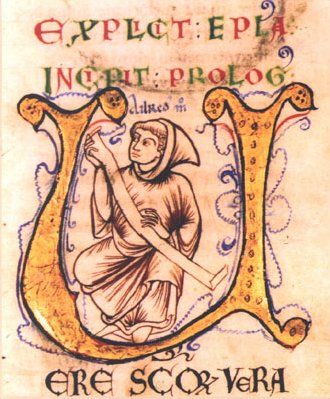
Image: De Speculo Caritatis.jpeg · Elredo de Rieval, posiblemente · Public domain, via Wikimedia Commons

From Sabine Baring-Gould, The Lives of the Saints, new and revised edition (Edinburgh: John Grant, 1914; first edition 1872). Public domain.

Image: Elredo de Rieval, posiblemente, Wikimedia Commons (Public domain)

From “Catholic Encyclopedia (1913)/St. Ælred,” The Catholic Encyclopedia (New York: Robert Appleton Company, 1907–1914), via Wikisource. Public domain. Matched by name and feast date; text unedited except for our bracketed notes in grey.

From Sabine Baring-Gould, The Lives of the Saints, new and revised edition (Edinburgh: John Grant, 1914; first edition 1872). Public domain in the United States. Reproduced unedited, except for short bracketed notes in grey that we added to explain names and terms (“S.” is the old abbreviation for Saint). Some history and judgments reflect 19th-century scholarship.