St. Agatha

Faithfulness to Christ when it cost everything.

Read the essentials →
February 5 · Virgin, Martyr

St. Agatha

St. Agatha

Faithfulness to Christ when it cost everything.

Traditional feast

February 5
1914 / pre-1969 calendar, per Baring-Gould (1897)

Current feast

February 5
Verified · General Roman Calendar

Represents

Virgin
Martyr

Their story

Adapted in modern English from Baring-Gould (1897) · original text below

Both Catania and Palermo claim to be Agatha's birthplace, with Catania slightly ahead. Catania was certainly the scene of her martyrdom under Decius in 251. Her Acts (the written account of a martyr's trial and death) may not be reliable in every detail, but their main facts seem well established.

According to them, Agatha came from an illustrious and wealthy Sicilian family and was known for her beauty and gentle manners, but from earliest youth her love was given to God. Quintianus, the governor of Sicily, desired her, and she withdrew to Palermo to escape him. When he discovered she was a Christian, his love turned to hatred. She was seized and taken to Catania, weeping and praying the whole way for strength.

For a month every means was tried to make her break her vow, but continual prayer kept her firm. Questioned by Quintianus, she confessed Christ and declared that serving Jesus was the highest nobility and the truest freedom. The next day she was racked and bore it calmly. When her breasts were cut off, she gently reproached Quintianus, reminding him of his own infancy and his mother's tenderness. She was returned to prison and refused food and medical care. Four days later she was tortured again, and back in prison she peacefully fell asleep in the Lord. The people buried her with great honour. She is patroness of Catania.

Early life

Selected sentences from the original account, unaltered.

THE honour of being the birth-place of S. Agatha is claimed by Catania and Palermo, in Sicily. According to these, S. Agatha was the daughter of an illustrious and wealthy house in Sicily, and was famed for her beauty and her gentle and amiable manners. But her love was consecrated to God from her very earliest youth.

What they represent

How they teach us to live

Drawn from themes in the original account

Stay faithful when it costs you. This account is about holding firm under pressure.

Pray a little every day. Prayer runs all through this account.

Learn from the kind of life it was. Faithfulness to Christ when it cost everything.

Read more

The full original · 504 words

Read Baring-Gould’s full account

Baring-Gould’s sources: Roman Martyrology and all others. Famous also among the Greeks. There are various editions of the Acts of her Martyrdom in Latin and in Greek. The latter are not as trustworthy as the former, which are very ancient, and though apparently tampered with by copyists, are on the whole to be relied upon. The Latin Acts were written by eye-witnesses, as appears from a passage in them, "From this we supposed he was her angel." There is an older version of the Greek Acts than that given by Metaphrastes (fl. 867), and there is a sermon on S. Agatha by S. Methodius. The name of S. Agatha occurs in the Canon of the Roman Mass; among the first five Virgin Saints enumerated in Nobis quoque peccatoribus .

THE honour of being the birth-place of S. Agatha is claimed by Catania and Palermo, in Sicily. The probabilities in favour of either are nearly equally divided, though there seems to be a slight superiority in the claims of Catania. It certainly was the scene of her martyrdom, which took place during the persecution of Decius [Roman emperor 249–251, who ordered everyone to sacrifice to the gods] in a.d. 251, as all her acts testify. If these are not in all particulars to be relied on, their main facts seem to be pretty well established. According to these, S. Agatha was the daughter of an illustrious and wealthy house in Sicily, and was famed for her beauty and her gentle and amiable manners. But her love was consecrated to God from her very earliest youth. Quintianus the Consular of Sicily, as the Governor was then called, admired her exceedingly, and the holy virgin retired to Palermo to avoid his importunities. As often happened in those days of heathen cruelty, his love was turned into hatred when he discovered that she was a Christian. She was seized and brought to Catania; and all the way thither she could only weep and pray to the Lord to strengthen her for the conflict which awaited her. Every means was tried during the space of a month to prevail on her to forget her vow; but she was supported by continual prayer, and at last came off victorious from this lingering martyrdom. She was privately examined before Quintianus as to her faith, and confessed Christ with undaunted firmness, declaring the service of the Lord Jesus to be the highest nobility and the truest freedom: she was then sent to prison, to which she went joyfully, recommending herself to God, and entreating His aid. The day after she was tortured on the rack, and suffered with calmness and constancy. And, when she was put to the cruel torment of having her breasts cut off, she mildly reproached the inhuman Quintianus with the remembrance of his own infancy, and with the tenderness of his mother. She was then led again to prison, and all sustenance and medical aid were denied her. Four days afterwards she was put to still further tortures, and then, being taken back to prison, sweetly fell asleep in the Lord, and was buried by the people with great honour.

Relics in Catania, and some in the Church of S. Méry, at Paris.

Patroness of Catania, La Mirandola, and the Order of Malta.

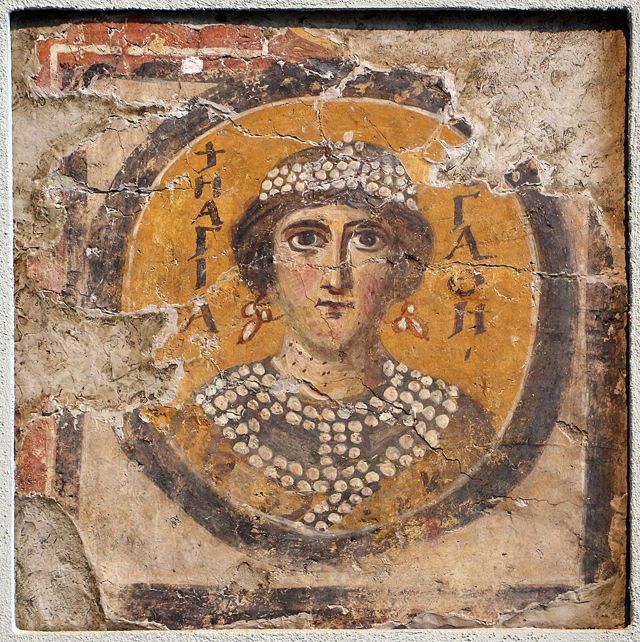
In Art S. Agatha is represented as a majestic virgin wearing a long veil, and over this, in early figures, a crown, the symbol of her victory over death; she usually holds a clasped book in her left hand, and a palm branch in the right; occasionally the place of this latter emblem is supplied by a pair of pincers, having a nipple between the teeth, in allusion to the fearful torture to which she was subjected. Sometimes she carries both her breasts cut off in a dish, or a sword is passed through them.
Feast days

Feast: February 5

Nine days · Free

Pray the novena
with us.

One short email a day for nine days. The day's prayer, a line from St. Agatha's story, and a nudge to keep going.

Also on February 5
A

St. Avitus of Vienne

February 5 · Bishop, Confessor
B

St. Bertulf

February 5 · Abbot
I

Sts. Indract and…

February 5 · Martyrs
← All 1726 saints in the library
Sources & notes

Feast-day sources

Story sources

Sources

Credits

Image: Sant'agata, VII-inizio VIII secolo ca., forse da s.m. antiqua (roma, coll. priv.).jpg · Sailko · CC BY 3.0, via Wikimedia Commons

From Sabine Baring-Gould, The Lives of the Saints, new edition in 16 vols. (London: John C. Nimmo, 1897), digitized text from Project Gutenberg. Public domain.

Image: Sailko, Wikimedia Commons (CC BY 3.0)

From Sabine Baring-Gould, The Lives of the Saints, new edition in 16 vols. (London: John C. Nimmo, 1897), digitized text from Project Gutenberg. Public domain in the United States. Reproduced unedited, except for short bracketed notes in grey that we added to explain names and terms (“S.” is the old abbreviation for Saint). Some history and judgments reflect 19th-century scholarship.