A

Leaving everything to pray, yet still drawing people who needed wisdom.

Read the essentials →
April 7 · Priest, Hermit

St. Aibert

St. Aibert

Leaving everything to pray, yet still drawing people who needed wisdom.

Traditional feast

April 7
1914 / pre-1969 calendar, per Baring-Gould (1897)

Current feast

April 7
Secondary source · Wikipedia

Represents

Priest
Hermit

Their story

Adapted in modern English from Alban Butler's Lives of the Saints · Baring-Gould original below · little is known

Aibert was born in 1060 at Espain, a village in the diocese of Tournay. As a child he prayed for hours at night, kneeling or lying on the ground, and when he could not pray unseen at home he hid in the stable or sheepfold. At meals he would take an apple or a bit of bread, so that he could say he had eaten.

On hearing a poor man sing a hymn about the hermit St Theobald, he longed for the same life. He joined John, a priest of the monastery of Crespin who lived as a recluse, and soon surpassed his teacher. They rarely ate bread, lived on wild herbs and never ate anything cooked by fire.

Early life

Selected sentences from the original account, unaltered.

…near TournaL From early childhood he loved prayer above everything, and would rise at night and kneel on the floor. But the servants having detected him, and complained to his father, the child hid himself in the sheep-fold every day, and prayed there, till he was found one day fast asleep on his knees, with his head in the straw, as he had fallen, overcome with weariness.

What they represent

How they teach us to live

Drawn from themes in the original account

Make time for silence. Solitude and withdrawal to pray shape this life.

Pray a little every day. Prayer runs all through this account.

Learn from the kind of life it was. Leaving everything to pray, yet still drawing people who needed wisdom.

Read more

The full original · 502 words

Read Baring-Gould’s full account

Baring-Gould’s sources: Belgian and Benedictine Martyrologies on April 7th and May 2nd. Authority A life written by a contemporary, Robert, Archdeacon of Oostrevand, dedicated to Alois, B. of Arras, d. 1148.] S. Aibert was the son of a knight Aldbald of Espen, April j.J •S’. Albert.

…near TournaL From early childhood he loved prayer above everything, and would rise at night and kneel on the floor. But the servants having detected him, and complained to his father, the child hid himself in the sheep-fold every day, and prayed there, till he was found one day fast asleep on his knees, with his head in the straw, as he had fallen, overcome with weariness. Wherever he was, in the fields or at home, if he heard the church bells beginning to tinkle, he at once ran to church. One day, when he was grown up, he heard a jongleur sing a ballad about S. Theobald the hermit, and his conversion from the world. Then Aibert went and placed himself under the direction of a hermit named John, who lived in a retired wood near Crespin. 1 After a pilgrimage to Rome, made in company with the abbot of Crespin, he entered the monastery of Crespin, in 1090.

After twenty-five years in the cloister, in 1115, he returned to a solitary life in the wilderness. A story is told of him when there, that one winter the waters were out, so that none could reach him, and he was unable to hear mass. This troubled him sorely, and he called on the Blessed Virgin to succour him. Then he fell asleep, and lo ! he saw a very beautiful woman enter his cell followed by a troop of maidens. At this Aibert exclaimed, “ Women in my cell ! It is not permitted. Go out instantly.” “ Pardon me, brother, I am the Virgin Mary, and thou hast summoned me,” answered she; “ And now why dost thou ask to hear masses, when thy whole life and acts are the solemnity of masses.” Then she put a piece of bread into his mouth and vanished. Such was his dream, and so implicitly did he believe in its reality, that he resolved not to eat bread any more, but only herbs.

To obviate the inconvenience from which he had suffered, 1 Between Valenciennes and S. Ghislaln. Burchardt, B. of Cambrai, ordained him priest; after which he was wont to say two masses every day, one for the living, and the other for the dead Every night he recited the whole psalter, or read nine lessons; and every day he bowed his knee a hundred times, saying at each genuflexion, “ Hail, Mary, full of grace, the Lord is with thee ! Blessed art thou among women, and blessed is the fruit of thy womb.” Crowds came to him from all the country round, and he gave them good advice, heard their confessions, and had such power that he converted many sinners. He died in the fiftieth year of his monastic life, in 1140, on Easter Day, and was buried in his cell His body was enshrined in 1303, and again in 1464. It was saved in the Calvinist riots of 1566, parts are at Toumai, other portions at Espain and Mons.
Feast days

Feast: April 7

Nine days · Free

Pray the novena
with us.

One short email a day for nine days. The day's prayer, a line from St. Aibert's story, and a nudge to keep going.

Also on April 7
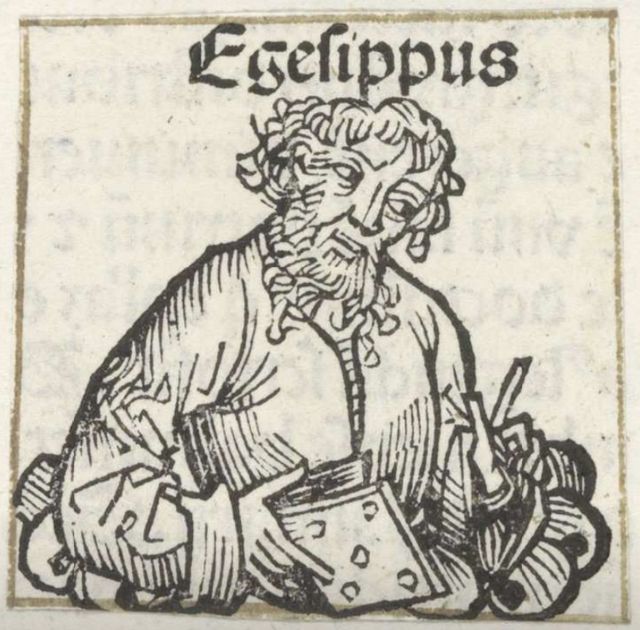
St. Hegesippus

St. Hegesippus

April 7 · Feast
C

St. Calliopius

April 7 · Martyr
A

St. Aphraates

April 7 · Hermit
← All 1726 saints in the library
Sources & notes

Feast-day sources

Story sources

Sources

Credits

From Sabine Baring-Gould, The Lives of the Saints, new edition in 16 vols. (London: John C. Nimmo, 1897–98); text from the Internet Archive scan (OCR, lightly cleaned; errors possible). Public domain.

From Sabine Baring-Gould, The Lives of the Saints, new edition in 16 vols. (London: John C. Nimmo, 1897–98); text from the Internet Archive scan (OCR, lightly cleaned; errors possible). Public domain in the United States. Reproduced unedited, except for short bracketed notes in grey that we added to explain names and terms (“S.” is the old abbreviation for Saint). Some history and judgments reflect 19th-century scholarship.