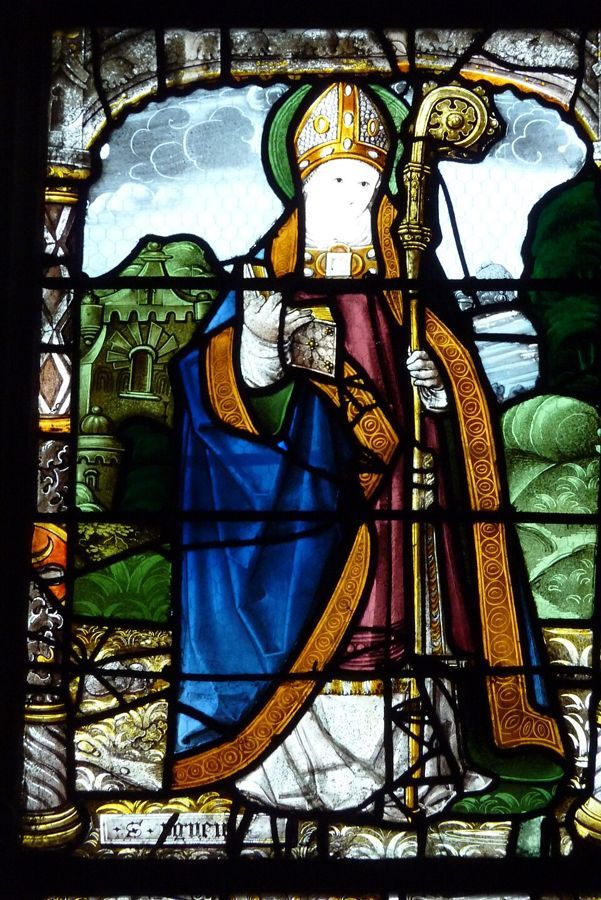
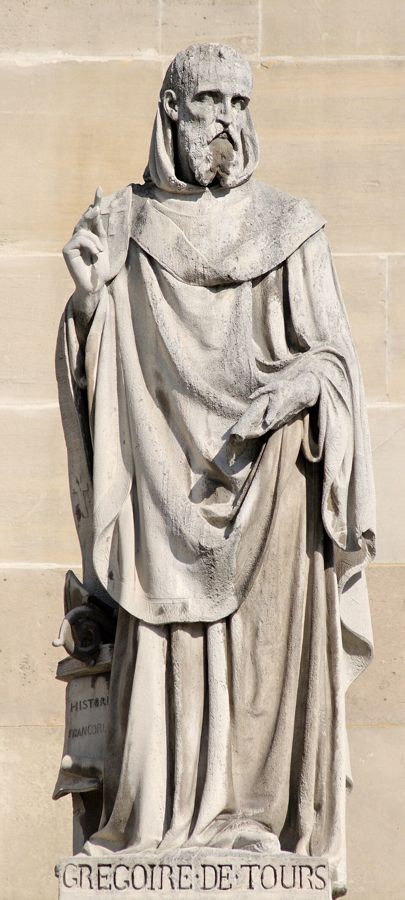
Baring-Gould’s sources: Roman and Gallican Marty rologies. Usuardus, Ado, &c. Authorities: — Gregory of Tours, Hist. Franc, ii. 7, and a Letter of Sidonius Apollinaris.] S. Aignan, in Latin Anianus, was born at Vienne in Gaul of refugee parents from Hungary, probably of Roman origin; they were Catholics, and the Arian Goths menaced both their faith and their substance. They saved both by a timely flight within the frontiers, where the failing arm of Rome was not altogether powerless. Aignan had a brother, Leonianus, who became an abbot, and is commemorated by Gallican Martyrologists on November 16.
At an early age Aignan retired to a hermitage near Vienne, and remained in it till he heard of the virtues of S. Evurtius of Orleans,1 when he went to him for guidance in the religious life. S. Evurtius ordained him priest, and then made him abbot of S. Laurence outside the city walls. About 391, when he was far advanced in age and looking forward to 1 Died 391; called Enurchus in Anglican Kalendar. S. Aignan.
his death, Evurtius determined to resign the bishopric and appoint a successor. He assembled the electors and bade them write the names of those for whom they voted on slips of parchment and place them in a box. A little child was enjoined to draw the lot, and the name drawn was that of Aignan. S. Evurtius then consulted the Sortes Sacrae. The Psalter was opened, then the book of Epistles, and then the Gospels, at hap-hazard. The text at the head of the page in the Psalms where the book opened was, “ Blessed is the man whom Thou choosest and receivest unto Thee: he shall dwell in Thy courts.” That in the Epistle was, “ Other foun dation can no man lay than is laid.” That in the Gospel, " On this rock will I build my church, and the gates of hell shall not prevail against it.” This convinced every one that Aignan was chosen by Providence. S. Evurtius therefore consecrated and installed him in his room. Aignan at once asked the governor of Orleans to release the prisoners in the town. Agrippinus, the governor, refused. But a stone having fallen on his head and bruised it whilst he was at church, he thought this was a warning not to disregard the request of the new bishop, and he opened the jails, and released all the criminals. Aignan buried S. Evurtius in the field of a senator named Letradus, on his death, shortly after his own election. Gaul [roughly modern France and Belgium] was at this time troubled with the invasion of the Huns [nomadic invaders from Central Asia, led in the 5th century by Attila] under Attila. In 451 his swarm of ferocious barbarians swept to the gates of Orleans. Romans, Gauls, Visigoths, Burgundians, Franks [the Germanic people who ruled Gaul and gave France its name], and Alans united under Aetius to resist the terrible invader, who had also in his ranks Goths [Germanic peoples who invaded the Roman Empire, many of them Arian Christians], Burgundians, Gepidae, Alans, and Franks, from beyond the Rhine. It was a wild chaos and conflict of barbarians, of every name and race, disputing one with another, pell-mell, the remnants of the Roman empire, torn asunder and in dissolution.
When Attila laid siege to Orleans, S. Aignan sustained the courage of the besieged by promising them aid from Aetius and his allies. The aid was slow to come; and the bishop sent to Aetius the message, “If thou be not here this very day, my son, it will be too late.” Still Aetius came not. The people of Orleans determined to surrender; the gates flew open; the Huns entered; the plundering began without much disorder; “waggons were stationed to receive the booty as it was taken from the houses, and the captives, arranged in groups, were divided by lot between the victorious chieftains.” Suddenly a shout rang through the streets: it was Aetius, Theodoric, and Thorismund, his son, who were coming with the eagles of the Roman legions and with the banners of the Visigoths. A fight took place between them and the Huns, at first on the banks of the Loire, and then in the streets of the city. The people of Orleans joined their liberators; the danger was great for the Huns, and Attila ordered a retreat. It was the 14th June, 451, and that day was for a long time celebrated in the church of Orleans as the date of a signal deliverance. The Huns retired towards Champagne, which they had already crossed at their coming into Gaul. Aetius and all his allies followed them, and Attila, perceiving that a battle was inevitable, halted in position at Chalons- surMarne, for giving it. “It was,” says Jornandes, “a battle which for atrocity, multitude, horror, and stubbornness has not the like in the records of antiquity.” Theodoric was killed, but the Huns were defeated and driven out of Gaul. This was the last victory in Gaul, gained still in the name of the Roman empire, but really for the advantage of the German nations which had already conquered it. Twenty-four years afterwards the Roman empire of the West disappeared with Augustulus.
Aignan died, at the age of ninety-five, in 453, and was buried in the church oi S. Laurence, where he had been 6". Gregory.
abbot. His relics [the bodily remains of a saint, or objects they used, kept with honor] were burned by the Huguenots in 1562, but some small fragments are preserved in the cathedral at Orleans.