Roman Martyrology, Gallican, German, Sarum, and York, but Mode.n Anglican Reformed Kalendar on the 17th, occasioned by a mistake of printer, XXII. having been altered into XVII. Authorities Gildas, or rather the author of the De Excidio Britannic <b, called Gildas by Bede [English monk and historian (d. 735)]. This work was supposed by Dr. T. Wright, “ Biographia Britannica Literaria,” 1842, to have been a forgery by a Saxon priest, who wrote it with the idea of using the writings of a British priest as an argument against the purity of that native church, which the Roman party were bent on upsetting or forcing into Roman obedience. This view has now been abandoned. Gildas belonged to the Roman party in the Celtic Church which strove to stamp out national peculiarities, and it is certainly a genuine treatise. The British retreating before the Saxons would carry with them the tradition of the martyrdom of S. Alban. That S. Alban's memory had not died out appears from the fact of S. Germain, on his visit to Britain, collecting earth stained, or supposed to be stained, with his blood.1 Venantius Fortunatus, who died in 609, mentions S. Alban in one of his hymns. The story as given by Gildas contains an inaccuracy. He makes the “noble river Thames" flow by Verulam. As Bede tells it, it contains several improbabilities, and presents chronological difficulties; for whilst the persecution of D.ocletian lasted, under which S. Alban is stated.S' Alban.
June is.] to have suffered, Britain was first alienated from the Roman empire by Carausius and Allectus, and was then under Const anti us Chlorus. It is difficult to believe that Constantius would sanction a bloody persecution in his dominions, but it is not improbable that local persecutions under severe governors may have broken out. Gildas’s general statement respecting the persecution by Diocletian [Roman emperor 284–305, who began the ‘Great Persecution’ of Christians in 303] rests, as is usual with him, upon an unauthorised transference to the particular case of Britain of the language used by Eusebius [Eusebius of Caesarea (d. c. 339), the first historian of the Church] (Lib. viii., c. 2) relating to the persecution in general, and is conclusively contradicted by Eusebius himself (viii. c. 13), who says that in Britain Constantius Chlorus “had no share in the hostility raised against us, but even preserved and protected those pioui persons under him free from harm and calumny, neither did he demolish the cl lurches, nor devise any mischief against us." Also Sozomen i. 6, and Lactantius, who also distinctly asserts that Constantius suffered no Christian to be killed, but adds, in contradiction to Eusebius, that he allowed the churches to be pulled down. The individual case of S. Alban, however, rests upon a local tradition traceable apparently up to 429, the date of S. Germain’s first visit to Britain; and perhaps the general assertions of Eusebius and the others may leave room for it, and for one or two other martyrdoms. Though Constantius Chlorus may have discouraged persecution himself, it is by no means improbable that local persecutions may have broken out under severe and bigoted magistrates. That S. Alban’s martyrdom, however, happened in the Diocletian persecution, rests only on the knowledge, or according to another reading, the guess (conjicimus for cognoscimus) of the pseudo-Gildas. And the Anglo-Saxon Chronicle, and the Liber Landavensis, although the latter still attribu es it to that persecution, date it in 286. All that seems certain is, that within one hundred and twentyfive years after the last persecution, a belief existed at Verulam that a martyr named Alban lay buried near that town. If the persecution was that of Diocletian, the date must have been 304, that persecution beginning with the first edict of Diocletian in March 303, but extending to laymen only with his fourth edict in 304, and ceasing altogether in Britain upon his resignation in 305. In a book of the lives of the abbots of S. Alban’s to the time of Eadwar (drc. 970) it is said that among the ruins of ancient Verulam was found a stone chest containing a book written in characters only decipherable by an old monk named Unwyn, who found it to contain the Acts of S. Alban in ancient British. This was translated Into Latin in the 1 2th cent, by William of S. Alban’s, at the request of the abbot Simon (d. 1x88). These pretended Acts, an impudent forgery of William of S. Alban's, perpetrated with the connivance of his abbot, purport to have been written by a British Christian in 590, when the Saxons had overrun the country and established paganism. In the prologue the author says: — 41 1 have not given my name, lest 1 should thereby forfeit both my name Lives oj the Saints.
[June as. and my life.” That most worthless of historian.*, except as a collector of popular ballads and romances, Geoffrey o. Monmouth, also mentions S. Alban, but does not tel' his story fully. He also names '*S. Amphibalus."] AIN I ALBAN, a pagan, received into his house and sheltered a Christian priest during the persecution of Diocletian, and was so struck by the devotion to God, and blameless life of the man whom he protected, that he placed himself under instruction and became a Christian. A rumour having reached the governor of Verulam, that the priest was hiding in the house of Alban, he sent soldiers to search it. Alban seeing them arrive, hastily cast the long cloak of the priest over his head and shoulders, and presented himself to the soldiers as the man whom they sought.1 He was immediately bound and brought before the governor. It fell out that the governor was then standing at the altar and was offering sacrifice. When the cloak was removed, which had concealed the face of Alban, and he perceived that the man was not the priest he had ordered to be arrested, his anger flamed hot, and he ordered Alban immediately to sacrifice or to suffer death.
S. Alban steadfastly refused to offer to idols. Then the magistrate asked, “Of what family and race are you ? ” “ How can it concern thee to know of what stock I am?” answered Alban. “If thou desirest to know what is my religion, I will tell thee — I am a Christian, and am bound by Christian obligations.” “ I ask thy name, tell it me immediately.” 1 The priest, whose name Bede does not gire, was afterwards supplied by the fabricator of the spurious Acts with the name of Amphibalus. from the cloak which he wore, Amphibalus being the Greek for a cloak. Bede says that the priest did not suffer then, "his time of martyrdom had not yet come.*’ The forger gave him an absurd name, and invented the acts of his martyrdom. Under the name of Amphibalus this priest figures in some maityrologies on June sand with & Alban, or alone on June astht S. ALBAN.
June sa. June M. i S. Alban. 297 I “I am called Alban by my parents,” he replied. “And I worship and adore the true and living God, who created all things.”
Then the governor said, “ If thou wilt enjoy eternal life, delay not to sacrifice to the great gods.” Alban rejoined, “ These sacrifices which are offered to devils are of none avail. Hell is the reward of those who offer them.”
The governor ordered S. Alban to be scourged, hoping to shake his constancy by pain. But the martyr bore the stripes patiently, and even joyously, for our Lord’s sake. When the judge saw that he could not prevail, he ordered Alban to be put to death. On his way to execution, the martyr had to cross a river. “There,” says Bede, “ he saw a multitude of both sexes, and of every age and rank, assembled to attend the blessed confessor [in old usage, a saint who was not martyred, or who suffered for the faith without being killed] and martyr; and these so crowded the bridge, that he could not pass over that evening. Then S. Alban, urged by an ardent desire to accomplish his martyrdom, drew near to the stream, and the channel was dried up, making a way for him to pass over.”1 Then the martyr and his escort, followed by an innumerable company of spectators, ascended the hill now occupied by the abbey church bearing his name. It was then a green hill covered with flowers sloping gently down into the pleasant plain. Then his executioner refused to perform his office, and throwing down his sword confessed himself a Christian. Another man was 1 This ** river’* is a stream, the \’er; It runs between the present church and the site of Verulam. The miracle of drying up the river is an exaggeration. The Ver Is nowhere unfordable, and in Midsummer is the merest brook. At the same time that S. Alban dried up the river, says Bede, he miraculously caused a fountain to spring up on the hill of martyrdom. This is prfibably Holywell, about half way between the abbey and Sopwell nunnery, in a field on the cast side of the street called Holywell Hill.
Iff ’* detailed to deal the blow, and both Alban and the executioner who had refused to strike were decapitated together.
On the site of the martyrdom rose a church directly that peace was restored, which, though it must have fallen into ruins during the Saxon pagan domination, was restored when the Anglo-Saxons were converted, and stood in the days of Bede. Afterwards, in 793, Offa, king of the Mercians, founded there the stately abbey of S. Alban’s. At the time of the Danish invasions, the monks of S. Alban’s sent the body of the saint for safety to Ely, and when all fear of the Danes [Viking raiders from Scandinavia] was over, reclaimed the body, but the monks of Ely refused to surrender it, whereupon they of S. Alban’s declared that they had never sent the true body of the saint to Ely, but another one; and that the real relics [the bodily remains of a saint, or objects they used, kept with honor] were buried in a secret place at S. Alban’s. They proceeded at once to dig them up and enshrine them.1 The shrines of S. Alban, “ S. Amphibalus,” and the martyred executioner, have lately been examined, and no traces of the relics were found; they were scattered by the commissioners in the reign of Henry VIII.8 The S. Alban venerated this day at Cologne is a different saint, though at Cologne it is pretended that the church of S. Alban in that city contains the relics of the English proto-martyr. The relics of S. Alban at Cologne were brought from Rome in the year 989, and 1 There can be no manner of doubt that this was a falsehood. The relics scattered at the Reformation in S. Alban’s were only those of the second S. Alban. This is not the only indictment against the monks there. healing of the infirm and the operation of cures does not cease to be famous,” although the localities had been forgotten before Offa built his monastery in 793 (Matt. Paris \ it. Off.) Thus, probably enough, the first relics were not genuine. It must be remembered also how scandalous was the forgery of the Acts of SAlban perpetrated in the same house later. jl * June aa.] SS. Ten Thousand Martyrs.
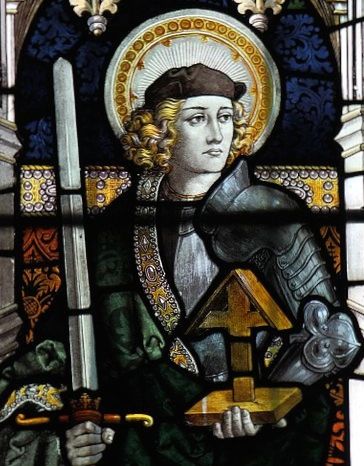
the supposition that the relics of the proto-martyr of England were carried to Rome after their invention in 793 by King Offa, is destitute of all probability, though it is insisted on by Cologne historians. The S. Alban enshrined at Cologne was given by Pope John XI., to the Empress Theophania, the wife of Otho II [German king and emperor, co-ruler with his father Otto I from 967 and sole ruler 973–983]., on her visit to Rome in 989; but nothing is known of who this S. Alban was, and how he suffered. In art S. Alban is represented sometimes in civil, and sometimes in military dress, bearing the palm and sword, or a cross and a sword.