St. Aldhelm of Sherborne

A shepherd who stayed with his people through hard times.

Read the essentials →
May 25 · Bishop

St. Aldhelm of Sherborne

St. Aldhelm of Sherborne

A shepherd who stayed with his people through hard times.

Traditional feast

May 25
1914 / pre-1969 calendar, per Baring-Gould (1897)

Current feast

May 25
Secondary source · Wikipedia

Represents

Bishop

Their story

Adapted in modern English from the Catholic Encyclopedia (1913) · original text below

Aldhelm, a kinsman of King Ine of Wessex, was educated at Malmesbury under the Irish teacher Maildubh, and later studied under Abbot Adrian at Canterbury. He succeeded Maildubh as head of the school and abbot of Malmesbury. He lived austerely and was known to recite the whole Psalter standing up to his neck in icy water. The abbey prospered, and his small church of St Lawrence at Bradford-on-Avon still stands.

At a synod's request he wrote to the Britons of Devon and Cornwall on the Easter question, and many are said to have returned to unity. In 705 he reluctantly became the first Bishop of Sherborne. Stubbs called him the first Englishman to cultivate classical learning with any success. Scholars from Ireland and the Continent consulted him, and he wrote 'In Praise of Virginity' in prose and verse, a work on Latin metre and a collection of riddles. He died about 709.

Early life

The book says little or nothing about early life. This is how the account begins.

…enriched with many gifts by the West-Saxon kings and nobles. Its abbot founded smaller houses at Frome and Bradford, in the neighbourhood. At Malmesbury he found a small but ancient church, then in ruins; this he rebuilt or repaired, and dedicated it to SS. Peter and Paul, in that age the favourite saints of the Anglo-Saxons.

What they represent

How they teach us to live

Drawn from themes in the original account

Share your faith, in words and by example. Preaching and conversion are central here.

Learn from the kind of life it was. A shepherd who stayed with his people through hard times.

From the Catholic Encyclopedia

1913 · 1056 words

​Aldhelm, Saint, Abbot of Malmesbury and Bishop of Sherborne, Latin poet and ecclesiastical writer (c. 639–709). Aldhelm, also written Ealdhelm, Ældhelm, Adelelmus, Althelmus, and Adelme, was a kinsman of Ine, King of Wessex [the Anglo-Saxon kingdom of southern England], and apparently received his early education at Malmesbury, in Wiltshire, under an Irish Christian teacher named Maildubh. It is curious that Malmesbury, in early documents, is styled both Maildulfsburgh and Ealdhelmsbyrig, so that it is disputed whether the present name is commemorative of Maildubh or Ealdhelm, or, by "contamination," possibly of both (Plummer's "Bede [English monk and historian (d. 735)]," II, 310). Aldhelm himself attributes his progress in letters to the famous Adrian, a native of Roman Africa, but formerly a monk of Monte Cassino, who came to England in the train of Archbishop Theodore and was made Abbot of St. Augustine's, Canterbury. Seeing, however, that Theodore came to England only in 671, Aldhelm must then have been thirty or forty years of age. The Saxon scholar's turgid style and his partiality for Greek and extravagant terms have been traced with some probability to Adrian's influence (Hahn, "Bonifaz und Lul," p. 14). On returning to settle in Malmesbury our Saint, probably already a monk, seems to have succeeded his former teacher Maildubh, both in the direction of the Malmesbury School, and also as Abbot of the Monastery; but the exact dates given by some of the Saint's biographers cannot be trusted, since they depend upon charters of very doubtful authenticity. As abbot his life was most austere, and it is particularly recorded of him that he was wont to recite the entire Psalter standing up to his neck in ice-cold water. Under his rule the Abbey of Malmesbury prospered greatly, other monasteries were founded from it, and a chapel (ecclesiola), dedicated to St. Lawrence, built by Aldhelm in the village of Bradford-on-Avon, is standing to this day. (A. Freeman, "Academy," 1886, XXX, 154.) During the pontificate of Pope Sergius (687–701), the Saint visited Rome, and is said to have brought back from the Pope a privilege of exemption for his monastery. Unfortunately, however, the document which in the twelfth century passed for the Bull of Pope Sergius is undoubtedly spurious. At the request of a synod, held in Wessex, Aldhelm wrote a letter to the Britons of Devon and Cornwall upon the Paschal question, by which many of them are said to have been brought back to unity. In the year 705 Hedda, Bishop of the West Saxons, died, and, his diocese being divided, the western portion was assigned to Aldhelm, who reluctantly became the first Bishop of Sherborne. His episcopate was short in duration. Some of the stone-work of a church he built at Sherborne still remains. He died at Doulting (Somerset), in 709. His body was conveyed to Malmesbury, a distance of fifty miles, and crosses were erected along the way at each halting place where his remains rested for the night. Many miracles were attributed to the Saint both before and after his death. His feast was on May the 25th, and in 857 King Ethelwulf erected a magnificent silver shrine at Malmesbury in his honour.

"Aldhelm was the first Englishman who cultivated classical learning with any success, and the first of whom any literary remains are preserved" (Stubbs). Both from Ireland and from the Continent men wrote to ask him questions on points of learning. His chief prose work is a treatise, "De laude virginitatis" ("In praise of virginity"), preserved to us in a large number of manuscripts, some as early as the eighth century. This treatise, in imitation of Sedulius, Aldhelm afterwards versified. The metrical version is also still extant, and Ehwald has recently shown that it forms one piece with another poem, "De octo principalibus vitiis" (On the eight deadly sins"). The prose treatise on virginity was dedicated to the Abbess and nuns of Barking, a community which seems to have included more than one of the Saint's own relatives. Besides the tractate on the Paschal controversy already mentioned, several other letters of Aldhelm are preserved. One of these, addressed to Acircius, i.e. Ealdfrith, King of Northumbria [the Anglo-Saxon kingdom of northern England and south-east Scotland], is a work of importance on the laws of prosody. To illustrate the rules laid down, the writer incorporates in his treatise a large collection of metrical Latin riddles. A few shorter extant poems are interesting, like all Aldhelm's writings, for the light which they throw upon religious thought in England at the close of the seventh century. We are struck by the writer's earnest devotion to the Mother of God, by the veneration paid to the saints, and notably to St. Peter, "the key-bearer," by the importance attached to the holy sacrifice of the Mass, and to prayer for the dead, and by the esteem in which he held the monastic profession. Aldhelm's vocabulary is very extravagant, and his style artificial and involved. His latinity might perhaps appear to more advantage if it were critically edited. An authoritative edition of his works is much needed. To this day, on account of the misinterpretation of two lines which really refer to Our Blessed Lady, his poem on virginity is still printed as if it were dedicated to a certain Abbess Maxima. Aldhelm also composed poetry in his native tongue, but of this no specimen ​survives. The best edition of Aldhelm's works, though very unsatisfactory, is that of Dr. Giles (Oxford, 1844). It has been reprinted in Migne (P.L., LXXXIX, 83 sqq.). Some of his letters have been edited among those of St. Boniface in the "Monumenta Germaniæ" (Epist. Aevi Merovingici, I).

Abbot Faricius in an eleventh-century biography [Acta SS., May (VI)]; William of Malmesbury, Gesta Pontificum, V; Wildman, Life of St. Ealdhelm (London, 1905); Browne, St. Aldhelm (London, 1903); Lingard, Anglo-Saxon Church; Montalembert, The Monks of the West (tr.), V; Hunt in Dict. of Nat. Biog.; Stubbs in Dict. of Christ. Biog.; Biron in Dict. de théol. cath.; Bonhoff, Aldhelm von Malmesbury (Dresden, 1894); Sandys, A History of Classical Scholarship (Cambridge, 1903), 430; Manitius, Geschichte der christlich-lateinischen Poesie (Stuttgart, 1891), 489–496; Sitzungsberichte Akad. Wien. Phil. Hist. cl. CXII, 536–634; Ebert, Geschichte der Litteratur des M. A. (2d ed., Leipzig, 1889), I, 623–634; Traube, Karolingischen Dichtungen (Berlin, 1888); Sitzungsberichte des Bayer. Akad. phil. philolog. cl. (Munich, 1900), 477; Erwald, Aldhelm's Gedicht de Virginitate (Gotha, 1904); bibliography in Chevalier's Repertoire, etc., Bio-Bibliogr. (2d ed., Paris, 1905), 45, 46.
Read more

The full original · 867 words

Read Baring-Gould’s full account

Baring-Gould’s sources: Roman and Anglican Martyrologies. His translation on March 31st. Authorities: — A life by William of Malmesbury, written towards the middle of the 12th century; another life written in the latter years of the nth century, by Faricius, a foreign monk of Malmesbury, who became abbot of Abingdon in 1 100, and died in 1 1 17. A copy of the first is preserved in MS., Cotton., Claudius A. v., written in the 12th cent.; fuller copies have been printed by Wharton and Gale from very modern MSS. Bede, though he speaks of the works of Aldhelm in terms of admiration, gives a very brief account of him. Malmesbury had before him a kind of common-place book written by King Alfred, which he quotes more than once for circumstances relating to Aldhelm, who seems to have been a favourite writer with that great monarch. Faricius says that there were, among the materials he used, some English documents, which he, as an Italian, calls “barbarice scripta.”] Aldhelm was born in Wessex, about the year 656. His father’s name was Ken ter, a near kinsman of King Ina; but a comparison of the dates is enough to show that Aldhelm was not, as Faricius states, King Ina’s nephew. When but a boy (flusio), Aldhelm was sent to Adrian, abbot of Canterbury (Jan. 9), and soon excited the wonder even of his teachers by his progress in the study of Latin and Greek. When somewhat more advanced in years ( majusculus ), he returned to his native land of Wessex. Near the beginning of the same century, an Irish monk named Maeldhu, which the Anglo-Saxons transformed into Meildulf, a voluntary exile from the land of his nativity, had taken up his abode among the solitudes of the vast forests which then covered the north-eastern districts of Wiltshire. He seems to have formed himself a cell amongst the ruins of an ancient British town. Maeldhu, after living for a short time as a hermit, found it necessary to secure for himself a less precarious subsistence by instructing the youths of the neighbouring districts; and thus the hermitage became gradually a seat of learning, and continued to be inhabited by Maeldhu’s scholars after his death. People gave to the place the name of Meildulfes-byrig, which, softened down into Malmesbury, it still retains. After his return to Wessex, Aldhelm joined this community of scholars, in imitation of whom he embraced the monastic life. His stay was not, however, of long duration; he made a second visit to Kent, and continued to attend the school of S. Adrian, until sickness compelled him to revisit the country of the West Saxons. He again sought the greenwood shades of Malmesbury; and after a lapse of three years he wrote a letter to his old master Adrian, describing the studies in which he was occupied, and pointing out the difficulties which he still encountered. This was in 680. From being the companion of the monks in their studies, Aldhelm soon became their teacher; and his reputation for learning spread so rapidly that the small society he had formed at Malmesbury was increased by scholars from France and Scotland. He is said to have been able to write and speak Greek, to have been fluent in Latin, and able to read the Old Testament in Hebrew. At this period the monks and scholars appear to have formed only a voluntary association, held together by similarity of pursuits and the fame of their teacher; and they do not appear to have been subjected to rules. How long they continued to live in this manner is uncertain; at a subsequent period, either at their own solicitation, or by the will of the West Saxon monarch and the bishop, they were formed into a regular monastery, and Aldhelm was appointed their abbot Under Aldhelm the abbey of Malmesbury continued long to be the seat of piety as well as learning, and was 1 A charter by Leutherius exists authorizing the foundation and appointing Aldhelm as its abbot, dated according to William of Malmesbury 675, according to the Malmesbury Chronicle 680; but it is almost certainly a forgery. See Wright: Biographia Brit. Literaria, I. p. 212.

…enriched with many gifts by the West-Saxon kings and nobles. Its abbot founded smaller houses at Frome and Bradford, in the neighbourhood. At Malmesbury he found a small but ancient church, then in ruins; this he rebuilt or repaired, and dedicated it to SS. Peter and Paul, in that age the favourite saints of the Anglo-Saxons. His biographers have preserved the verses which Aldhelm composed to celebrate its consecration.

Aldhelm may be considered the father of Anglo-Latin poetry. But he also composed in Anglo-Saxon. King Alfred placed him in the first rank of the vernacular poets of his country; and we learn from William of Malmesbury, that, even so late as the 12th century, some ballads he had composed continued to be popular. To be a poet, it was then necessary to be a musician also; and Aldhelm’s biographers assure us that he excelled on all the different instruments then in use, the fiddle and the pipes, &c. Long after he became abbot of Malmesbury, he appears to have devoted much of his leisure to music and poetry. King Alfred entered into his note-book an anecdote which is peculiarly characteristic of the age, and which probably belongs to the period that preceded the foundation of the abbey. Aldhelm observed with pain that the peasantry, instead of assisting as the monks sung mass, ran about from house to house gossiping, and could hardly be persuaded to attend to the exhortations of the preacher. He watched the occasion, and stationed himself in the character of a minstrel on the bridge over which the people had to pass, and soon collected a crowd of hearers, by the beauty of his verse. When he found that he had gained possession of their attention, he gradually introduced, among the popular ballads he was reciting to them, words of a more serious nature, till at length he succeeded in impressing upon their minds a truer feeling of religious devotion; “ Whereas if,”.S'. Aldhelm.

as William of Malmesbury observes, “he had proceeded with severity and excommunication, he would have made no impression whatever upon them.” 1 Few details of the latter part of Aldhelm’s life have been preserved. We know that his reputation continued to be extensive. After he had been made abbot of Malmesbury, he received an invitation from Pope Sergius I. to visit Rome, and he is supposed to have accompanied Coedwalla, king of the West Saxons, who was baptized by that pope, and died at Rome in 689. Whether this be true, or not, Aldhelm’s visit to Rome cannot be placed earlier than 688, because Sergius had been raised to the papal chair only in the December of the preceding year. Aldhelm did not long remain at Rome. In 692, he appears, from his letter on the subject quoted by his biographers, to have taken part to a certain degree, though not very decidedly, with S. Wilfrid [bishop of York (d. 709)], in his great controversy against the Keltic usages of the Northumbrian Church. Soon after this, we find him employed in the dispute about the celebration of Easter with the Britons of Cornwall. A synod was called by King Ina, about 693, to attempt a reconciliation between the remains of the ancient British Church in the extreme west with the Anglo-Saxon Church, and Aldhelm was appointed to write a letter on the subject 1 In after times Stephen Langton did something of the same sort. He sang a dancing-song and then moralized on it as his text. The sermon is preserved in the British Museum. This was the song, somewhat modernized in spelling “ Belle Alez matin leva Son corps vesti et para Enz un verger s’en entra Cinq fleurettes y trouva, XJn chapel et fit en a de rose fleurie Par Dieu trahex vous en la vous hinc aimez mie.”

The mediaeval preacher Maillard did much the same thing when preaching at Toulouse, singing at the top of his voice as a text the ballad “ Bergeronette Savoisienne.”

to Geraint, king of Cornwall, which is still preserved. We hear nothing further of the abbot of Malmesbury till the year 705, when, on the death of Hedda, the bishopric of Wessex [the Anglo-Saxon kingdom of southern England] was divided into two dioceses, of which one, that of Sherborne, was given to S. Aldhelm, who appears to have been allowed to retain at the same time the abbacy, and the other, Winchester, to one named Daniel. Four years afterwards he died at Dilton, near Westbury, in Wiltshire, on the 25th May, 709. His body was carried to Malmesbury, where it was buried in the presence of Egwin, bishop of Worcester.

S. Aldhelm was not a voluminous writer. The works which alone have given celebrity to his name, are his two treatises on Virginity and his zEnigmata. It is impossible to admire their style. Even so far back as the 12th century, William of Malmesbury felt himself obliged to offer an apology for him, grounded on the taste of that age in which he lived. “The Greek language is involved, the Roman splendid, and the English pompous,” is Malmesbury’s account of the characteristics of these three languages. Certainly Aldhelm made English pomposity transpire through the splendour of Latin, which he involved like Greek.

Feast days

Feast: May 25

Nine days · Free

Pray the novena
with us.

One short email a day for nine days. The day's prayer, a line from St. Aldhelm of Sherborne's story, and a nudge to keep going.

Also on May 25
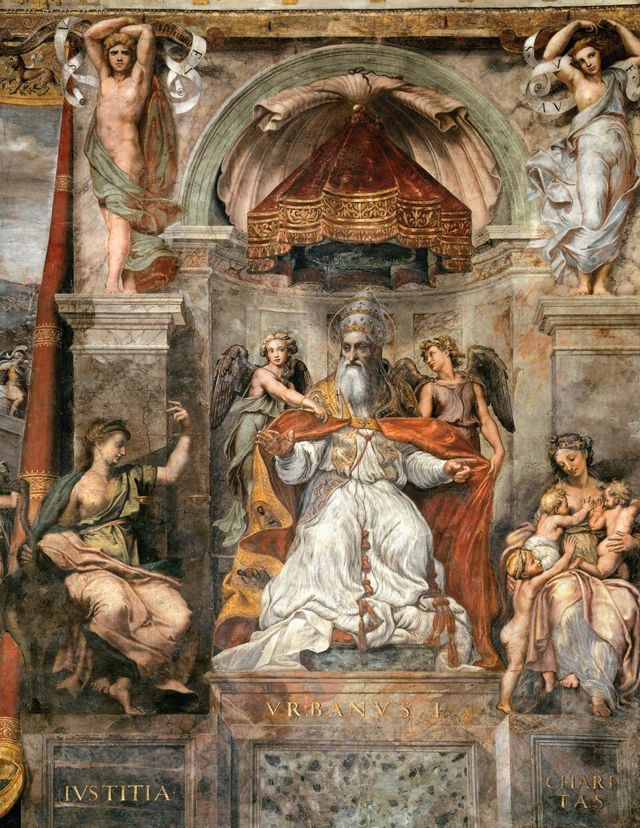
St. Urban I., Pope

St. Urban I.

May 25 · Martyr
M

Sts. Maximus and…

May 25 · Martyrs
I

Sts. Injuriosus and…

May 25 · Feast
← All 1726 saints in the library
Sources & notes

Feast-day sources

Story sources

Sources

Credits

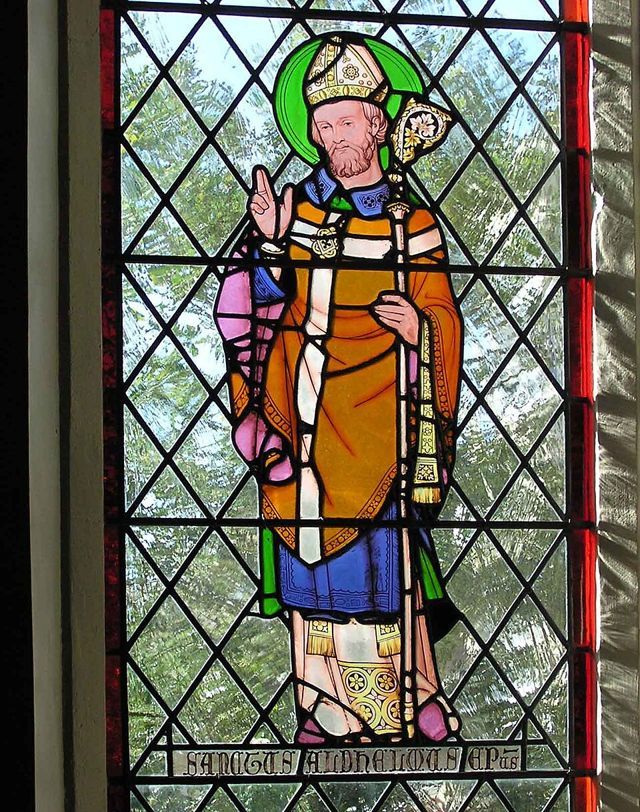
Image: Aldhelm.malmesbury.arp.jpg · Arpingstone · Public domain, via Wikimedia Commons

From Sabine Baring-Gould, The Lives of the Saints, new edition in 16 vols. (London: John C. Nimmo, 1897–98); text from the Internet Archive scan (OCR, lightly cleaned; errors possible). Public domain.

Image: Arpingstone, Wikimedia Commons (Public domain)

From “Catholic Encyclopedia (1913)/St. Aldhelm,” The Catholic Encyclopedia (New York: Robert Appleton Company, 1907–1914), via Wikisource. Public domain. Matched by name and feast date; text unedited except for our bracketed notes in grey.

From Sabine Baring-Gould, The Lives of the Saints, new edition in 16 vols. (London: John C. Nimmo, 1897–98); text from the Internet Archive scan (OCR, lightly cleaned; errors possible). Public domain in the United States. Reproduced unedited, except for short bracketed notes in grey that we added to explain names and terms (“S.” is the old abbreviation for Saint). Some history and judgments reflect 19th-century scholarship.