St. Alexander I., Pope

…were unhurt, the priests were executed with the sword, and Alexander was stabbed to death in all his limbs.

Read the essentials →
May 3 · —

St. Alexander I.

St. Alexander I., Pope

…were unhurt, the priests were executed with the sword, and Alexander was stabbed to death in all his limbs.

Traditional feast

May 3
1914 / pre-1969 calendar, per Baring-Gould (1897)

Current feast

Not verified yet

Represents

Feast

Their story

Adapted in modern English from the Catholic Encyclopedia (1913) · original text below

St Irenaeus (bishop of Lyon, d. c. 202, who listed the early popes), writing late in the second century, counts Alexander as the fifth bishop of Rome after the apostles, though he says nothing of a martyrdom. Ancient writers gave him a pontificate of about ten years. Modern scholars date it variously, around 106 to 116.

A tradition current in the Roman Church by the end of the fifth century, and recorded in the Liber Pontificalis (the early medieval 'Book of the Popes', not always reliable for the earliest ones), says he was a Roman by birth, ruled under Trajan (Roman emperor 98–117), and was martyred by beheading on the Via Nomentana on 3 May. The same source credits him with introducing the blessing of water mixed with salt for Christian homes. In 1855 the tomb of the martyrs Alexander, Eventulus and Theodulus was found at the spot named in the tradition. Some archaeologists hold that this Alexander was the pope, but Duchesne denies it, while granting that the two were already confused in ancient times. His so-called Acts are not genuine and were written much later. His relics are said to have been moved to Freising in Bavaria in 834.

Early life

The book says little or nothing about early life. This is how the account begins.

Thin entry · the 1897 book gives only 28 words. We have not filled the gap with invented detail.

…were unhurt, the priests were executed with the sword, and Alexander was stabbed to death in all his limbs. Relics in the church of S. Sabina, in Rome.

What they represent

How they teach us to live

Drawn from themes in the original account

Keep their day. Remember them on May 3 with a short prayer, and ask for their help.

From the Catholic Encyclopedia

1913 · 574 words

​Alexander I, Saint, Pope.—St. Irenæus of Lyons, writing in the latter quarter of the second century, reckons him as the fifth pope in succession from the Apostles, though he says nothing of his martyrdom. His pontificate is variously dated by critics, e. g. 106–115 (Duchesne) or 109–116 (Lightfoot). In Christian antiquity he was credited with a pontificate of about ten years (Eusebius [Eusebius of Caesarea (d. c. 339), the first historian of the Church], Hist. Eccl. IV, i,) and there is no reason to doubt that he was on the "catalogue of bishops" drawn up at Rome by Hegesippus (Eusebius, IV, xxii, 3) before the death of Pope Eleutherius (c. 189). According to a tradition extant in the Roman Church at the end of the fifth century, and recorded in the Liber Pontificalis he suffered a martyr's death by decapitation on the Via Nomentana in Rome, 3 May. The same tradition declares him to have been a Roman by birth and to have ruled the Church in the reign of Trajan [Roman emperor 98–117] (98–117). It likewise attributes to him, but scarcely with accuracy, the insertion in the canon of the Qui Pridie, or words commemorative of the institution of the Eucharist, such being certainly primitive and original in the Mass. He is also said to have introduced the use of blessing water mixed with salt for the purification of Christian homes from evil influences (constituit aquam sparsionis cum sale benedici in habitaculis hominum). Duchesne (Lib. Pont., I, 127) calls attention to the persistence of this early Roman custom by way of a blessing in the Gelasian Sacramentary that recalls very forcibly the actual Asperges prayer at the beginning of Mass. In 1855, a semi-subteranean cemetery of the holy martyrs Sts. Alexander, Eventulus, and Theodulus was discovered near Rome, at the spot where the above mentioned tradition declares the Pope to have been martyred. According to some archæologists, this Alexander is identical with the Pope, and this ancient and important tomb ​marks the actual site of the Pope's martyrdom. Duchesne, however (op. cit., I, xci–ii) denies the identity of the martyr and the pope, while admitting that the confusion of both personages is of ancient date, probably anterior to the beginning of the sixth century when the Liber Pontificalis was first compiled [Dufourcq, Gesta Martyrum Romains (Paris, 1900), 210–211]. The difficulties raised in recent times by Richard Lipsius (Chronologie der römischen Bischofe, Kiel, 1869) and Adolph Harnack (Die Zeit des Ignatius u. die Chronologie der antiochenischen Bischofe, 1878) concerning the earliest successors of St. Peter are ably discussed and answered by F. S. (Cardinal Francesco Segna) in his "De successione priorum Romanorum Pontificum" (Rome 1897); with moderation and learning by Bishop Lightfoot, in his "Apostolic Fathers: St. Clement" (London, 1890) I, 201–345; especially by Duchesne in the introduction to his edition of the "Liber Pontificalis" (Paris, 1886) I, i–xlviii and lxviii–lxxiii. The letters ascribed to Alexander I by Pseudo-Isidore may be seen in P. G., V, 1057 sq., and in Hinschius, "Decretales Pseudo-Isidorianæ" (Leipzig, 1863) 94–105. His remains are said to have been transferred to Freising in Bavaria in 834 (Dümmler, Poetæ Latini Aevi Carolini, Berlin, 1884, II, 120). His so-called "Acts" are not genuine, and were compiled at a much later date (Tillemont, Mém. II, 590 sqq; Dufourcq, op. cit., 210–211).

Liber Pontificalis (ed. Duchesne). I, xci–ii. 127, Hist. Ancienne de l'Eglise (Paris, 1906), 236–237; Acta SS., May 1, 375 sqq.; Atti del martirio di S. Alessandro, etc. (Rome, 1855); De Rossi, Bullettino di archeologia cristiana (Rome. 1865).
Read more

The full original · 28 words

Read Baring-Gould’s full account

Baring-Gould’s sources: Roman Martyrology. Bede, Hrabanus, Ado, Notker, Usuardus. Authority: — Mention in the Catalogue of Roman Pontiffs. The Acts of S. Alexander are fabulous.] |C CORDING to the Acts of S. Alexander, which are not deserving of much credence, the pope converted Hermes, prefect of Rome (Aug. 28th), and all his household, consisting of twelve hundred souls, by healing his infirm son. Aurelian, the governor, hearing of this, ordered S. Alexander to be cast into prison, where he was visited by the tribune, Quirinus (March 30th), who professed his readiness to believe, if Alexander, laden with three chains, could transfer himself to the cell where Hermes was confined. In the night an angel in the form of a little child bearing a torch brought Alexander forth laden with his chains, and conveyed him to the cell of Hermes. The conversion of S. Quirinus led to that of his daughters, S. Balbina (March 31st), and all the other prisoners. They received baptism from the hands of Evantius and Theodulus, priests imprisoned with S. Alexander. Finally the pope and the two priests were thrown into a fiery furnace; but as they vSkS. Timothy and Maura.

…were unhurt, the priests were executed with the sword, and Alexander was stabbed to death in all his limbs. Relics in the church of S. Sabina, in Rome.

Feast days

Feast: May 3

Nine days · Free

Pray the novena
with us.

One short email a day for nine days. The day's prayer, a line from St. Alexander I.'s story, and a nudge to keep going.

Also on May 3
T

Sts. Timothy and Maura

May 3 · Martyrs
← All 1726 saints in the library
Sources & notes

Feast-day sources

Story sources

Sources

Credits

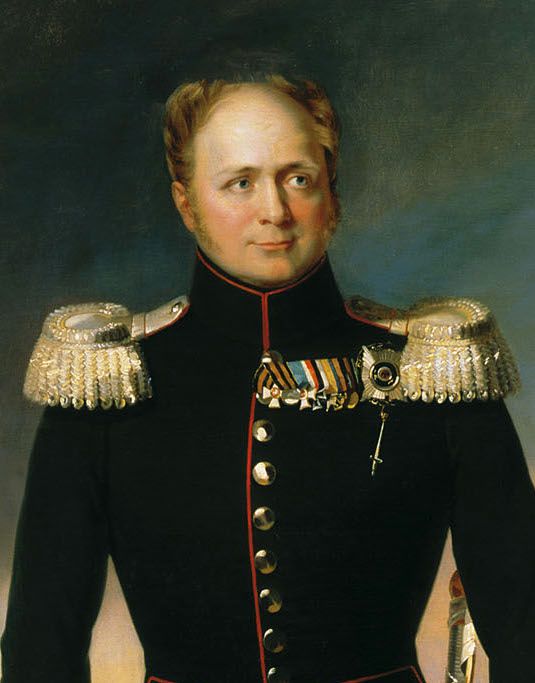
Image: Alexander I of Russia by G.Dawe (1826, Peterhof)-crop.jpg · George Dawe · Public domain, via Wikimedia Commons

From Sabine Baring-Gould, The Lives of the Saints, new edition in 16 vols. (London: John C. Nimmo, 1897–98); text from the Internet Archive scan (OCR, lightly cleaned; errors possible). Public domain.

Image: George Dawe, Wikimedia Commons (Public domain)

From “Catholic Encyclopedia (1913)/Pope St. Alexander I,” The Catholic Encyclopedia (New York: Robert Appleton Company, 1907–1914), via Wikisource. Public domain. Matched by name and feast date; text unedited except for our bracketed notes in grey.

From Sabine Baring-Gould, The Lives of the Saints, new edition in 16 vols. (London: John C. Nimmo, 1897–98); text from the Internet Archive scan (OCR, lightly cleaned; errors possible). Public domain in the United States. Reproduced unedited, except for short bracketed notes in grey that we added to explain names and terms (“S.” is the old abbreviation for Saint). Some history and judgments reflect 19th-century scholarship.