S
Sts. Speratus and…
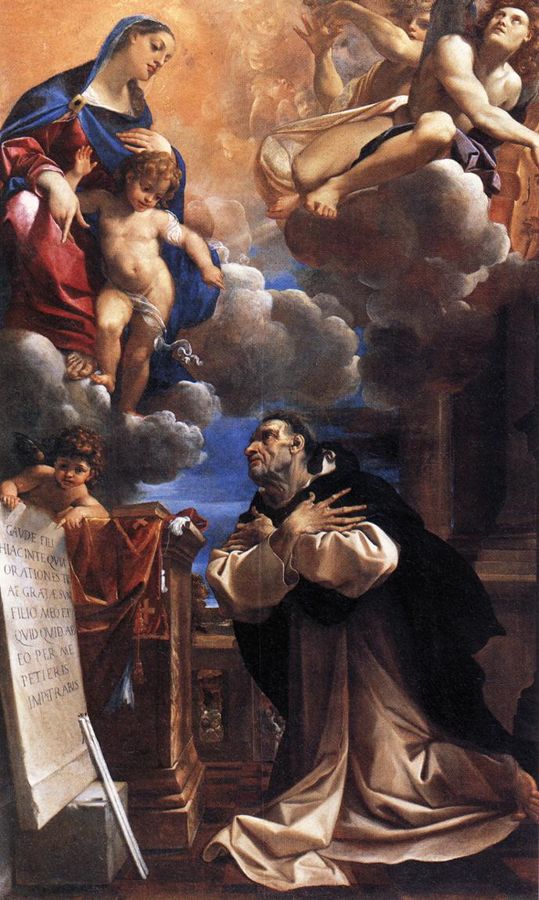
St. Hyacinth
Witnessing to Christ by the way of life, not by death.
July 17
Not verified yet
Confessor
The Menology of the Emperor Basil II. (d. 1025), relates: — “Alexis was a Roman, son of the patrician Euphemian, who provided him with a wife. But his virtue having made him manifest, he returned to Rome, to his parents’ house, and took up his abode in the vestibule, seeing his father and mother daily, and derided by the servants; whilst his parents and his chaste bride bewailed his absence. There disembarking, he went to his father’s house, and besought admission into it, crying, “ Sir, give me lodging and food, and God will bless your, old age, and have compassion on him whom you have lost.”
Learn from the kind of life it was. Witnessing to Christ by the way of life, not by death.
Keep their day. Remember them on July 17 with a short prayer, and ask for their help.
The next account of S. Alexis is, no doubt, the Greek life, which unfortunately the Bollandists [Jesuit scholars who since the 1600s have critically studied the lives of the saints] do not print, " Ecgraphum habemus, sed luce indignum censemus.,? The Menology of the Emperor Basil II. (d. 1025), relates: — “Alexis was a Roman, son of the patrician Euphemian, who provided him with a wife. July 17O S. A lexis.
But having dissolved his marriage at that time when he ought to have made the maiden his wife, having given her in token a ring, he left the house, and went to Edessa, where he spent eighteen years in the church. But his virtue having made him manifest, he returned to Rome, to his parents’ house, and took up his abode in the vestibule, seeing his father and mother daily, and derided by the servants; whilst his parents and his chaste bride bewailed his absence. But when death approached, he procured a bit of parchment, on which he wrote all that had befallen him; and when he was dead, it was found in his hand. Then the Emperor Honorius took and read it, in the audience of all; and the body of the saint was taken up, and buried in the church of S. Peter.”
A Syriaic life of S. Alexis — who is called in Syriac Mar-Risca— exists. 1 This is certainly a translation from the Greek original. The Latin Acts are also a translation, or free rendering of them into Latin. According to the original Acts, S. Alexis, finding that his virtues were blazed abroad, and that ' since a heavenly voice had proclaimed his sanctity, he could not maintain that privacy which was so dear to him, resolved to return to his native land, and sailing from Laodicaea ad Mare, he came to Tarsus, where he hoped to spend the end of his days in the church of S. Paul. But the ship was caught by a gale, and. swept to Rome. There disembarking, he went to his father’s house, and besought admission into it, crying, “ Sir, give me lodging and food, and God will bless your, old age, and have compassion on him whom you have lost.”
Moved by this appeal, the father allowed him to 1 So also an Arabic life, translated from the Syriac. VOL. VIII. Lives oj the Saints. [.Mr vlodge in the atrium of his house, and to be fed with the broken victuals from the kitchen. The servants used to mock him, and throw the dish-water over him. Thus he spent seventeen years in his father’s house, till he felt that he was dying; then he wrote down his life on a roll of parchment, and when he was dead this was discovered in his stiffened grasp.
The emperors Arcadius and Honorius, and the Pope Innocent buried him with great pomp. (Latin Acts.) The Latin version of the Aots soon became popular in the West. Till it was made, no one at Rome had heard anything about S. Alexis. And now the church of S. Boniface [English missionary to Germany, martyred 754] was called after him. This was in the 1 2th cent, 1 and in a.d. 1200, according to Gavantus, the festival of S. Alexis was introduced into the Roman Breviary. No notice of S. Alexis occurs in either the little Roman Martyrology of the 8 th cent., or in any Latin one previous to this date, and we may safely conclude that the Romans were ignorant that they had possessed such a Saint, till they were informed of the fact by the Greeks.
How this was, it is not difficult to discover. The notion that S. Alexis lived and died in Rome arises from a mistake. There can be little doubt, in the minds of any who are not committed to accept the statements of the Roman Martyrology, that he was a native of, and died at, New Rome, Constantinople, and not Old Rome. The names of his parents are Greek, and the father is a member of the Senate. According to S. Joseph the Hymnographer, it is the Patriarch who buries the Saint. Had he meant the Pope, he would probably have stated the fact. That the ship, bound ' The first mention of the church as that of SS. Boniface and Alexis is in a letter of S. Peter Damian to Pope Nicolas II., a.d. n?a. S. Alexis.
July i?.] for Tarsus, should have been blown to Rome, is absurd. It is more probable that it entered harbour at Byzantium; though nothing can be concluded from the statement one way or the other. But it is a coincidence deserving of notice that in the life of S. John the Calybite, when he was returning home from Gomon, his ship encountered a gale on its way “near to Rome.” In this case it was certainly Constantinople, as the genuine Acts tell us; but there exists another version of the Acts of S. John Calybite, in which the statement that the ship put into the port of Rome has led the writer into the absurd mistake of making the ship blown by the gale out of the Euxine over the Mediterranean to Old Rome. On the strength of which, some hagiographers, who had only the apocryphal acts, converted S. John the Calybite into a Roman Saint. S. Alexis was known and venerated in Constantinople, before the fame of him reached Rome. How could this have been if Alexis was a native of, and died at Rome ? And how, if his obsequies had been attended by the pope and the emperors, did the remembrance of him fade utterly out of the minds of the Romans ?
But when the Romans were fully satisfied that Alexis belonged to their city, and not to New Rome, his body was discovered in the church of S. Boniface, in 1216, during the pontificate of Honorius III. And the Latin Acts were then composed from the Greek original. 1 The points of difference shall be indicated as we proceed. Alexis, say the Acts, was born at Rome, where his father, Euphemian, was a senator. His mother’s name was Aglamades (Aglae in the Latin Acts); she was long 1 In several cases the words are the same. But the Latin Acts are shorter than the Arabic ones. The Greek word paramonarios is adopted into them. sterile, but at length her prayer and alms-deeds having gone up as a memorial before God, she was given a son. From earliest childhood, Alexis exhibited a pronounced repugnance to the theatre, childish sports, and jokes. No blandishments, no punishments could induce him to indulge in pastimes. When he reached a mature age, his father selected for him a young and beautiful bride; and they were crowned in the Church of S. Peter (S. Boniface, L.A.). On the night of the marriage, Alexis gave his bride his ring and cloak, and then fled away, took ship, and went to Edessa, “ where the sacred portrait of the Lord Jesus Christ is preserved.” He there made acquaintance with the bishop, Rabulas (not named in L.A.), 1 and lodged continually in the vestibule of the church of the Virgin Mother of God.. One night a voice resounded in the church announcing that a model of virtue resided in the porch. Next day this was heard by all the people, and S. Alexis could no longer remain unobserved, for every one sought to know the man thus indicted as a saint by a voice from heaven. Some while after this, according to the Syriac version of the story, he sickened, and was carried to the hospital, where he died, and was buried in Edessa by the hands of Rabulas, the bishop.
But the Latin life here varies greatly from the Syriac version. The latter was no doubt altered from the original, that Alexis might be made to die at Ed t essa, that the church there might claim the honour of possessing his tomb. But it is evident that the original Greek Acts did not relate this, for Basil II. followed them, as did also the Latin translator. His body having been so happily found at Rome, it was not long before the stone step under which Alexis 1 Rabulas of Edessa died a.d. 435.
S. Alexis. had spent so many years in his fathers house, was found also. 1 This step is now in the church of Alexis, and those who venerate it on ordinary days receive indulgence of a hundred years, and forty times as many on every double festival and in Lent [the forty days of fasting before Easter].
In the same church is preserved the picture of the Blessed Virgin, which proclaimed the merits of S. Alexis, at Edessa. 2 In the church of S. Paolo fuori Muri is an arm of the saint, in that of S. Nicolas “ in Carcere ” is another arm; a third arm in the church of S. Catherine at Venice, but this was brought from the isle of Lemnos, in the Egean. A rib in the church of S. Praxedes at Rome, other relics [the bodily remains of a saint, or objects they used, kept with honor], i.e n a tooth and a bone, in the church of S. Cecilia; another tooth and a part of the jaw in the Jesuit church of S. Ignatius; a third tooth in the church of S. Alexis at Bologna; a bone at S. Maria Maggiore at Bergamo; another arm-bone at Ciudad Real in Spain; several bones at Cologne, a finger and part of the head in the Jesuit church there; a joint of the back-bone at Lisbon, also a bit of one of the ribs. Other bones and teeth at Louvain, Maestricht, and S. Tron.
The office of S. Alexis was made a semi-double by order of the Sacred Congregation of Rites in 1697. There is a metrical life of S. Alexis, attributed to - 1 The Acta say nothing about his having lived under a step, but popular imagination speedily amplified the story and gave the saint a den in which to sleep under the stairs of his father’s mansion. 2 The Latin Acts do not say that the voice proceeded from the sacred image of the B. Virgin in the church at Edessa. The Syriac Acts only say that the voice was heard in the church at night. The sacred picture at Edessa was the portrait of Christ, not of the B. Virgin. Had this incident heen recorded in the original Greek Acts, it would have been quoted in the 2nd Council of Nicsea in 787, which it was not \ therefore either the Acts did r.otthen exist, or the incident was not then includecl in them.
Marbod, bishop of Rennes (a.d. 1223), and the story has found its way into that popular book of the Middle Ages, the “Gesta Romanorum.”
Feast: July 17
One short email a day for nine days. The day's prayer, a line from St. Alexis's story, and a nudge to keep going.
From Sabine Baring-Gould, The Lives of the Saints, new edition in 16 vols. (London: John C. Nimmo, 1897–98); text from the Internet Archive scan (OCR, lightly cleaned; errors possible). Public domain.
From Sabine Baring-Gould, The Lives of the Saints, new edition in 16 vols. (London: John C. Nimmo, 1897–98); text from the Internet Archive scan (OCR, lightly cleaned; errors possible). Public domain in the United States. Reproduced unedited, except for short bracketed notes in grey that we added to explain names and terms (“S.” is the old abbreviation for Saint). Some history and judgments reflect 19th-century scholarship.