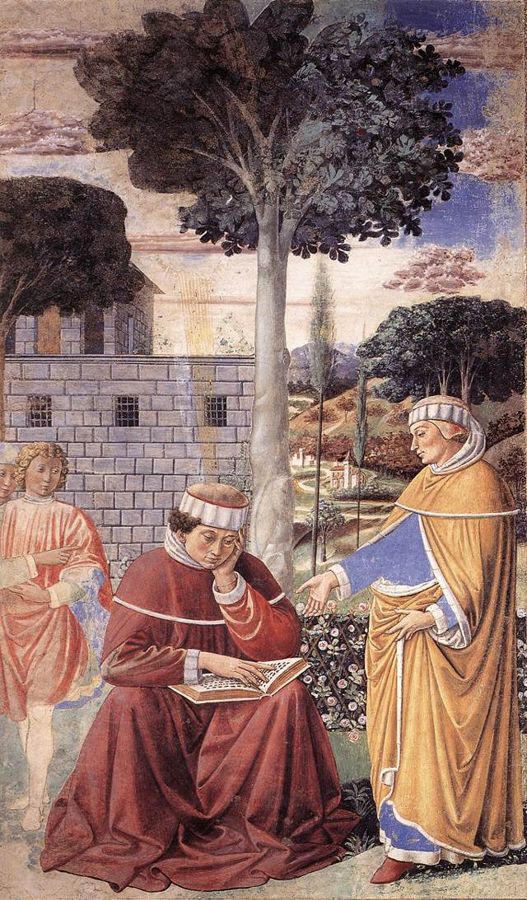
Baring-Gould’s sources: Not in any ancient Martyrologies, Greek or Latin. Inserted in the Roman Martyrology in 1584. Authorities: — A letter to S. Alypius by S. Paulinas of Nola; three epistles of S. Augustine; mention in the Confessions of S. Augustine.] ■ Alypius was a native of Tagaste in Numidia, the city of which S. Augustine was also a native. He was born about a.d. 354, and was rather younger than Augustine. He studied grammar at Tagaste with Augustine, and the two young men became warmly attached to one another. When Augustine moved to Carthage and opened his school for rhetoric, Alypius followed him. In the capital the games of the circus interested,, excited, engrossed Alypius, to the vexation of his friend and instructor. A difference arose between the father of Alypius and Augustine, which led to the interruption of the attendance of the former in the school. Their intimacy continued, though a coolness had begun to dash it, when a circumstance occurred which restored it to its former warmth. Alypius one day sauntered into the school, and sat down to listen to the declamation of his friend, who, just then had taken the games of the circus as his topic for vehement condemnation. Augustine was not at the moment FROM THE OFFICE OF THE ASSUMPTION OF THE B.V.M. la the Vienna Missal August is-] ■S'. Alypius.
…thinking of Alypius, but the latter took the words to heart, and resolved to shake off the powerful attraction exerted on him by the circus. He appealed to his father, and he was again allowed to attend the lectures of Augustine. Both young men were at this time attracted by the stem virtue of the Manichasans to embrace their doctrine, so clear, cutting the knot of difficulties which beset the order of the world. Spirit on one side, matter on the other; here those who live to the spirit, there those who yield themselves servants to the world. The contest is ever going on, the camps are ever in deadly hostility; the world, life, is the battlefield on which the warfare is incessantly waged. Augustine never wholly broke free from Manichseism, which tinged his teaching in afterlife. From Carthage Alypius betook himself to Rome to learn law, strong in his resolution to keep stern guard over his passions, to live to reason, intelligence, spirit; and not to become the prey of passion and the delights of the flesh. There came a great show day in the amphitheatre, a fight of men with wild beasts, of gladiators with gladiators. All Rome was crowding to the sight. His comrades drew him with them. “You may draw my body,” said he, “but my soul cannot be stirred. I will keep my eyes shut.” He took, or was forced to, a seat. He saw the great ring full of heated, excited faces, the yellow sandy arena, on which a few listless attendants stood awaiting the signal. Alypius closed his eyes. The games began; men were fighting each other. The blood began to spout; the contest waxed hot. A quiver ran through the thousands present, a hush, a gasp; then one of the gladiators hewed a great gash in his opponent, who staggered back. The whole concourse burst into a fierce roar. Alypius opened his eyes. At once the enthusiasm, the mad ferocious passion for blood woke within him, his heart bounded or stood still, he waved his hand, his VOL. IX. io cheeks burnt, his eyes glared, his voice roared with the mob.
Who of us can tell what was the mad delight of an old gladiatorial combat? Only those who have witnessed a Spanish bull-fight, and they only coldly; for what is the slaughter of a bull or two, to the butchery of men with living souls and nerves strung as keen as ours, with weeping widows and wailing orphans in prospect ? The late Maximilian of Mexico, than whom a gentler, purer, more amiable spirit has scarcely existed in this age, confesses in his “Recollections,’’ the sympathetic delight he felt in a bull-fight. “ How the feelings of a man can be changed in so short a space as a quarter of an hour ! On entering I felt uneasy and uncomfortable, and now a mania for the bloody spectacle possessed me. I could not turn my eyes away; each moment of the fight enchained me with irresistible force. The excitement produced by the sight of danger carries every mind away along the stream of enthusiasm. I was told of a stranger who expressed himself strongly as to the barbarism of this festival, his tender feeling made him abhor what he had not seen, and that a friend who knew from experience the charm of this national pleasure, induced him, though filled with abhorrence, to visit the Corrida. At the sight of the noble combat he was also seized by the sweet, wild intoxication, and eagerly asked his friend when the next bull-fight would take place. I only regretted that my sojourn in Spain was not long enough for me to enjoy this splendid sight, again.” Alypius was overmastered. On every opportunity he was again in the Colosseum; and he resumed his visits to the circus, his passion for horse and chariot races having revived, beside this new rage for gladiatorial fights. But withal he lived well, was chaste and temperate, upright and truthful, was generally respected, and became assessor of justice THE VIRGIN CROWNED BY THE FATHER ETERNAL. At the foots. JOHN. S.' AUGUSTINE, S. JEROME and S. ELOI. T, i n n-1. 11. A Posnv.Arh THorPTI n&.
•S'. Alyprns. in the court of the treasurer of Italy. In this charge he showed the strictest integrity. A powerful senator, whose favour was courted by many, and whose resentment was dreaded by all, had made an unjust usurpation, and when the case was brought before the tribunal, heavy bribes were offered. The judge wavered. But Alypius indignantly rejected the money, and disregarding the threats of the senator, he threatened that if the judge did not give sentence according to justice he would leave the bench. When S. Augustine came to Rome, Alypius clave to him with all the warmth of old friendship, and in 384 accompanied him to Milan. There the two friends were joined by Nebridius, another African acquaintance. They lived happily together, and were now subject to the influence of S. Ambrose [bishop of Milan (d. 397)]. The conversion of Augustine was followed by that of Alypius, and they were baptized together on Easter Eve by the great Ambrose, at Milan, in 387. Some time after, they returned to Rome, and having spent a year there in retirement, went back to Africa. They lived together at Tagaste, in a small community of devout souls, and in the practice of prayer, fasting, and study. Thus they spent three years, when S. Augustine was ordained priest at Hippo. The community removed there to be with him. Alypius shortly after paid a visit to Palestine, and saw and made the acquaintance of S. Jerome [translator of the Bible into Latin (d. 420)]. Upon his return to Africa he was consecrated Bishop of Tagaste, about a.d. 393. He assisted S. Augustine with all his might in his labours and difficulties. S. Augustine speaks of him in a letter written in 429, as old. He probably did not live long after.