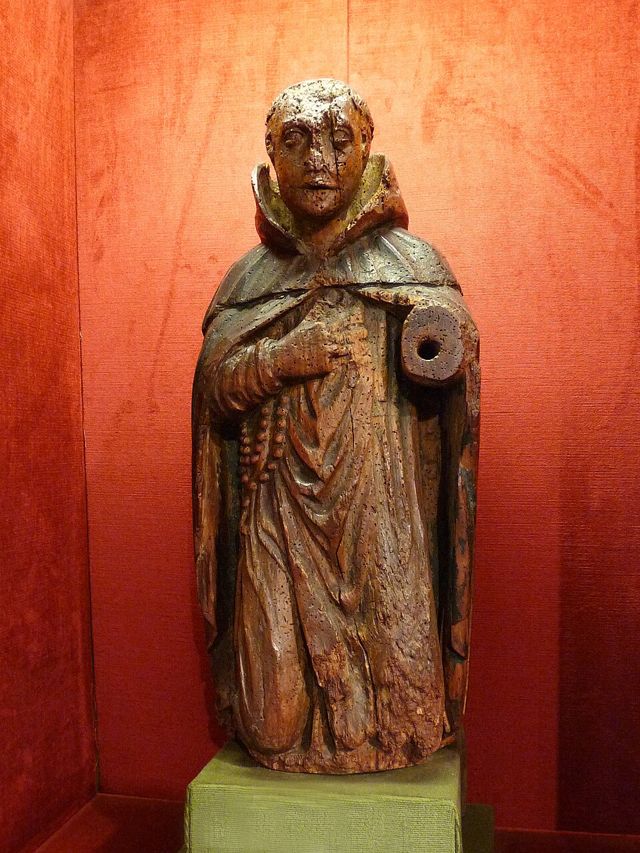
Baring-Gould’s sources: Ado, Usuardus, Notker, Modem Roman Martyrology, Gallican Martyrologies. Authority:~The Life of S. Amatus by a contemporary, and Uie lives of S. Eustasius and of S. Romaric.] Amatus, the son of a nobleman of Roman family resident at Grenoble, was sent by his father when a child to the monastery of Agaunum built under a precipitous wall of rock in the Valais beside the Rhone, where lay the bones of S. Maurice and his faithful companions. He lived thirty years either in the abbey, or in an isolated cell in the face of the cliff which overhangs the monastery, and where now stands a little chapel, clinging to the surface of the precipice, like the clay nest of a swallow to the eaves of a house. A little ledge of rock served Amatus for garden. There he grew a scanty crop of barley, and a tiny trickling spring which issued from the living rock served him for drink. There this noble Gallo-Roman lived, always barefooted and clad in a sheep-skin, with the glorious panorama of the Alps before him. The fountain, miraculously formed with his staff, says the biographer, was received in a little basin which he had hollowed out and covered with lead. The barley that he grew on his rocky ledge he ground by turning a millstone with his arms, like the slaves of antiquity. This fatiguing labour was to him a preservative against sleep and the temptations of the flesh. S. Eustace, the Abbot of Luxeuil, returning from Lombardy after a visit to S. Columbanus, stopped at Agaunum, and decided Amatus upon following him to Luxeuil The gentleness of the anchorite, his eloquence, and even the noble and serene beauty of his features won all hearts.
Amatus was nominated by the monks of Luxeuil, on account of his eloquence, to bear the word of God into the Austrasian cities. Romaric, a wealthy lord, who occupied a castle on a rock whose base is bathed by the clear waters of the Moselle near its source, some leagues from Luxeuil, received him at his table, and, during the repast, inquired of him the best way of working out his salvation. “Thou sees! this silver dish,5' said the monk; “ how many masters, or rather slaves, has it already had, and how many more shall it have still ? And thou, whether thou wilt or not, thou art its serf; for thou possessest it only to preserve it. But an account will be demanded of thee; for it is written 1 your silver and gold shall rust, and that rust shall be a witness against you.’ I am astonished that a man of great birth, very rich, and intelligent like thyself, should not remember the answer of our Saviour to him who asked him how he should attain eternal life: 1 If thou wilt be perfect, go, sell all thou hast, and give to the poor, and follow me; and thou shalt have treasure in Heaven/ ”
From that moment Romaric was vanquished by the love of God, and the desire of Heaven. He distributed all his lands to the poor, with the exception of his Castle of Habend, freed a multitude of serfs of both sexes, and went to Luxeuil, taking with him all that remained of his wealth, to become a monk. After some years' residence there, during which time his friendship for Amatus became intimate and affectionate, the two friends left Luxeuil, where, for some unknown reason, they had incurred the displeasure of the Abbot Eustace. With his consent, however, they went together to the estate which Romaric had reserved to himself.
The Castle of Habend had once been a Roman fortress; the remains of a temple, statues, and some tombs were still visible, as at Luxeuil, upon the height of a steep hill, situate between two valleys, the base of which was watered by two tributaries of the Moselle. They built a church there, placed as many as seven chapels upon the sides of the hill, and afterwards founded there the greatest female monastery which had been seen in Gaul [roughly modern France and Belgium]. Amatus to Jt the government of it, but soon devolved it upon Romaric, and the house was called, after the latter, Remiremont.
Amatus formed a cell for himself below among the rocks, and received his food let down to him by a rope, every day; but on Sundays and festivals he issued from his retreat to minister in divine things to the nuns. He also apparently busied himself with all sorts of little matters connected with their well-being, making the hives for the bees, and the like, and when a pert nun thought she knew better than he which hive was most suitable for a new swarm, the bees refused to enter it, because it was not the one selected for them by the man of God.
He died in the midst of his monks and nuns, chanting alternately in psalmody around him. S. Amatus is called in French S. A me, or A met