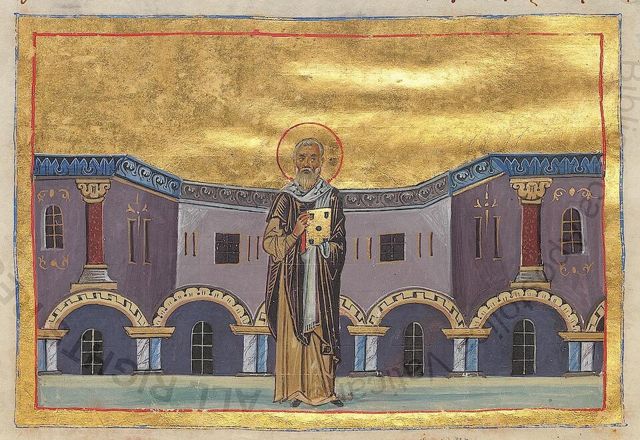
St. Amphilochius

Amphilochius came from a distinguished Cappadocian family and was probably a cousin of St. Gregory Nazianzen.

Read the essentials →
November 23 · Bishop

St. Amphilochius

St. Amphilochius

Amphilochius came from a distinguished Cappadocian family and was probably a cousin of St. Gregory Nazianzen.

Traditional feast

November 23
1914 / pre-1969 calendar, per Baring-Gould (1897)

Current feast

November 23 (also listed: November 22)
Secondary source · Wikipedia

Represents

Bishop

Their story

Adapted in modern English from the Catholic Encyclopedia (1913) · original text below · little is known

Amphilochius came from a distinguished Cappadocian family and was probably a cousin of St. Gregory Nazianzen. He practised law at Constantinople, then withdrew to a religious life near Gregory and under St. Basil's influence. In 374 he became Bishop of Iconium.

Basil dedicated his book 'On the Holy Spirit' to him, and Amphilochius defended the Spirit's divinity against the Macedonians. When Emperor Theodosius rebuked him for ignoring his son, he replied that God likewise abhors those who are ungrateful towards His Son. St. Jerome ranked him with Basil and Gregory.

Early life

Selected sentences from the original account, unaltered.

Thin entry · the 1897 book gives only 212 words. We have not filled the gap with invented detail.

S. Amphilochius having come to the palace with other bishops to pay their respects to the emperor, disregarded Arcadius, who was seated near his father.

What they represent

How they teach us to live

Drawn from themes in the original account

Keep their day. Remember them on November 23 with a short prayer, and ask for their help.

From the Catholic Encyclopedia

1913 · 522 words

​Amphilochius of Iconium, a Christian bishop of the fourth century, son of a Cappadocian family of distinction, b. perhaps at Cæsarea, c. 339 or 340; d. probably some time between 394 and 403. His father was an eminent lawyer, and his mother Livia remarkable for gentleness and wisdom. He was probably first cousin to Gregory of Nazianzus, and was brought up in the peculiarly religious atmosphere of the Christian aristocracy of his native province. He studied for the bar, practised at Constantinople, but soon retired to lead a religious life in the vicinity of his friend and relative, the "theologian" of Nazianzus. He was soon drawn within the circle of St. Basil's influence, and seems to have been for a while a member of the Christian "City of the Poor" that Basil had built at Cæsarea. Early in 374 he was bishop of the important see of Iconium [a bishop’s “see” is his diocese, named from his seat (Latin sedes)], probably placed there by Basil, whom he continued to aid in Cappadocian ecclesiastical affairs until Basil's death (379). Thenceforth he remained in close relations with Gregory of Nazianzus, and accompanied him to the Synod of Constantinople (381), where St. Jerome met and conversed with him (De Vir. Ill., c. 133). In the history of theology he occupies a place of prominence for his defence of the divinity of the Holy Spirit against the Macedonians (q.v.). It was to him that St. Basil dedicated his work "On the Holy Spirit". He wrote a similar work, now lost. We know, however, that he read it to St. Jerome on the occasion of their meeting at Constantinople. His attitude towards Arianism [followers of Arius, who taught that the Son is a created being, not fully God] is illustrated by the well-known anecdote concerning his audience with Theodosius [name of Roman emperors; Theodosius I (379–395) made Christianity the state religion] and his son Arcadius. When the Emperor rebuked him for ignoring the presence of his son, he reminded him that the Lord of the universe abhorreth those who are ungrateful towards His Son, their Saviour and Benefactor. He was very energetic against the Messalians (q. v.), and contributed to the extirpation of that heresy. His contemporaries rated him very high as a theologian and a scholarly writer. Not to speak of his admirers and friends already mentioned, St. Jerome says (Ep. 70) of the Cappadocian triad (Basil, Gregory, and Amphilochius) that "they cram their books with the lessons and sentences of the philosophers to such an extent that you cannot tell which you ought to admire most in them, their secular erudition or their scriptural knowledge". In the next generation Theodoret described him in very flattering terms (Hist. Eccl., IV, x; V, xvi), and he is quoted by councils as late as 787. His only genuine extant work is, according to Bardenhewer (Patrologie, p. 249), the "Epistola Synodica", a letter against the Macedonian heresy in the name of the bishops of Lycaonia, and probably addressed to the bishops of Lycia (Goldhorn, S. Basil., Opp. Sel. Dogm., 630–635). The spurious "Iambics to Seleucus" offer an early and important catalogue of the canonical writings; other spurious fragments, current under his name, are taken from scriptural discourses, dogmatic letters and controversial writings (P.G., XXXIX, 13–130).

Fessler-Jungmann, Instit. Patrolog., I, 600–604; Lightfoot in Dict. of Christ. Biogr., I, 103–107.
Read more

The full original · 212 words

Read Baring-Gould’s full account

Baring-Gould’s sources: Roman Martyrology, from Greek Mensea and Menologies. But the Menology of Basil on Oct. 19, and the 10th cent. Gallipolitan Synaxarium, and the Greek Synaxaria in the Florentine Library, on Dec. 10. Authorities: — His own letters and those of S. Basil; Sozomen, Theodoret, Socrates, &c.] On the death of Faustinus, bishop of Iconium, in 374, Amphilochius, a friend of S. Basil, and most probably first cousin of S. Gregory Nazianzen, was elected to fill the vacant see. He was a native of Cappadocia, of noble family, and much younger than his two illustrious friends. He had studied elocution, and had exercised his talents as a lawyer, acquiring fame for his eloquence and for his integrity. After awhile he retired into a solitude in Cappadocia. He was elected and consecrated bishop against his will, and to the extreme annoyance of his father, who had other prospects for him. S. Basil wrote to Amphilochius on his ordination, to encourage and console him, to advise him, and express his desire to confer by word of mouth with him. Being himself too aged to visit him, he begged Amphilochius to seek him at Caesarea. Amphilochius did so, and preached there. At the request of his guest, S. Basil wrote his work on the Holy Spirit. The occasion of this was that Basil had in public exclaimed, “ Glory to the Father, with the Son, and with the Holy Ghost/' and at another time, “ Glory to the Father by the Son, in the Holy Ghost.” Some were scandalized, thinking this latter exclamation unsound. S. Basil wrote to Amphilochius three canonical epistles on penitential discipline. On the death of S. Basil, Amphilochius pronounced his funeral panegyric. He attended the council of Constantinople in 381. Amphilochius was desirous of obtaining a law restraining the Arians and other heretics, and forbidding them the right to assemble for worship. Theodosius, the emperor, had the good sense at first to refuse to commit such an act of intolerance and injustice. Amphilochius gained his end by a curious expedient.

Theodosius [name of Roman emperors; Theodosius I (379–395) made Christianity the state religion] had declared Arcadius his son Augustus, in the January of 383. Arcadius was then only six years old. S. Amphilochius having come to the palace with other bishops to pay their respects to the emperor, disregarded Arcadius, who was seated near his father. Theodosius thought the bishop acted by inadvertence, and reminded him of his neglect. Then the bishop of Iconium stroked the cheek of the little Augustus with his finger, and said, “Good day, my child.” The emperor, highly incensed, ordered the old man to be driven from his presence. As he reached the door, Amphilochius turned and cried, “Thou, sire, canst not endure that thy son should not receive the honour due to him; how, then, can God the Father bear that His Son should be disregarded ? ” Theodosius was struck with the words of the prelate, and passed in September, 383, the law forbidding the heretics to worship God in public or in private.

In the same year Amphilochius held a council at Sida against the Messalians; he attended the council of Constantinople in 394, and died apparently shortly after. He left several writings which were greatly esteemed, but only scanty portions of them have remained.

Brought before the Roman Frefect. S. C^ECILIA. Staffers Martyrdom. >S'. Trudo.

Feast days

Feast: November 23

Nine days · Free

Pray the novena
with us.

One short email a day for nine days. The day's prayer, a line from St. Amphilochius's story, and a nudge to keep going.

Also on November 23
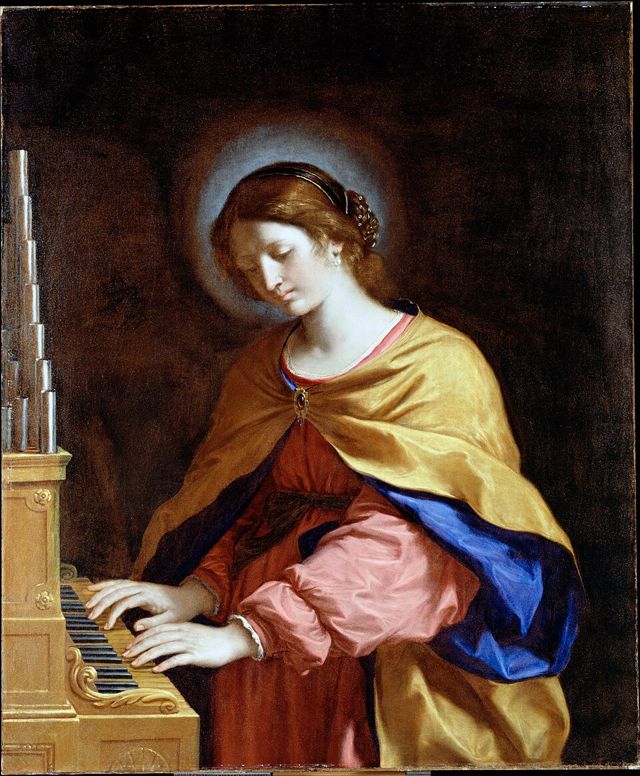
St. Cecilia

St. Cecilia

November 23 · Virgin, Martyr
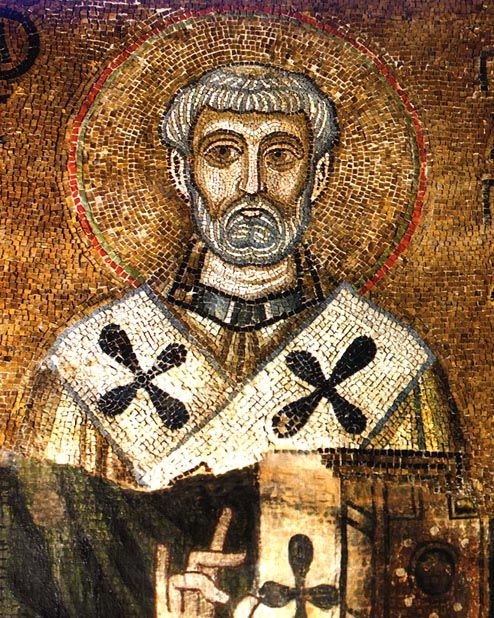
St. Clement

St. Clement

November 23 · Bishop, Martyr
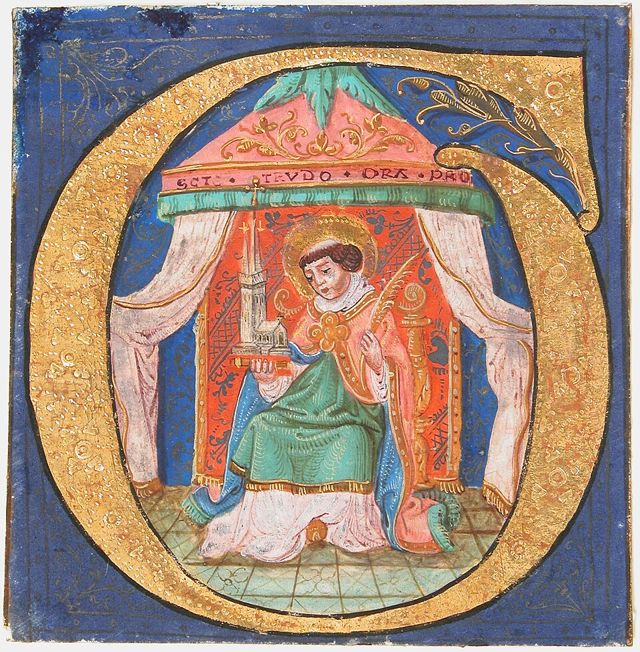
St. Trudo

St. Trudo

November 23 · Priest, Confessor
← All 1726 saints in the library
Sources & notes

Feast-day sources

Story sources

Sources

Credits

Image: Amphilochius of Iconium (Menologion of Basil II).jpg · Authors of Menologion of Basil II (circa 985 AC, Constantinople), Byzantine manuscript illuminators[1]: Pantoleon with G · Public domain, via Wikimedia Commons

From Sabine Baring-Gould, The Lives of the Saints, new edition in 16 vols. (London: John C. Nimmo, 1897–98); text from the Internet Archive scan (OCR, lightly cleaned; errors possible). Public domain.

Image: Authors of Menologion of Basil II (circa 985 AC, Constantinople), Byzantine manuscript illuminators[1]: Pantoleon with G, Wikimedia Commons (Public domain)

From “Catholic Encyclopedia (1913)/Amphilochius of Iconium,” The Catholic Encyclopedia (New York: Robert Appleton Company, 1907–1914), via Wikisource. Public domain. Matched by name and feast date; text unedited except for our bracketed notes in grey.

From Sabine Baring-Gould, The Lives of the Saints, new edition in 16 vols. (London: John C. Nimmo, 1897–98); text from the Internet Archive scan (OCR, lightly cleaned; errors possible). Public domain in the United States. Reproduced unedited, except for short bracketed notes in grey that we added to explain names and terms (“S.” is the old abbreviation for Saint). Some history and judgments reflect 19th-century scholarship.