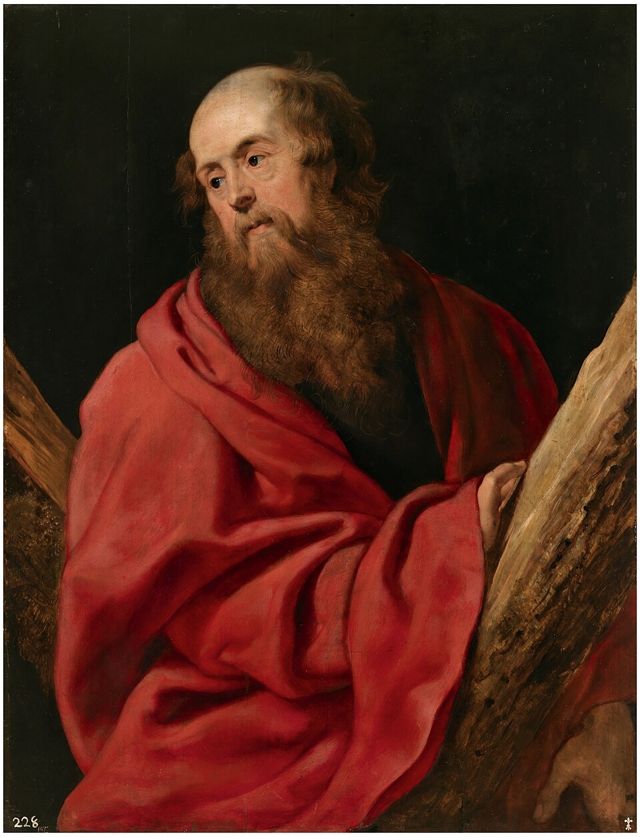
Baring-Gould’s sources: Roman and all Western Martyrologies, also all Greek, Russian, Koptic, Syriac Kalendars, Menseas, and Menologies. In 337 Constantine brought the relics of the Apostle Andrew to Constantinople. In some Martyrologies on May 9 is the commemoration of this translation; in others on this day, “At Milan the commemoration of S. Andrew in the basilica at the Roman Gate.” In the Martyrology wrongly called that of S. Jerome, this translation on Sept. 3, and on Nov. 3, “ The dedication of the basilica of S. Andrew,” whilst on Nov. 30 is the “ Dies natalis.” S. Andrew’s Day (Nov. 30) in the Gothic Missal, in the list of festivals of the Council of Rheims, 625, in that of Charlemagne, and that of S. Boniface. In the Sacramentary of Leo I., the pontifical of Egbert of York, the Sacramentary of S. Gregory. In the Ordo Gelasianus, and in the ancient Missale Gellonense this festival has an octave (Martene, De Antiq. Eccl. Discip. c. 30).]. ANDREW was one among the first called of the apostles of our Lord.1 He was the brother, probably the younger brother, of S. Peter, and of Bethsaida; and therefore the son of Jonas the fisherman. He became a disciple of S. John the Baptist. On hearing Jesus a second time designated by him as the Lamb of God, he left his former master, and in company with another disciple of John, attached himself to Christ By his means his brother Simon Peter was brought to Jesus. In the catalogue of the apostles, Andrew appears in Matthew x. 2 and Luke vi. 14, second, next after his brother Peter; but in Mark iii. 16 and Acts i. 13, fourth, next after the three — Peter, James, and John — and in company with Philip. And this appears to have been his real place of dignity among the apostles, for in Mark xiii. 3, we find SS. Peter, James, John, and Andrew inquiring privately of our Lord about His coming; and in John xii. 22, when certain Greeks wished for an interview with Christ, they applied to S. Andrew, who consulted Philip, and in company with him made the request known to our Lord. The last circumstance, combined with the Greek character of their names, may point to some shade of Hellenistic connection on the part of the two apostles.
On the occasion of the five thousand in the wilderness wanting food, it was Andrew who pointed out the little lad with the five barley loaves and the two small fishes. In the scanty notices we have of Andrew, we see him represented as bringing others into notice — his brother Peter, the Greeks, this lad — and this indicates a kindly nature. There are various traditions about him. The earliest represents him as apostle to the Scythians.1 According to a later account of no authority,2 he travelled in Cappadocia [a region of central Turkey], Galatia, and Bithynia, and the foundation of the Church at Byzantium was attributed to him on his return from his mission to the Scythians. Thence he travelled through Thrace, Macedonia, and Thessaly. Gregory Nazianzen (Orat. 26) says that Andrew preached in Epirus.
Pseudo Dorotheus says that he travelled in Bithynia, Pontus [a region on the Black Sea coast of Turkey], Thrace, and Scythia, that then he went to Sebastopol, and to the castle of Apsarus near the river Phasis, and that S. ANDREW, APOSTLE AND MARTYR.
After Wilhelm Kandler. he was crucified and buried at Patras of Achaia. S. Jerome [translator of the Bible into Latin (d. 420)] says (Ep. 148) that he preached in Achaia. Pseudo Abdias gives a long account of his apostolic journeys, preaching, and death. It is generally supposed that he died on a cross shaped like an X- The Syriac history of S. Andrew published by Dr. Wright, makes him carried whilst asleep by angels to the kingdom of the cannibals. The king had so many prisoners killed for his table every day. By the help of Andrew the prisons were opened and the captives took occasion to run away. Whereupon the king ordered the seven keepers to be killed and cooked for his victuals, “ and straightway collect us all the old men of the city, and let them cast lots among themselves, and those on whom the lot falls we will go on killing every day, seven by seven, for our food, whilst the young men go on board ships, and go to the countries round and procure us men for our victuals.” One of the old men on whom the lot fell, offered his little son and daughter in place of himself. These, as tenderer morsels, were of course accepted, and the old man discharged. S. Andrew, however, saved these children, and preached to the people against their cannibalism. When they would not hearken, he made a statue they worshipped spout water from its mouth over the city and submerge it so that the cattle and children were all drowned. It is satisfactory to know that Andrew also made the earth open and swallow up the old man who had in such a dastardly manner devoted his children to death to save his own life. The Syriac acts do not give an account of the death of S. Andrew. The story by Abdias is not quite so foolish. It may be briefly condensed as follows, omitting the most grotesque and impossible incidents.
^Egeas, proconsul of Achaia, came in his circuit to Patras, where, observing that multitudes had abandoned paganism, and had embraced Christianity, he endeavoured by all arts vol. xiv. 15 both of favour and cruelty, to recover the people to their former idolatries; but so far was he from succeeding in this, that his wife Maximilla, and his brother Stratocles, having been cured by S. Andrew of dangerous diseases, embraced the faith which he preached. He therefore called the apostle before him, and derided him as an innovator in religion, a propagator of that superstition whose Author the Jews had infamously put to death on a cross. Upon this S. Andrew took occasion to rehearse the infinite love and kindness of our Lord, who came into the world to purchase the salvation of mankind, and for that end did not disdain to die upon the tree. Whereupon the proconsul replied that S. Andrew might persuade those who would believe him; but, for his part, unless he was obeyed by the apostle’s doing sacrifice to the deities of the empire, he would cause him to suffer upon that cross which he had so much extolled and magnified. S. Andrew replied that he did sacrifice every day to God, the only true and omnipotent Being — not with incense and bloody offerings, but in the sacrifice of the Immaculate Lamb of God. Upon this the apostle was remanded to prison, at which the people were so enraged that they would have broken out into a mutiny had not he restrained them, persuading them to imitate the mildness and patience of our meek and humble Saviour, and not to hinder him from receiving the crown of martyrdom that now awaited him. The next day he was again brought before the proconsul, who urged him not to destroy himself foolishly, but live and enjoy with him the pleasures of this life. The apostle told^Egeas he should share with him eternal joys, if, renouncing his execrable idolatries, ^Egeas would heartily entertain Christianity, which Andrew had hitherto so successfully preached among his people. Upon this the proconsul could hold out no longer, but passed sentence of death upon him. He was first scourged, seven lictors successively S. Andrezv.
whipping his naked body; and then the proconsul, beholding the apostle’s invincible patience and constancy, commanded him to be crucified, but not to be fastened to the cross with nails, but with cords, that so his death might be more lingering and tedious. As he was being led to execution with a cheerful and composed mind, the people cried out that he was an innocent and good man, and unjustly condemned to die.
On coming within sight of the cross he saluted it, exclaiming, “ Hail, precious Cross, that hast been consecrated by the body of my Lord, and adorned with His limbs as with rich jewels. I come to thee exulting and glad; receive me with joy into thy arms. O, good Cross, that hast received beauty from our Lord’s limbs: I have ardently loved thee. Long have I desired and sought thee; now thou art found by me, and art made ready for my longing soul: receive me into thine arms, take me from among men, and present me to my Master; that He who redeemed me on thee, may receive me by thee.” Having prayed, and exhorted the people to constancy and perseverance in that religion which he had delivered to them, he was fastened to the cross. Thereon he hung two days, and refrained not all that while from teaching and instructing the people. When the excited Christians urgently besought the proconsul to spare the apostle’s life, Andrew prayed our Lord to let him depart, and seal his confession of the faith with his blood.
His petition was heard, and he immediately expired, on the last day of November, but in what year is uncertain. The instrument of his martyrdom seems to have been somewhat peculiar, and is generally affirmed to have been a cross decussate,, formed of two pieces of timber crossing one another in the form of the letter X — a form of cross which has become known by his name.
Constantine brought the relics [the bodily remains of a saint, or objects they used, kept with honor] of S. Andrew from Patras to Constantinople in 337. Tiberius II. gave an arm to S. Gregory the Great. Another body at Amalfi. A head was brought from Patras, 1462, by Thomas, brother of Constantine Palaeologus. An arm-bone is at Notre Dame at Paris; other bones at Bordeaux, Agde, Avranches, in the abbey church of Saint Remi at Rheims, in the collegiate church of S. Ame, and in the Cistercian [strict Benedictine reform begun at Cîteaux in 1098] monastery at Douai. Others at S. Bertin, at S. Omer, atLiesse near Avesnes, in Belgium, others in the palace chapel at Brussels. A foot of the Saint at Aix in Provence, Avith skin and flesh on it, incorrupt. Other relics before the Huguenot spoliation at Orleans. The cross of S. AndreAv, formerly at Beaune, near Marseilles,1 another at S. Victor in Marseilles, made of olive Avood. Portions of the cross at Toumai. S. AndreAv is the patron of Russia and of Hungary, Burgundy, and Scotland. For the reason of his being regarded as patron of Scotland see the Life of S. Rule or Regulus (Oct. 17), who carried off the body of S. AndreAv, or at all events considerable parts of it, to Scotland. In art S. AndreAv is represented with his X cross.