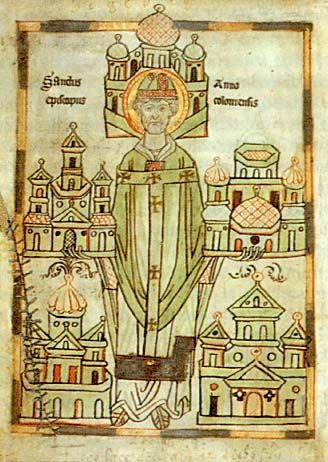
Baring-Gould’s sources: Roman and German Martyrologies. Authorities: — A Life by a monk of Siegburg, written in 1109, in Pertz, Mon. sc. xi. p. 465-514. A valuable vernacular metrical Life by an unknown author, thought by Lachmann to have been written in 1 183, but by Holtzman to have been composed by Lambert of Hersfeld (or of Aschaffensburg) in 1080. Of this there are several editions; the latest and best by K. Roth, “ Leben des heilen Anno, nach der Opitzischen Handschrift herausgegeben,” Miinchen, 1848. Also especial mention of S. Anno in Lambert of Aschaffensburg’s contemporary Chronicle, from which the monk of Siegburg makes verbatim extracts.] S. Anno was the son of Walter, count of Pfullingen and Engela, of an honourable family, but not either wealthy or important, and was destined for military service. But his uncle, a canon of Bamberg, having visited the father of the boy, persuaded him to let Anno be brought up for the Church. He carried the lad back with him to Bamberg, and instructed him in letters and the Latin tongue. He became master of the school at Bamberg, and having gained the goodwill of the Emperor Henry III., he was attached to his person as chaplain. On the death of Hermann II., archbishop of Cologne, the emperor appointed Anno to that important see, investing him with both crosier and ring. He thought, no doubt, that by thus elevating a man of unimportant family and fortune he would secure the allegiance of one of the most powerful electors of the empire, and attach him to his crown. The people of Cologne were, however, by no means pleased at having so insignificant a personage set above them, and they received him with murmurs and scoffs. He was consecrated in spite of their discontent, in the cathedral church, on March 3, 1056. His gratitude was forgotten in the pride of precedence above the haughty archbishop of Mainz, which was accorded him by Henry III., and he forgot both gratitude and decency in his violent rebukes administered to the emperor, who went to him for confession before attending a diet of the empire. Anno even beat the emperor with his fists, slapped his face, and refused to allow him to wear his imperial crown next day, till he had disbursed a large sum of money, which Anno scattered amongst the poor.
In 1055 the emperor was in Italy, but was obliged to hasten home on account of an insurrection organized by Godfrey of Lorraine, and threats of war from France. Victor II., whom Henry had elevated to the papacy from the bishopric of Eichstadt, came to Goslar to the emperor in 1056, to the aid of his old master. He arrived to receive his confession, and administer to him the last sacraments. The emperor, in consequence of violent exertions in the chase, had caught a fever, which, working on a mind harassed by the perplexing state of affairs, brought him to the grave. He died, leaving an infant son, Henry, to the care of his wife Agnes of Poitou, and of Pope Victor.
' Agnes, left alone at the head of the state, chose Henry, bishop of Augsburg, and Guibert, archbishop of Ravenna, to be her advisers. She was a pious, cultivated woman, but deficient in the energy befitting her station. She sought to rule the turbulent spirits of the age by gentleness and persuasion. One aim of her policy was to keep the haughty archbishops in check by means of the lay princes, and she endeavoured to unite the dukes to the young king by binding them with favours. Anno of Cologne and Siegfried of Mainz, with Eckbert, margrave of Meissen, and Otto, count of Nordheim, determined, if possible, to wrest the government from the hands of Agnes. The two archbishops were jealous of the bishop of Augsburg, a pious man, but proud, and not disposed to bribe them. They trumped up a vile report of criminal attachment between the pure empress S. Anno.
and the holy bishop, and agitated men’s minds with suspicion, to prepare them for the execution of the bold stroke which they contemplated.
Agnes was celebrating the feast of Pentecost on the island of Kaiserwerth in the Rhine. The conspirators were also there. After the banquet, when the young prince was in high spirits, the archbishop of Cologne invited him to inspect the new and beautiful ship that had brought him down the river. The boy was easily persuaded to enter the ship, when, at a signal, the vessel was cut adrift, and the rowers bowed over their oars, the sail was spread, and the boat shot up the river. The young king, fearing an attempt on his life, sprang overboard, but was saved by Count Eckbert and brought back again into the vessel. The confederates endeavoured to pacify him with flattery and assurances, and brought him safely to Cologne. In the meantime those on the island, seeing the archbishop’s vessel breasting the stream, ran to the shore and shouted wrathfully against the confederates, bitterly inveighing against their treachery. The news spread like wild-fire, and the whole of Germany was in agitation. Many nobles demanded of Archbishop Anno that he should restore the king to his rightful guardians, the bishops of Freisingen and Halberstadt loudly and indignantly complained, the people murmured, and Anno saw his former popularity changed into hatred. But he was not disposed to relinquish his hold of the goose that laid golden eggs, and he used his power to bribe those loudest in their complaints into acquiescence in his plans. He made the bishop of Freisingen archbishop of Magdeburg, and he gave the archbishopric of Salzburg to the bishop of Halberstadt To the bishop of Bamberg, who, after having been loaded with gifts by the empress Agnes, had turned against her, he restored the lordship of Froschheim and thirtysix estates of which he had been deprived by the emperor Henry III. He stopped the mouth of Duke Ordulf of Saxony with munificent gifts of lands belonging to the emperor. Of course the confederates took good care to reward themselves out of the imperial possessions. To keep up appearances, Anno ruled that the regent and guardian of the young king should be that bishop in whose diocese he happened to reside, but he was fully resolved not to let his charge escape his guardianship, and if allowed to leave Cologne it was only that Henry might pass to the care of the archbishop of Mainz, who was in league with him. But perhaps the most dreadful incident in the whole of this infamous proceeding was the revengeful murder of the bishop of Augsburg, whom Anno and his confederates condemned, on notoriously false charges, to a horrible and shameful death.1 The broken-hearted empress, bereft of her son, resigned the regency, and retired to an Italian convent However, Anno soon found out that King Henry hated him and the archbishop of Mainz alike, and that from this cause it was impossible for him to obtain the power he desired. He was therefore obliged to look out for someone who could adapt himself to the position by acquiring the confidence of the youth, without becoming independent of the archbishop. He hoped to have found such a man in Archbishop Albert of Bremen, a prelate of high birth, great accomplishments, and courteous manners. Anno was austere and sanctimonious, and Henry made no secret of his hatred of him. Albert was a gentleman, the brother of the Palatine Frederick of Saxony, was a keen politician, zealous in spreading Christianity among the heathen of Scandinavia, accustomed to, and loving pleasure, was very handsome, pure in morals, fond of splendour, munificent in his charities, a genial friend, but an implacable enemy. He had formed the plan of raising the number of bishoprics under 1 '* Coleis ligneo palo pertusU.”
his rule to twelve, and of constituting himself Patriarch of the North. To carry out this scheme it was necessary for him to have a share in the government of the empire, and when Anno of Cologne offered to admit him to the joint guardianship of the young king he embraced the proposal with enthusiasm, and in a very short while had obtained for himself nearly the whole of the power.
Archbishop Albert won the favour of the young king, who was only too glad to escape the cloistral monotony of the palace of Cologne for the splendid luxury of that of Bremen. Archbishop Albert, instead of rebuking the boy for his faults, laughed at them — instead of going counter to his wishes, gave them full rein; and treated with equal indulgence his companion and friend Count Werner, a frivolous and undisciplined youth. Albert, himself loving pomp, gave the king a train of courtiers, and prepared for him magnificent banquets and varied entertainments, the cost of which was defrayed from the funds of the see. In order to protect himself from the envy of powerful vassals of the crown, he had recourse, like Anno, to bribery. For this purpose he gave away the wealthy abbeys. Archbishop Siegfried of Mainz was given, together with other imperial estates, the abbey of Seligenstadt; Archbishop Anno of Cologne, who had already managed to appropriate a ninth part of the imperial treasure, was further enriched by the gift of the abbeys of Malmedy and Comelis-Miinster; Duke Otto of Bavaria received the abbey of Kempten; Duke Ordulph of Saxony was secured by the gift of the castle of Ratzeburg; Count Werner, the king’s favourite, received Kirchberg, although it belonged to the abbey of Hersfeld, and Archbishop Albert had no right to dispose of it. The bishop of Speyer was given two abbeys, and ail the other bishops and archbishops were given monasteries, lands, and privileges at the expense of the imperial crown. Archbishop Albert of vol. xv. 3 Bremen, as may be supposed, took care to feather his own nest well. The amount of lands, the number of monastic houses, whose revenues he appropriated was enormous. The empire during the regency of the bishop of Augsburg and the archbishops of Cologne, Mainz, and Bremen, was a great mine which these unscrupulous prelates plundered at will.
Archbishop Anno had used his time of power to enrich his relations and friends: in defiance of the right of election belonging to the chapters, he appointed his brother Wetzel to the archbishopric of Magdeburg, his nephew Burkhard to the bishopric of Hildesheim, and his friends Eilbert and Wilhelm to the bishoprics of Minden and Utrecht. But Albert was too proud to distribute church offices among his relatives, at the cost of the empire. He desired that those whom he benefited should derive their benefits from himself alone. He therefore made to his kinsmen munificent presents in money out of his own possessions. Those lands which the king gave him he gave as feudal tenures to others, or to the diocese, being desirous of making a great show through the number of his vassals. Before he had become governor of the king he had spent his revenues in building churches; now they went in the erection of castles, and in the satisfaction of extravagant caprices. He amused himself by turning barren districts into gardens and vineyards, not for purposes of utility, but to astonish by the exhibition of his power. At the same time he lost all control over himself: when he was angry he struck those who offended him, even priests, till he drew blood; if he felt a charitable impulse, he gave extravagantly: thus, on one occasion, he gave a beggar a hundred pounds of silver.
His extravagance in time exhausted the revenues of his see and of the royal possessions, and he then had recourse to unworthy means of supplying himself with the means Anno.
necessary for keeping up his usual sumptuousness and lavish expenditure. First he ground down his subjects with taxes, and after that sold bishoprics, abbeys, and every office in Church and State. The proceeds he divided with Count Werner, the king's favourite. At last no single office could be had, whether secular or ecclesiastical, except by purchase. To increase his revenue he tried to obtain from the king the wealthy abbeys of Lorsch and Corbie. He endeavoured by every means in his power to obtain the deposition of the abbot of Lorsch, but the abbot conducted himself with such caution that no occasion could be found against him. Then the king without excuse gave the abbey to the archbisLop; but the retainers of the abbot assembled, armed, in such numbers to oppose his taking possession, that Albert did not venture to enforce his claim. The king nominated the abbot of Corbie to the bishopric of Pola, in Istria, to draw him from his possession; but Duke Otto of Bavaria having discovered that the bishop of Pola was alive, and that the nomination was a trick to get the abbot out of the way in order to install the archbishop of Bremen in his place, protected the abbot. Other abbots were not so fortunate. They were forced to pay large sums to the king and the archbishop to be allowed to retain peaceable possession of their lands and offices. When Bishop Gunther of Bamberg was dead, his steward betook himself to court, and bought the bishopric for himself.
The pride and avarice of the archbishop of Bremen had stirred up against him many enemies, and a conspiracy was formed to oppose and overthrow him by Archbishop Anno of Cologne, Archbishop Siegfried of Mayence, the Dukes Rudolf of Swabia, Otto of Bavaria, and Gottfried of Lorraine. A diet was held at Tribur, and the king was required either to abdicate the throne, or to dismiss the archbishop from his court The king gave no answer, and Archbishop Albert advised him to take jhorse and fly by night with the imperial insignia to Saxony. The confederates were informed of this, and placed guards round the palace; and the king was obliged to disgrace the archbishop. Albert retired humbled and poor to his exhausted see, and was reduced to live on the pittance he could drain from the monasteries of his diocese.
The character of the young emperor had been ruined by his two episcopal governors. Anno had been harsh, conscientious in a way, ascetic in life, and despotic in his rule of the youthful prince. Albert had been the reverse in every particular. The sudden change from the severity with which he had been disciplined by Anno to the unlimited indulgence with which he was treated by Albert was most pernicious. The gravity and study to which he had been inured had been abruptly exchanged for the thoughtless gaiety of a luxurious court, where affairs of State were treated as lightly as a jest.
The unbridled simony of the archbishop knew no scruple as to the means whereby he could obtain benefices of importance for his partizans. He is accused, perhaps unjustly, of having employed for this shameless object the caresses of beautiful courtezans, and even of abbesses and nuns of high birth, to extract from the prince the letters, signatures, and donations requisite for the success of his plans. But as Albert, with all his faults, was of pure morals himself, this charge is perhaps an invention of his enemies. The disorderly life of the king was beyond his control, but it was his fault that this was the case.
The fall of Albert reinstated Anno, who had no sooner resumed the power, than he appointed his nephew Cuno to the archbishopric of Trfeves, in defiance of the right of election which had always belonged to the clergy and people of the electorate. As the people of Trfeves refused to receive •S’. Anno.
the archbishop thus unconstitutionally forced upon them, Anno sent a body of armed men, and the bishop of Speyer to induct him into the see; but Count Dietrich, marshal or vogt of the diocese, attacked him at Bittbuig, cut the retinue to pieces, and plundered the treasure of the archbishop. The bishop of Speyer took refuge in a church behind the altar, where he was caught and cudgelled, stripped of his clothes, and obliged to fly barefooted and half-naked on an old horse. The intrusive archbishop was loaded with chains, brutally maltreated, and then given to some knights to make away with. They threw him down some rocks, but as he still breathed, ran him through with their swords. The murderers were never punished.1 In 1065, Henry had been, at Anno’s advice, solemnly declared capable of bearing arms. No sooner was his sword girded on, than he drew it jestingly upon Anno — an action at once indicative of dislike and levity. Anno next committed the grave mistake of forcing on the young prince a wife whom he detested. Bertha, daughter of the Italian margrave of Susa, a noble-spirited woman, who only wanted beauty easily to supplant the mistresses of the young emperor, had been affianced to him in childhood. Anno insisted on their being married, and Henry, as soon as the marriage ceremony was over, deserted her, and refused to live with her.
In the meantime, owing to the dissensions that prevailed throughout the empire, and the humiliation of Albert of Bremen, who for three years was obliged to remain in concealment, the Saxons devastated the archdiocese of Bremen, and the Northern Sclaves in Mecklenburg and Pomerania rose and extirpated Christianity. The vain attempts of Ordulf of Saxony, and, after his death, those of his son Magnus ' A full account of this transaction is given by a contemporary* Dietrich, monk of Tholei. — Peru, Mon Sacr. viiL p. 212.
to oppose the inroads of the Sclaves merely added to the misery of the Saxons, and embittered their hatred of their inactive and licentious emperor. Hamburg and Mecklenburg were destroyed by the pagans, who sacrificed John, bishop of Mecklenburg, to their deities, stoned S. Ansverus, the abbot of Ratzeburg, and twenty-eight monks to death, assassinated Gottschalk, the Christian chief of the Obotrites, at Leuzen, at the foot of the altar, and turned his Danish wife out naked.
Whilst the north was thus convulsed, the imperial court presented a continued scene of petty dissension. The emperor, still influenced by the prejudices of his youth, was alternately swayed by conflicting passions, but at length, notwithstanding the opposition of Anno and Bertha, recalled Albert of Bremen to court in 1069. The fidelity and patience of the wretched empress merely contributed to increase the dislike manifested towards her by her husband, and to strengthen his resolution to free himself from the tie that bound him to her. Siegfried, archbishop of Mainz, offered to assist him in procuring a divorce, on condition of receiving in return the tithes of Thuringia. To these tithes he had no right, except this: that during the minority of Henry his predecessor had obtained from the prince a donation of them. This the Thuringians had steadily and successfully resisted. The promise of Henry to support the claim embittered the Thuringian nobles against him. In a diet held at Worms Henry made a public declaration of his unconquerable aversion to his unoffending wife, from whom he demanded a separation. His plan was frustrated by the arrival of S. Peter Damiani, the legate [an official representative sent by the pope] of Pope Alexander II., whose eloquence impressed even his versatile mind. The death of Albert of Bremen, which, fortunately for the empire, took place in 1070, once more threw the reins of government for a short period into the hands of Anno. S. Anno.
A synod held by the emperor at Erfurt, in which he imposed the tithes demanded by the archbishop of Mainz on Thuringia, effectually alienated the minds of the Saxon bishops from him, and in 1073 a conspiracy was formed against him by the Saxon and Thuringian nobles, and among the bishops, by Wetzel of Magdeburg, by Bucco of Halberstadt, whose pursuits were rather those of a warrior than a bishop, Anno’s nephew, and Henry’s most violent opponent, and by Benno of Meissen, a peaceful missionary, a planter of the fruit tree and the vine, besides all the other Saxon bishops, with the exception of those of Bremen, Zeiz, and Osnabriick, who sided with the emperor, and were consequently expelled the country.
But it would carry us too far to follow the miserable discords of that long reign, and relate all the treasons, insurrections, and violences of the German bishops against Henry IV. His fifty years’ reign was passed in contest and bloodshed. He fought sixty-two battles, and in each one of those a prelate was among his opponents. The many opposition kings who started up were all supported by the bishops, who even incited his own son to supplant him. It was in 1104 that Henry, the best loved and youngest son of the old emperor, instigated by Pope and prelates, raised his hand against his father. The touching appeals of the emperor to his son being disregarded, Henry IV. put himself at the head of his troops and marched against him; but the emperor discovering that he was betrayed by his followers, fled in the sorrow of his heart. He had still numerous adherents in the Rhineland, and his son, finding force unavailing, attempted by cunning to oblige him voluntarily to abdicate the throne, and proposed a conference at Coblentz. The emperor came; but struck to the heart at the sight of his ungrateful child, flung himself at his feet, exclaiming: “ My son, my son, if I am punished by God for my sins, at least stain not thine honour by sitting in judgment on thy father.”
The emperor was shut up in the Castle of Bingen, and was required by the archbishops of Mainz and Cologne, and the bishop of Worms, to surrender the crown jewels. The aged emperor placed the imperial insignia of Charlemagne [king of the Franks, crowned emperor in 800] on his own person, and appearing in state before the bishops, defied them to touch die ornaments worn by the ruler of the world. But to these prelates nothing was sacred: the crown and mantle of Charlemagne were plucked off him, and they hasted to adorn with them the person of his son, then at Mainz. The fallen emperor was given into the hands of Gebhard, bishop of Speyer, who took a fiendish pleasure in humbling and tormenting the prostrate monarch, aged fifty-four. He kept him without sufficient food, so that the old emperor was obliged to sell his boots in order to procure bread. Henry IV. had formerly richly endowed the cathedral of Speyer, and he entreated the haughty prelate to grant him a prebend, to supply his necessities. The meek request was scornfully refused. He was forbidden the use of a bath and of a barber to shave him, and even of a priest to confess him. At length he found means of escaping into Lorraine, where he was offered a refuge by the bishop of Ltege and the count of Limburg. His rebel son pursued him, but was defeated on the Meuse. The old king died at Lilge, after solemnly pardoning his son, in token of which he sent him his sword and ring. But the animosity of the prelates followed him after death. They forced Bishop Albert of Ltege, who had buried him in the church of S. Lambert with imperial honours, to dig him up and lay him in unconsecrated ground, where an aged pilgrim from Jerusalem for several years watched over his tomb. In 1 1 1 1, his body was brought to Speyer, but the bishop refused to allow Divine service to be performed over it, placed the bones in an unconsecrated chapel, and put to penance those who had taken part in the ceremony.
We have seen a good deal of the doings of Archbishop Anno, but we have not seen all that darkens his character. A saint he has been regarded because he fasted, and prayed, and saw visions, but there was little of sanctity of the truest and noblest description in this ambitious and revengeful prelate. As has been already shown, he left no stone unturned for acquiring wealth, possessions, and power, whilst he was self-constituted guardian of Henry IV. Amongst other abbeys which attracted his rapacity was that of Malmedy; and he obtained it for himself from the king. But the abbot of Stablo (Stavloo) claimed the abbey of Malmedy as belonging to Stablo, as it certainly did, and Abbot Dietrich loudly and vehemently protested at this infringement of his rights. His protests were not listened to, for the young king was wholly in the hands of the archbishop, and Frederick, duke of Nether Lorraine, the protector of Stablo, was either not powerful enough or interested enough in the quarrel to reverse the donation made to S. Anno.
The abbot was invited to the royal court at Tribur, neai the Rhine, above Mayence, and when he remonstrated at the separation of Malmedy from Stablo he was arrested. However, he persisted in asserting his right, and was at length liberated. In vain had the abbot expended the treasures of his church in presents to the courtiers and to the king himself; in vain also had he procured a brief from the Pope in his favour: Anno remained in possession, and boldly affirmed that he would not surrender it even were the patron of the house, S. Remade, still alive. As the abbot had tried every ordinary means to recover his rights to Malmedy, and they had failed, he had recourse to a singular expedient, prompted by despair. King Henry had summoned a diet at Lidge in 1071. The Abbot Dietrich betook himself thither with all his monks in solemn procession, carrying the bones of the blessed Remade, and these he laid on the table before the king as he sat at banquet with his lords and prelates. Henry was startled, and gave a solemn assurance to the abbot that he would investigate the claims of Stablo at the diet. The abbot urged an immediate examination. Archbishop Anno, who sat at the right hand of the emperor at table, rose, and angrily advised the king not to let himself be turned into ridicule by the monks. The king left the table, unable to proceed with his meal in such close proximity to the august relics [the bodily remains of a saint, or objects they used, kept with honor] of the saint, and the abbot refused to remove the bones from the banquet table till right was done him. In the meantime the crowd that had followed the procession poured into the hall and shouted frantically for justice. A few miraculous cures happening on the spot still further excited the mob. Anno stormed, and swore that the miracles were impostures, but the people would not attend to his words, and when the king saw that the temper of the people would not brook opposition, he promised to confirm the rights of the abbot of Stablo to Malmedy, and threatened Anno with his displeasure if he did not peaceably restore Malmedy to the monks, and assured him, in the event of his neglecting to comply with his orders, that he would wrest the abbey from him by force.
Then the monks returned in triumph to their cloister, bearing the bones of their patron, and the king resumed his seat, and continued his meal.
In 1074, Archbishop Anno celebrated Easter at Cologne, and Bishop Frederick of Munster was his guest. On the day of the bishop’s departure, S. Anno sent his servants to the Rhine to prepare a vessel for the accommodation of the bishop. The servants took the ship of a rich merchant, S. Anno.
and ordered the sailors to unlade it of all the wares. The sailors refused, and the merchant’s son, a bold young man, much esteemed in Cologne for his excellent qualities, called his friends to his assistance and drove off the archbishop’s servants and the town constable, who had been summoned to their assistance. The constable called out the mercenaries, and there would have been a bloody skirmish had not the archbishop threatened with his ban whoever broke the peace. S. Anno was far too haughty to bear with equanimity the refusal of the vessel to his servants. Next feast of S. George he ascended the pulpit and rebuked in most violent terms the audacity of the city in refusing hftn the vessel, and declared that if the citizens did not do penance therefor, they would become the prey of Satan and all his devils. The merchant’s son, who was present during the sermon, was highly incensed. He hurried to his friends, stirred up the people, reminded them of the citizens of Worms, who, without being as powerful and wealthy as those of Cologne, had driven away their bishop when he had taken part against the emperor, and urged the good folk of Cologne to do the same. Many young men, apprentices and sons of merchants, joined him, and attacked the archbishop’s palace, where, at the moment, S. Anno was banqueting with the bishop of Munster and his friends. The mob broke the windows, penetrated into the courtyard, and threw stones into the hall. The servants of the archbishop were killed or driven back.
Whilst the Cologne mob was storming the palace, the servants of the bishops conveyed the two prelates by a secret passage into the cathedral, and locked and barricaded the doors. A moment after, the mob burst into the palace, and sacked it from the attics to the cellars. Some stove in the barrels and let the rich wine flow away; others carried off all the costly goods they could lay hands on. Such an abundance of wine was let out, that the cellar was flooded, and several men were drowned in it. A servant, mistaken for the archbishop in the scuffle, was murdered; but when it was discovered that the saintly archbishop had taken refuge in the cathedral, the people streamed towards it, surrounded it, and threatened to fire it unless the obnoxious prelate was given up. But the night was far spent, and Anno took advantage of the darkness to disguise himself in a lay dress, and to escape out of the cathedral and take refuge in the house of one of his servants, to whom he had shortly before accorded permission to break a doorway through the city walls from his house, which was built against them. Through the door he fled the town, and escaped his enemies. He met the bishop of Munster and his servants with horses awaiting him, and he escaped to Neuss. In the meantime, the rioters were storming the minster, and breaking open the doors with sledge hammers. The servants within pretended that they were searching for the prelate, but could not find him, and when they felt satisfied that he was safe, they threw open the door, and the mob rushed in to seek him themselves.
After the people had satisfied themselves that the archbishop was not there, they locked the city gates, and sent a deputation to the emperor, who was then quarrelling with Anno, to inform him that they had been forced to maintain the honour of their city against the archbishop, and that they requested Henry to take possession of Cologne. But the news had spread through all the electorate, and the peasants, who had a great veneration for the sanctity and liberality of their archbishop, rose in his support against the citizens, with whom there had been a long-standing jealousy. S. Anno soon found himself at the head of an army, and he at once marched against his capital. The citizens, alarmed at the promptitude and power of the preDec.*] S. Anno.
late, sent an embassy to him, asking pardon, and promising amendment. The archbishop answered that he would not withhold forgiveness. He sang a High Mass at S. Gereon’s, which was then outside the city walls, and after it ordered as a preliminary that all those who had taken part in the insurrection should be put to penance. They accordingly appeared before him barefoot, in white sheets, and he had the greatest difficulty to restrain the peasants from falling upon them. He then commanded all to appear the next day in S. Peter’s church, and hear his ultimate decision. The night he spent in prayer in S. Gereon’s church. The citizens of Cologne were not at ease, for clemency was not a distinguishing feature in his saintly character, and during the night six hundred of the wealthiest burghers fled for protection to the emperor. In the meantime the servants of Anno entered the city, and pillaged the houses and murdered the citizens who resisted them; but this was without Anno’s knowledge, he was busy praying among the bones of the Theban martyrs, and knew nothing of what was taking place among his living subjects. Anno’s final judgment, after long prayer, was that the young merchant and many of his companions should have their eyes plucked out, that many others should be publicly whipped, and that others should be expelled the city. All who remained in the city were to take oaths of allegiance to the archbishop.
Although the people of Cologne were certainly guilty of insurrection, yet unquestionably Anno was to blame in forcing them to it, and his savage reprisals led to most disastrous results. The city, which, like Mainz, had been the most populous and wealthiest of the German cities, was suddenly reduced to desolation. The streets were empty, the houses fell into ruin, and the markets were deserted. With what bloody severity S. Anno administered justice may be gathered from another instance. A widow complained to him that the magistrates had given wrong judgment against her. The archbishop summoned the magistrates before him to Siegburg, where he held his court, and finding that the widow’s appeal was just, he had all the magistrates blinded except one who was his own kinsman. There were seven whose eyes were plucked out; and by the archbishop’s orders stone heads without eyes were built into the walls of their houses as a witness to all the town of his uncompromising love of justice.
He set priests to acts as spies at night, and watch for men who followed women of loose character. These men he seized, shaved their heads, and publicly branded them. | Anno is renowned for several miracles. Perhaps the ! most interesting of them is the following. He was one day saying Mass, and had just come to the fraction of the Host, when a fly buzzed up, and carried off a particle.1 The horror of the saint cannot be expressed in words. He grew deadly pale, his blood froze in his veins, his conscience smarted for his incaution, and in an agony of remorse, and a tempest of groans and tears, he prayed that the fly might restore what it had taken. Scarcely had he done praying, when the insect returned, deposited the particle on the paten, then fell over on its back, was convulsed, and died miserably.* He had visions. In the church of S. Gereon lay, somewhat disregarded, the bones of three hundred and sixty martyred Moors [the Muslims of North Africa and Spain]. When S. Gereon and the Theban legion had been put to death at Cologne and Xanten, a legion of Moors had been sent to the Rhine to supply their places. But on their arrival, it occurred to the authorities to inquire 1 “ Imago dxmoniorum, musca videlicet spurci&suna visu nauseam generans impetu super corpus Domini ruit, ereptamque morsu particulam, cum maximo dolor** sacerdods avolans exporta vit.’’ S. Anno.
into their religious convictions, and they found to their disgust that the empire had again been put to the expense and trouble of conveying to Germany a band of Christian soldiers. They were accordingly also put to death. The people of Cologne were certainly not kept short of relics; they had the bones of the eleven thousand viigins, and of S. Gereon with his three hundred and ten companions. They might therefore be excused, one would have thought, if they somewhat overlooked the merits of the black martyrs. However, these latter were not disposed to be treated with indifference. One night S. Anno saw himself in vision in the church of S. Gereon, in the midst of a council of negro saints, whom he would probably have mistaken for devils, but for the aureoles about their heads. The martyrs complained of the neglect of the prelates and people of Cologne, and resolved by acclamation to make the present occupant of the see suffer for it. The three hundred and sixty thereupon fell on Anno, pummelled and lashed him, till the breath was all but beaten out of his body. When he woke, aching in all his bones — no doubt with rheumatism — he resolved to give the holy Moors the respecJ and devotion they demanded. The church of S. Gereon was then circular. He added a nave, and enlarged the crypt, and magnificently enshrined the black saints. On his way to Salfeld, in Thuringia, riding in his car, he was rapt in vision, and became so big and heavy with the mysteries revealed to him, that his attendants were obliged to yoke sixteen horses to the conveyance to get it along.1 Just before his last illness, in vision he saw himself in a magnificent mansion surrounded with thrones, all occupied by the great bishops and saints of the German Church. One throne was vacant, and Anno went forward to take it. Then 1 *' SOlich roancraft ihn unricng, das man sescein ros d demo wagine spien."— Annolied, 41.
up rose Arnold of Worms and forbade him, saying that he was not destined to occupy the seat till he had purged his conscience from the stain that defiled it Anno looked round, and saw the same prohibition on the faces of Bardus of Mainz, of Boppo and Eberhard of Trfeves, and of Cunibert of Cologne. Then the vision faded, and when he woke and considered the matter, it occurred to him that he had nourished a bitter, revengeful temper towards the citizens of Cologne since their outbreak. He resolved to overcome it. He went to Siegburg, and was there laid up with gout in his left foot. The gout spread up his leg. He thought he saw a wicked little black devil at his side pinching his tortured limb, and he screamed for holy water wherewith to drive the demon away. The gout reached his stomach, and he died, forgiving the people of Cologne, and ordering his money to be distributed among the poor.