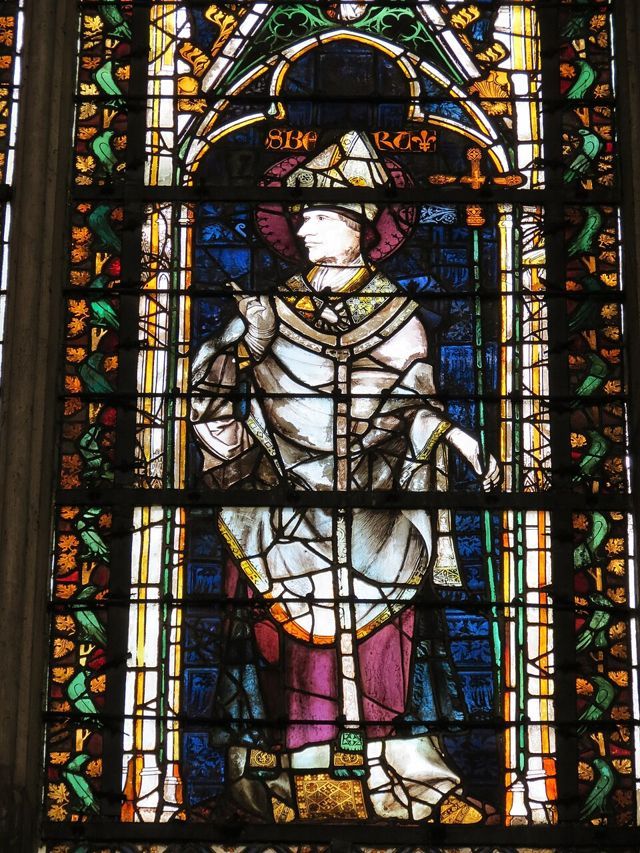
Baring-Gould’s sources: Roman and other Martyrologies. Authority:—Life by Ansgrad, the monk, dedicated to Abbot Hilbert, the successor of S. Ansbert. This life has, however, suffered from interpolators.
This saint was at one time chancellor to Clothaire III., and in the midst of the temptations of a court, preserved his integrity and purity. At length, quitting the court, he assumed the monastic habit at Fontenelle, and on the election of the abbot Lantbert to the see of Lyons [a bishop’s “see” is his diocese, named from his seat (Latin sedes)], he succeeded him as abbot of that famous monastery. He was confessor [in old usage, a saint who was not martyred, or who suffered for the faith without being killed] to Thierri III., and was, with his consent, chosen archbishop of Rouen, on the death of S. Ouen, in 683. Pepin, mayor of the palace, afterwards banished him, on a false accusation of treason, to the monastery of Hautmont in Hainault, where he died on the 9th February, 695. His body was transported to the abbey of Fontenelle, and afterwards to Boulogne, but in 944, through fear of the Northmen, it was translated to the convent of S. Peter in Ghent; but was dragged from its resting-place by the furious Calvinists, under William of Orange, in 1578; some portions of the sacred relics [the bodily remains of a saint, or objects they used, kept with honor] have, however, we believe, been preserved.
S. Ansbert is often called S. Aubert.
Then when Paphnutius heard these words, and saw that she was fallen asleep, all his bowels were moved, and he fell on the ground, and was as one dead. Now Agapitus came running in, and saw Smaragdus dead, and Paphnutius lying senseless on the ground, so he cast water on his face and said, "What aileth thee, Master Paphnutius?" Then said Paphnutius, "Let me go that I may die." And when he was risen up, he cast himself on the face of the dead monk, and cried, "Woe is me! my sweetest daughter, why didst thou not tell me before, that I might have died with thee?" So Agapitus, having guessed the truth, was amazed, and hasted and told the abbot, who came, and cried "Euphrosyne, spouse of Christ, forget not thy fellow-servants, who dwell in this monastery, but pray for us to our Lord Jesus Christ, that he may make us manfully contend to reach the port of safety, and to have our portion with Him, and with all His saints." Then he called all the brethren together, and they buried Euphrosyne reverently. And after that her father came and dwelt in the same cell, and was there for ten years, and after that he migrated to God, and they laid him beside his daughter.