A

Leaving everything to pray, yet still drawing people who needed wisdom.

Read the essentials →
April 7 · Hermit

St. Aphraates

St. Aphraates

Leaving everything to pray, yet still drawing people who needed wisdom.

Traditional feast

April 7
1914 / pre-1969 calendar, per Baring-Gould (1897)

Current feast

January 29
Secondary source · Wikipedia

Represents

Hermit

Their story

Adapted in modern English from Alban Butler's Lives of the Saints · Baring-Gould original below

Aphraates came from a noble but pagan Persian family. After coming to the truth, he left home for Edessa, then lived in a cell near Antioch, eating only a little bread after sunset and sleeping on a mat. When the governor Anthemius offered him a new robe from Persia, he refused, saying he would not swap a faithful old servant of sixteen years for a new one.

When the Emperor Valens persecuted the Catholics, Aphraates left his cell to help Flavian and Diodorus look after the flock. Valens asked why a monk was wandering abroad. Aphraates answered that if his father's house were on fire, no one would blame him for running to put it out: 'Blame yourself, who have kindled the fire.'

One of the emperor's eunuchs threatened the old man, and soon afterwards fell into a cauldron of boiling bath water and died. Butler says this so frightened Valens that he would not banish the saint.

Early life

Selected sentences from the original account, unaltered.

“ Prince,” said the holy man; “ if I were a young virgin sitting at home in my bower, and my father's house caught fire, what wouldest thou counsel me ? — To sit still and be burnt or to bestir myself to extinguish the blaze ?” “ Why, man, labour to put the fire out” “I am doing so now, Sire!

What they represent

How they teach us to live

Drawn from themes in the original account

Make time for silence. Solitude and withdrawal to pray shape this life.

Learn from the kind of life it was. Leaving everything to pray, yet still drawing people who needed wisdom.

Read more

The full original · 317 words

Read Baring-Gould’s full account

Baring-Gould’s sources: By the Latins on April 7th; by the Greeks on Jan. 29th. Authority: — Theodoret, B. of Cyrus, in his Philotheus and Hist Ecclesiastica. Also Theophanes. Theodoret had been taken to visit him and received his blessing when he was a child.] Aphraates was a Persian by birth, of an illustrious, heathen family, of the race of the Magi. On his conversion to Christianity, he abandoned his country, and retired into a cell near Edessa. After having spent some tipie there he came to Antioch, then tom with heresy. He took lessons in Greek, and laboured in his broken jargon of Persian and 1 As when Paul persecuted the Church, Christ addressed him with, "Saul, Saul, why persecutest thou Me.”— Acts ix. 4. April f.J S. Aphraates.

Greek to sustain the Catholics, then united under Flavian and Diodorus, against the Arians [followers of Arius, who taught that the Son is a created being, not fully God], who were supported by the Emperor Valens. 1 Acting in concert with these champions of the Catholic cause, he sent Acacius of Beroea to S. Julian Sabas, that he might urge him to come to Antioch to confirm the faithful The presence of the emperor in Antioch did not intimidate him. One day Valens met him hastening to the oratory by the river's side where the Catholics met “ Whither in such haste ?” asked the emperor. “Sire! I am going to pray for the whole world, but especially for the empire.”

“ But why dost thou, who professest a solitary life, come forth from thy cell and mix with a throng in public assemblies ?”

“ Prince,” said the holy man; “ if I were a young virgin sitting at home in my bower, and my father's house caught fire, what wouldest thou counsel me ? — To sit still and be burnt or to bestir myself to extinguish the blaze ?” “ Why, man, labour to put the fire out” “I am doing so now, Sire! My Father's house is on fire, heresy is consuming it, and I rush forth from my bower to arrest the conflagration. Fare thee well 1 ” and he sped away, staff in hand.

The story is told of him that Anthiraius, afterward (in 405) prefect of Antioch, but then an ambassador to Persia, passing through Antioch visited him and presented him with a coat “ Sir,” said the hermit; “ I have a dear old friend who has been with me many years. Would you have me change him for a new friend ?” “ Certainly not” said Anthimius. “Then,” said the hermit, “you will excuse me if I stick to my old coat”

1 See life of S. Meletlus, Feb. lath. VOL. IV. 8
Feast days

Feast: January 29
Traditional: April 7

Nine days · Free

Pray the novena
with us.

One short email a day for nine days. The day's prayer, a line from St. Aphraates's story, and a nudge to keep going.

Also on April 7
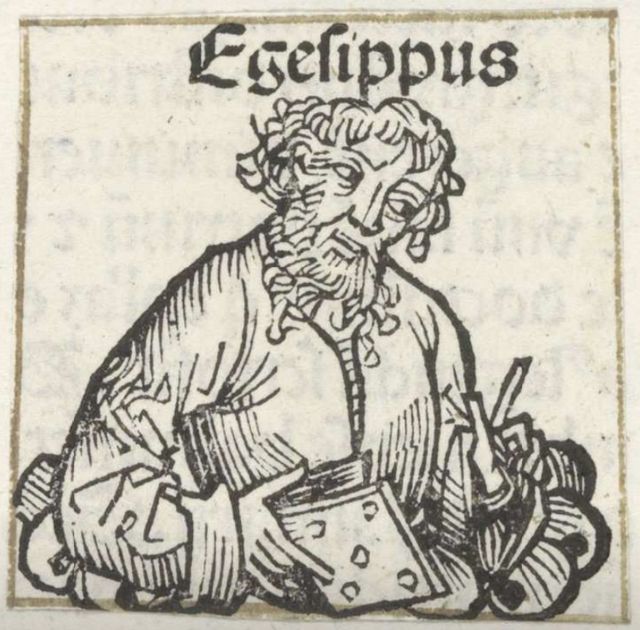
St. Hegesippus

St. Hegesippus

April 7 · Feast
C

St. Calliopius

April 7 · Martyr
E

Bl. Eberhardt

April 7 · Feast
← All 1726 saints in the library
Sources & notes

Feast-day sources

Story sources

Sources

Credits

From Sabine Baring-Gould, The Lives of the Saints, new edition in 16 vols. (London: John C. Nimmo, 1897–98); text from the Internet Archive scan (OCR, lightly cleaned; errors possible). Public domain.

From Sabine Baring-Gould, The Lives of the Saints, new edition in 16 vols. (London: John C. Nimmo, 1897–98); text from the Internet Archive scan (OCR, lightly cleaned; errors possible). Public domain in the United States. Reproduced unedited, except for short bracketed notes in grey that we added to explain names and terms (“S.” is the old abbreviation for Saint). Some history and judgments reflect 19th-century scholarship.