St. Apollonia

Apollonia's martyrdom is described by Dionysius, Bishop of Alexandria, who was himself a confessor in that persecution.

Read the essentials →
February 9 · Virgin, Martyr

St. Apollonia

St. Apollonia

Apollonia's martyrdom is described by Dionysius, Bishop of Alexandria, who was himself a confessor in that persecution.

Traditional feast

February 9
1914 / pre-1969 calendar, per Baring-Gould (1897)

Current feast

February 9
Secondary source · Wikipedia

Represents

Virgin
Martyr

Their story

Adapted in modern English from Baring-Gould (1897) · original text below

Apollonia's martyrdom is described by Dionysius, Bishop of Alexandria, who was himself a confessor in that persecution. In Alexandria the persecution began a full year before the imperial edict. A heathen prophet and poet whipped up the crowd against the Christians. They stoned an old man named Metras, dragged a woman named Quinta through the streets and stoned her, and then rushed on Christian homes, looting them and burning the furniture in the roads.

They also seized Apollonia, an admirable virgin of advanced age. They beat her jaws until all her teeth were broken out. Then they lit a fire outside the city and threatened to burn her alive unless she repeated their impious words. Dionysius writes that at first she seemed to shrink a little, but when they let her go she suddenly sprang into the fire and was consumed.

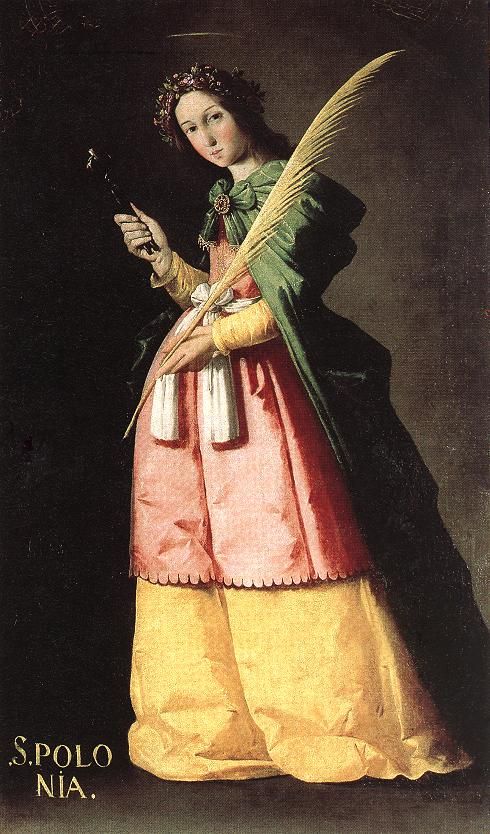
Because of her sufferings she is invoked against toothache, and in art she holds a tooth, sometimes gripped in pincers.

Early life

The book says little or nothing about early life. This is how the account begins.

THE following is the account of the martyrdom of S. Apollonia, by Dionysius, the bishop of Alexandria, himself a confessor at the time, in the persecution. "The persecution with us did not begin with the imperial edict, but preceded it a whole year. And a certain prophet and poet excited the mass of the heathen against us, stirring them up to their native superstition.

What they represent

How they teach us to live

Drawn from themes in the original account

Stay faithful when it costs you. This account is about holding firm under pressure.

Keep their day. Remember them on February 9 with a short prayer, and ask for their help.

From the Catholic Encyclopedia

1913 · 691 words

A holy virgin who suffered martyrdom in Alexandria during a local uprising against the Christians previous to the persecution of Decius [Roman emperor 249–251, who ordered everyone to sacrifice to the gods] (end of 248, or beginning of 249). During the festivities commemorative of the first millenary of the Roman Empire, the agitation of the heathen populace rose to a great height, and when one of their poets prophesied a calamity, they committed bloody outrages on the Christians whom the authorities made no effort to protect. The great Dionysius, then Bishop of Alexandria (247-265), relates the sufferings of his people in a letter addressed to Fabius, Bishop of Antioch, long extracts from which Eusebius [Eusebius of Caesarea (d. c. 339), the first historian of the Church] has preserved for us (Hist. Eccl., I, vi, 41). After describing how a Christian man and woman, named respectively Metras and Quinta, were seized by the seditious mob and put to death with the most cruel tortures, and how the houses of several other Christians were completely pillaged, Dionysius continues: "At that time Apollonia the παρθένος πρεσβῦτις (virgo presbytera, by which he very probably means not a virgin advanced in years, but a deaconess) was held in high esteem. These men seized her also and by repeated blows broke all her teeth. They then erected outside the city gates a pile of fagots and threatened to burn her alive if she refused to repeat after them impious words (either a blasphemy against Christ, or an invocation of the heathen gods). Given, at her own request, a little freedom, she sprang quickly into the fire and was burned to death." Apollonia belongs, therefore, to that class of early Christian martyrs who did not await the death they were threatened with, but either to preserve their chastity, or because confronted with the alternative of renouncing their faith or suffering death, voluntarily embraced the latter in the form prepared for them. In the honour paid to her martyrs the Church made no distinction between these women and others. St. Augustine touches on this question in the first book of the "City of God", apropos of suicide (De. Civ. Dei, I, 26); "But, they say, during the time of persecution certain holy women plunged into the water with the intention of being swept away by the waves and drowned, and thus preserve their threatened chastity. Although they quitted life in this wise, nevertheless they receive high honour as martyrs in the Catholic Church and their feasts are observed with great ceremony. This is a matter on which I dare not pass judgment lightly. For I know not but that the Church was divinely authorized through trustworthy revelations to honour thus the memory of these Christians. It may be that such is the case. May it not be, too, that these acted in such a manner, not through human caprice but on the command of God, not erroneously but through obedience, as we must believe in the case of Samson? When, however, God gives a command and makes it clearly known, who would account obedience thereto a crime or condemn such pious devotion and ready service?" The narrative of Dionysius does not suggest the slightest reproach as to this act of St. Apollonia; in his eyes she was as much a martyr as the others, and as such she was revered in the Alexandrian Church. In time, her feast was also popular in the West. A later legend assigned a similar martyrdom to Apollonia, a Christian virgin of Rome in the reign of Julian the Apostate [Roman emperor 361–363 who tried to restore paganism]. There was, however, but one martyr of this name, i.e. the Saint of Alexandria. The Roman Church celebrates her memory on 9 February, and she is popularly invoked against the toothache because of the torments she had to endure. She is represented in art with pincers in which a tooth is held. There was a church dedicated to her at Rome but it no longer exists. The little square, however, in which it stood is still called "Piazza Sant' Apollonia".

Acta SS., Feb., II, 278 sqq.; Katholik (1872), I, 226 sqq.; Bibliotheca hagiographica latina, ed. BOLLAND. (Brussels, 1898), 103 sqq.; NEUMANN, Der römische Staat und die allgemeine Kirche (Leipzig, 1890) I, 252 sqq.; BUTLER, Lives, 9 Feb.

Read more

The full original · 478 words

Read Baring-Gould’s full account

Baring-Gould’s sources: This saint is named in the Roman and all Western Martyrologies. There is, however, another Apollonia, martyr under Julian the Apostate, 114 years her junior, commemorated in some churches on this day, and some apocryphal Acts of this latter saint are extant. There is much doubt whether this Roman Apollonia ever really existed, and whether the Martyrologists have not fallen into an inaccuracy in writing S. Apollonia "of Rome," instead of "of Alexandria," because her relics were brought to Rome. The account of the martyrdom of S. Apollonia of Alexandria is perfectly authentic, it occurs in a letter from S. Dionysius B. of Alexandria, during the persecution, to Fabius, B. of Antioch, giving him an account of the sufferings of his church. This letter is preserved by Eusebius, in his Ecclesiastical History, lib. vi. c. 41.

THE following is the account of the martyrdom of S. Apollonia, by Dionysius, the bishop of Alexandria, himself a confessor [in old usage, a saint who was not martyred, or who suffered for the faith without being killed] at the time, in the persecution. "The persecution with us did not begin with the imperial edict, but preceded it a whole year. And a certain prophet and poet excited the mass of the heathen against us, stirring them up to their native superstition. Stimulated by him, and taking full liberty to exercise any kind of wickedness, they considered this the only way of showing their piety—to slay us. First, then, seizing a certain aged man, named Metras, they called on him to utter impious expressions, and as he did not obey, they beat his body with clubs, and pricked his face and eyes; after which they led him away to the suburbs, where they stoned him. Next, they led a woman called Quinta, who was a believer, to the temple of an idol, and attempted to force her to worship; but when she turned away in disgust, they tied her by the feet, and dragged her through the whole city, over the rough stones of the paved streets, dashing her against the millstones, and scourging her at the same time, until they brought her to the same place, where they stoned her. Then, with one accord, all rushed upon the houses of the pious, and whomsoever of their neighbours they knew, they drove thither in all haste, and despoiled and plundered them, setting apart the more valuable of the articles for themselves; but the more common and wooden furniture they threw about and burnt in the roads, presenting a sight like a city taken by the enemy. They also seized that admirable virgin Apollonia, then in advanced age, and beating her jaws, they broke out all her teeth, and kindling a fire before the city, threatened to burn her alive, unless she would repeat their impious expressions. She appeared at first to shrink a little, but when suffered to go, she suddenly sprang into the fire, and was consumed."

Relics in the Church of S. Apollonia, at Rome; her head in S. Maria Transtiberina; her arms in S. Laurence, outside the walls; part of her jaw in S. Basil's; other relics [the bodily remains of a saint, or objects they used, kept with honor] at Naples, Volaterra, Bonona, at Antwerp in the Jesuit Church; in S. Augustine's, at Brussels; in the Jesuit Church at Mechlin; in S. Cross at Liége; at Cologne, in the Jesuit Church; and in those of S. Gereon, S. Maurice, S. Alban, S. Cunibert, and others; and elsewhere. These relics consist in some cases of a tooth only, or a splinter of bone.

S. Apollonia is invoked, and the application of her relics is sought against toothache, and other pains in the jaw.

In Art, she is always to be recognized by her being represented holding a tooth, sometimes pincers grasping a tooth, in her hand.
Feast days

Feast: February 9

Nine days · Free

Pray the novena
with us.

One short email a day for nine days. The day's prayer, a line from St. Apollonia's story, and a nudge to keep going.

Also on February 9
N

St. Nicephorus

February 9 · Martyr
A

St. Athracta or Taraghta

February 9 · Virgin
St. Teilo of Llandaff

St. Teilo of Llandaff

February 9 · Bishop
← All 1726 saints in the library
Sources & notes

Feast-day sources

Story sources

Sources

Credits

Image: Francisco de Zurbarán 035.jpg · Francisco de Zurbarán · Public domain, via Wikimedia Commons

From Sabine Baring-Gould, The Lives of the Saints, new edition in 16 vols. (London: John C. Nimmo, 1897), digitized text from Project Gutenberg. Public domain.

Image: Francisco de Zurbarán, Wikimedia Commons (Public domain)

From “Catholic Encyclopedia (1913)/St. Apollonia,” The Catholic Encyclopedia (New York: Robert Appleton Company, 1907–1914), via Wikisource. Public domain. Matched by name and feast date; text unedited except for our bracketed notes in grey.

From Sabine Baring-Gould, The Lives of the Saints, new edition in 16 vols. (London: John C. Nimmo, 1897), digitized text from Project Gutenberg. Public domain in the United States. Reproduced unedited, except for short bracketed notes in grey that we added to explain names and terms (“S.” is the old abbreviation for Saint). Some history and judgments reflect 19th-century scholarship.