A shepherd who stayed with his people through hard times.
Read the essentials →A shepherd who stayed with his people through hard times.
July 7
April 18 (also listed: July 23)
Bishop
Thin entry · the 1897 book gives only 127 words. We have not filled the gap with invented detail.
And now, as the hour of midnight was passed, Apollonius desired to celebrate the Divine mysteries and communicate all whom he had baptized. But there was no altar. Therefore he prayed, and lo ! there came down out of heaven a white altar-linen (sindon) stretched out as though on an altar, and in the middle was a chalice full of the Blood of the Lord, and above shone four burning lights.
Share your faith, in words and by example. Preaching and conversion are central here.
Pray a little every day. Prayer runs all through this account.
Learn from the kind of life it was. A shepherd who stayed with his people through hard times.
And now, as the hour of midnight was passed, Apollonius desired to celebrate the Divine mysteries and communicate all whom he had baptized. But there was no altar. Therefore he prayed, and lo ! there came down out of heaven a white altar-linen (sindon) stretched out as though on an altar, and in the middle was a chalice full of the Blood of the Lord, and above shone four burning lights. Then Apollonius stood before the white sheet, and communicated therefrom all that great multitude. 1 From this fanciful story the value of the acts of SS. Faustinus and Jovitta, and of their evidence in favour of the existence of S. Apollonius, may be estimated. The relics [the bodily remains of a saint, or objects they used, kept with honor] of S. Apollonius are shown in the cathedral at Brescia.
Feast: April 18
Traditional: July 7
One short email a day for nine days. The day's prayer, a line from St. Apollonius's story, and a nudge to keep going.
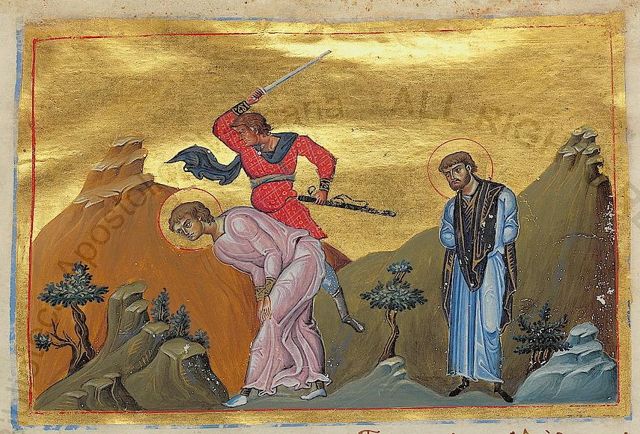
Image: Philemon and Apollonius of Antinoe (Menologion of Basil II).jpg · Authors of Menologion of Basil II (circa 985 AC, Constantinople), Byzantine manuscript illuminators[1]: Pantoleon with G · Public domain, via Wikimedia Commons
From Sabine Baring-Gould, The Lives of the Saints, new edition in 16 vols. (London: John C. Nimmo, 1897–98); text from the Internet Archive scan (OCR, lightly cleaned; errors possible). Public domain.
Image: Authors of Menologion of Basil II (circa 985 AC, Constantinople), Byzantine manuscript illuminators[1]: Pantoleon with G, Wikimedia Commons (Public domain)
From Sabine Baring-Gould, The Lives of the Saints, new edition in 16 vols. (London: John C. Nimmo, 1897–98); text from the Internet Archive scan (OCR, lightly cleaned; errors possible). Public domain in the United States. Reproduced unedited, except for short bracketed notes in grey that we added to explain names and terms (“S.” is the old abbreviation for Saint). Some history and judgments reflect 19th-century scholarship.
