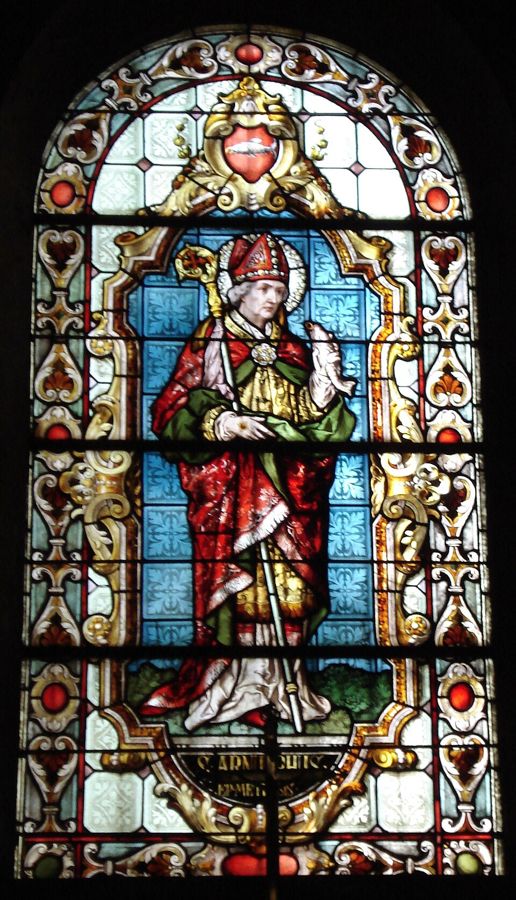
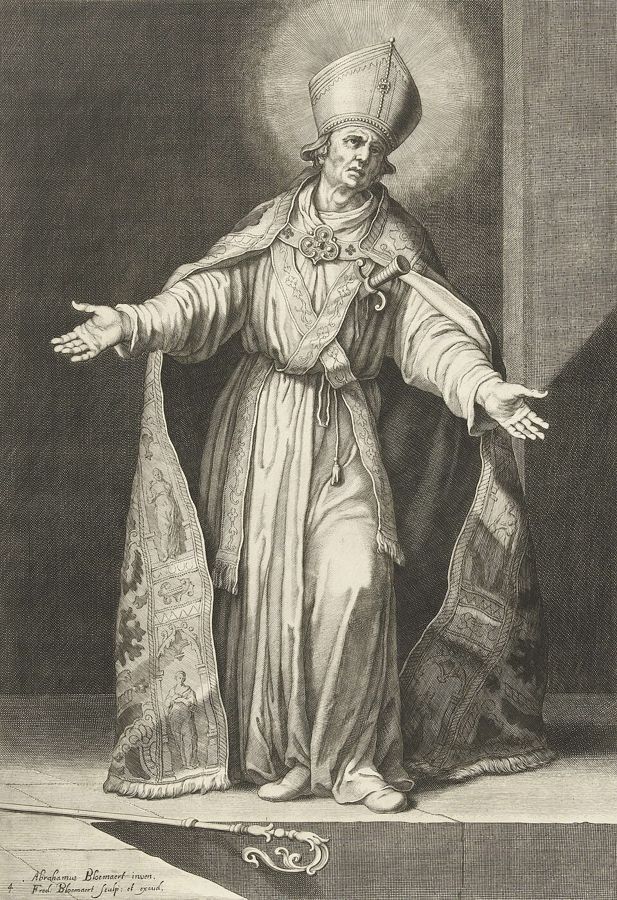
Baring-Gould’s sources: Florus, in his additions to Bede, Usuardus, Ado, Hrabanus, Notker, Sarum, Scottish, Galilean, German and Roman Martyrologies. Authority; — A Life by a contemporary; and mention by Paul Warnefield in his. account of the Bishops of Metz; written A.D. 777.] Arnulf, a man of noble Frank birth, 1 was advanced in the court of Theodebert, by Gundulf, mayor of the palace, when he was only sixteen years old. He served the king in war and in peace, and became accomplished in every art then cultivated. He could read, but he could also fight, write, and also hunt.
He remained at court with Clothair II. after the defeat and assassination of Theodebert by his brother Thierry, king of Burgundy. Thierry died of sickness in 61 1, the year after the death of Theodebert, and his young son, Sigebert, was left in the hands of the ferocious Brunehaut, his great grandmother. Clothair, son of Fredegund and Chilperic, king of Soissons, ascended the throne of Soissons in 584, on the murder of his father, probably by Fredegund, who had assassinated the sons of Chilperic by his first wife. In 6 ji, on the death of Thierry, Clothair banished, or put to death, the sons of Thierry, and became sole king of the Franks [the Germanic people who ruled Gaul and gave France its name].
S. Arnulf was married to Doda, a Swabian lady, and by her had two sons, one of whom was S. Chlodulph or Clou, and the other Ansigis; it is from the latter that the Carlovingian race of kings is sprung.
It may be easily imagined that Arnulf, a man loving God, 1 He is said to have been son of Arnoald, and Oda. Arnoald was the son of Ansbert and Blithilda, the daughter of Clothair 1. S- Arnulf was born about a.d. 582, in Lorraine.
2 Theodebert, son of Childebert, became king of Austrasia, Paris, and Orleans, seeking righteousness, should feel ill at ease in attendance on the throne of a prince like Clothair, stained with so much blood, and much of that the blood of brothers and father. He would have retired to the monastery of Lerins, but was not suffered to do so by the king. The story is told of him, that as he was crossing a bridge over the Moselle, he looked down into the rushing stream, and drawing a gold ring from his finger, cast it in, saying, 11 1 shall not believe that my sins have been pardoned till I see this ring again.” Years after, when he was a priest, a fisherman brought him a large fish, - and when it was being cleaned for table, the ring was found in its belly. But this is only an old and favourite nursery tale which reappears again and again, in this instance attaching itself to S. Arnulf. 1 On the see of Metz [a bishop’s “see” is his diocese, named from his seat (Latin sedes)] becoming vacant, in or about a.d. 599, Arnulf was elected by the clergy and people to the vacant see, and his election was ratified by the king. In 622, Clothair II. divided his dominions, and gave Austrasia to his son Dagobert, when S. Arnulf was appointed to be his principal adviser. He was thus drawn once more into the current of political life, which had grown distasteful to him, as it interfered with the work he had to do for his own soul. He urged the king to suffer him to retire from court, and from his see, but was long refused, and finally only extorted consent with difficulty. Clothair threatened to cut off the heads of his sons if he insisted, then drew his sword upon him, but was conquered by the gentle persistency of the bishop.
He retired to the Vosges mountains, near the monastery of Remiremont, and there prepared for his death, which took place on August 16th, 640.
1 The reader will remember the ring of Polycraies. July i8.] S. Frederick.