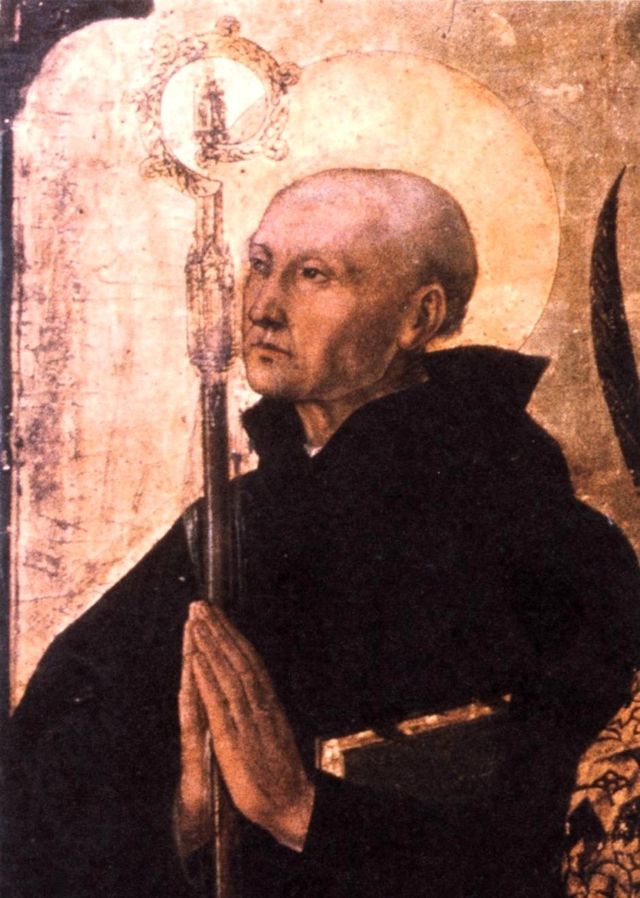
Their story
Adapted in modern English from the Catholic Encyclopedia (1913) · original text below
Atticus was born at Sebaste in Armenia and educated by monks of the Macedonian heresy, whose errors he adopted. As a young man in Constantinople he gave them up and was ordained priest.
With another ambitious priest, Arsacius, he was a chief accuser of St John Chrysostom at the Synod of the Oak (a hostile gathering of bishops near Chalcedon) in 403, which deposed Chrysostom. In 406 Atticus took the see himself. At first he used the civil power to pull the faithful away from their exiled bishop.
When the people still shunned him, even after Chrysostom's death, he restored Chrysostom's name to the prayers of the churches. His charity to the poor slowly won them over, and Pope Innocent I recognised him. He drove the Messalians out of Pamphylia and opposed the Pelagians (the teaching of Pelagius that people can be good without God's grace) so firmly that Pope Celestine praised him as 'a true successor of St Chrysostom'.
Early life
The book says little or nothing about early life. This is how the account begins.
Thin entry · the 1914 book gives only 98 words. We have not filled the gap with invented detail.
Atticus, a man of gentle spirit and conciliatory manners, succeeded S. Chrysostom in the see of Constantinople. He, at first, refused to admit the name of his predecessor into the diptychs; but was afterwards moved to yield, in accordance with the Latin Church, which refused communion with the see of Constantinople till the righteousness of the cause of the great Chrysostom had been acknowledged. Atticus was engaged in correspondence on this subject with S. Cyril of Alexandria, who vehemently resented the admission of the name of Chrysostom, till he also yielded at the instance of Isidore of Pelusium.
From the Catholic Encyclopedia
1913 · 263 words
Patriarch of Constantinople (406-425), born at Sebaste in Armenia; died 425. He was educated in the vicinity of his native town by Macedonian monks, whose mode of life and errors he embraced. When still young he went to Constantinople, abjured his heretical tenets, and was raised to the priesthood. He and another ambitious priest, Arsacius, were the chief accusers of St. Chrysostom in the notorious Council of the Oak, which deposed (405) the holy patriarch [the title of the bishops of the great ancient sees: Rome, Constantinople, Alexandria, Antioch, Jerusalem]. On the death (406) of the intruder Arsacius, he succeeded him in the See of Constantinople, and at first strove hard, with the help of the civil power, to detach the faithful from the communion of their lawful pastor. But finding that, even after the death of St. Chrysostom, they continued to avoid his own spiritual ministrations, he re-inserted the name of his holy predecessor in the diptychs of the churches. This change of attitude and his charity to the poor gradually made him less unpopular, and he at length managed to have himself recognized as patriarch by Innocent I. Intent upon enlarging the prerogatives of his see, he obtained from Theodosius [name of Roman emperors; Theodosius I (379–395) made Christianity the state religion] the Younger two rescripts which placed Bithynia and Illyria under his jurisdiction. Rome resisted these encroachrments, and the rescripts, thanks to the intervention of Honorius, were recalled. Atticus in some measure atoned for his ambition and the irregularity of his promotion by his zeal in the cause of orthodoxy. He drove the Messalians from Pamphylia and his opposition to the Pelagians [followers of Pelagius, who taught people could be good without God’s grace] caused him to be praised by Celestine I as "a true successor of St. Chrysostom".