Latin Martyrologies. borne commemorate the conversion of S. Augustine on May 17, his baptism on May 5, the translation [the solemn moving of a saint’s relics to a new shrine] of his relics [the bodily remains of a saint, or objects they used, kept with honor] by the Roman Martyrology on Feb. 28, by the Augustinian [religious following the Rule of St. Augustine] hermits on Oct. 11. Other Martyrologies give commemorations of S. Augustine on Jan. 24, March 6, April 1, June 5. By Bull of Leo X. the festival of S. Augustine's death, Aug. 28, was ordered\to be observed with the same honours as the feast of an Apostle. The same injunction was given for special dioceses by John XXII. and Innocent VIII.; for the whole of Spain by Innocent XI. Authorities: — Augustine's own Confessions for his early life; a Life by S. Possidius, his disciple and companion for forty years; the letters and other writings of Augustine, &c.J Aurelius Augustine was born at Tagaste in Northern Africa, on the Ides of November (Nov. 13) a.d. 354. His father’s name was Patricius, his mother was the holv and gentle Monica. Patricius was a choleric man, a Pagan, but upright for his lights, and loving his wife and children. Augustine, like other boys full of animal spirits, was not fond of books; as for Greek, he hated it, and would not learn it. “ I perhaps knew that ‘ o\uv ’ did not mean one but all, and that ‘ KadoXov,’ whence the Catholic name is derived, meant according to all." In after years he was obliged to extend his knowledge of Greek.
He was sent early to Carthage, and there learned rhetoric. The theatres, racecourse, and amphitheatre delighted him, and corrupted the simplicity of his boyish mind. At Carthage he contracted a connexion with a young woman, and at the age of eighteen became a father.
The reading of Cicero’s Hortensius excited his growing mind to the study of philosophy. Manichaeism offered to him a clear system of belief, a solution to the mystery of the universe, to that greatest of all mysteries., his mind was so saturated with its tenets, that even in his after-life, when converted to the Catholic faith, the influence of these first ideas coloured and biased his theological conceptions. But he found that the Manichseans were great rather in pulling to pieces the religious faith of others than in supporting their own doctrines with satisfactory proofs, and what especially dissatisfied him was the contemptuous way in which they threw doubt on the historical existence of Christ. They were prepared to celebrate the martyrdom of Manes, but took no notice of the death and resurrection of Jesus; “ For,” said they, “we are not sure that these events ever occurred.” The early instructions of his mother were not to be eradicated by a light breath of doubt such as this. Faustus of Milevis, an eminent Manichaean, came to Carthage. Augustine listened to him with eagerness, admitted his eloquence, but was dissatisfied with his logic. In an unsettled state of mind, not knowing what to believe, he devoted himself to aestheticism, and wrote, at the age of twenty-six, on “ The Beautiful and the Fitting.” In 383 Augustine went to Rome, there to teach rhetoric, against his mother’s advice.1 At Rome he lived with Manichees, and his confidence in them received another shock. He had been attracted by the asceticism of some of the “Elect” of the sect, but he soon found that Manichseism admitted of luxury or asceticism with easy indifference. Each was compatible with its fundamental doctrine. Matter is evil, spirit is good. The spirit chained to the body aspires to emancipation. Flesh and spirit are opposed to one another, ruled by different laws, under separate lawgivers. Some Manichees agreed that the work of life was the emancipation of the spirit from the thraldom 1 The story of Monica and the youth of Augustine has been already told in the life of the mother of the great doctor {May 4), and the reader is referred to it for much that is omitted here, so as not to go over the same ground twice. August 28.3 6: Augustine. 353 of the body by crushing out the lusts of the flesh; but others argued that the spirit was not bound by the law of ' the body, that if the flesh lusted, the soul remained undefiled, so that the flesh might be indulged with impunity to the spirit. It was the insufficiency of Manichausm to supply man with an ethical code which finally revolted the intellect of Augustine. He saw that a religion to be a true one must establish morality on a foundation of adamant. Manichseism failed to do this; therefore he was alienated from it. Augustine, in after years, wrote his experiences of Manichseism,1 exposing its errors and the immorality of its “Elect.” The diatribes of a convert against his former religion and co religionists are never to be taken without a pinch of salt, coloured as they always are by bitterness and injustice occasioned by the consciousness that such an attack is ungenerous and in bad taste. Every religion is the groping of ignorant souls after light; its errors are deserving of compassion, not of insulting exposure by those who arrogate to themselves superior enlightenment. Having shaken himself free from Manichseism, Augustine joined himself to the Academicians; in the conflict of philosophies he could not find rest. He felt like a man in a forest, through which long aisles betwixt tree boles led, all offering a road, and all leading to points whence radiated similar long passages of gloom and bewilderment.2 From Rome he went to Milan in 384, to teach rhetoric, and there fell under the charm of the presence and teaching of S. Ambrose [bishop of Milan (d. 397)]. Another, a softer, even a holier presence came also to exert its influence on the young rhetorician. His mother, Monica, unable to find rest for her aching heart in Africa, took ship, and came to Italy, to Milan, seeking her best-loved, erring son.
His friend Alypius, his brother Navigius, and his son 1 De Moribus Manich2eorum. 2 De utilitate credendi, c. 8. Adeodatus, were his companions, living in the same house. The first observable effect of the refining presence of Monica on the young men was that they gave up a habit of swearing into which they had fallen.1 Monica urged him to marry. At her entreaty, he sent back the woman who had so long lived with him, to Africa, whence he had brought her, but two years after he formed another similar connexion.
All this while he was not happy. His soul was hungry for bread, and nothing satisfied it. He had tried philosophies, and they did not give him what he wanted. In pleasure, in ambition, was only disappointment; and happiness was the subject of endless discussions between the friends and his mother. One day after Augustine had delivered a panegyric on the Emperor, full of suppression of the truth, of bombast, and exaggeration, disgusted with himself he was passing through a street with his companions, when they encountered a beggar laughing and lively. “There,” said Augustine sadly, “ that poor wretch is happy, and has got what I cannot attain to.” He read Plato in a Latin translation, and Plato seemed to him to point to Christ. The great mystery of evil was to him for long insoluble. He thought to deny the existence of evil, to hold all things to be good, what we think to be evils to be but minor goods. Yet this theory, so plausible on paper, is a poor one to act upon in life. The wrongs, the agonies, the sins of life will not square with the theory in our consciences. Augustine could not hold it seriously for long. He consulted S. Simplician, who afterwards succeeded Ambrose on the episcopal throne of Milan, and by degrees his objections to Christian doctrines melted away. Yet his head only was enlightened; his heart was not touched. He attended church with his bosom friend, 1 Serin, xxviii.
Alypius, listened to the discourses of Ambrose, and began to read the sacred Scriptures. An African named Pontitian, an officer in the Imperial palace, called one day at the house of Augustine, and sitting down at the table drew towards him a scroll Augustine had been reading, and looked at it. It was one of the Epistles of S. Paul. The New Testament writers had interested Augustine and convinced him of the truths of Christianity; but something else, greater, was wanted to touch and conquer his heart — the evidence of Christian truth, living, moving, ruling sovereign over human, souls. This was what Pontitian was about unconsciously to supply.
What follows must be given in the words of Augustine himself “When I told him I was giving attention to these writings, we began to talk, and he to tell of Antony, the monk of Egypt, whose name was then very famous among thy servants,1 but was unknown to us till that moment. When he discovered that, he spent some time over the subject, detailing his virtues, and wondering at our ignorance. We were astounded at hearing such well-attested marvels of him, so recent and almost contemporaneous, wrought in the right faith of the Catholic Church. We all wondered: we, that they were so great; and he. that we had not heard of them. Thence his discourse ran on to those flocks of hermit-cells, and the morals of thy sweetness, and the fruitful deserts of the wilderness, of which we knew nought. There was a monastery, too, at Milan, full of good brethren, outside the city walls, under the tutelage of Ambrosius, and we knew nothing of it. He went on still speaking, and we listened intently; and it befell that he told us how, I know not when, he and three of his mess companions at Treves [Trier in Germany], while the Emperor was engaged in an afternoon 1 He is addressing our Lord.
Bpectade in the circus, went out for a walk in the gardens round the walls; and as they walked there in pairs, one with him alone, and the two others by themselves, they parted. And those two, straying about, burst into a cottage, where dwelt certain servants of thine, poor in spirit, of such as is the kingdom of heaven; and there found a book, in which was written the life of Antony. One of them began to read it, and to wonder, and to be warmed; and, as he read, to think of taking up such a life, and leaving the warfare of this world to serve thee. Now, he was one of those whom they call Managers of Affairs. Then, suddenly filled with holy love and sober shame, angered at himself, he cast his eyes on his friend, and said, ‘ Tell me, prithee, with all these labours of ours, whither are we trying to get ? What are we seeking ? For what are we soldiering? Can we have a higher hope in the palace, than to become friends of the Emperor ? And when there, what is not frail and full of dangers ? And through how many dangers we do not arrive at a greater danger still ? And how long will that last? But if I choose to become a friend of God, I can do it here and now.' He spoke thus, and, swelling in the labour-pangs of a new life, he fixed his eyes again on the pages, and read, and was changed inwardly as thou lookedst on him, and his mind was stripped of the world, as soon appeared. For while he read, and rolled over the billows of his soul, he shuddered and hesitated from time to time, and resolved better things; and already thine, he said to his friend, ‘ I have already torn tnyself from that hope of ours, and have settled to serve God; and this I begin from this hour in this very place. If you do not like to imitate me, do not oppose me.’ He replied that he would cling to his companion in such a great service and so great a warfare. And both, now thine, began building, at their own cost, the tower of leaving all 6". Augustine.
things and following thee. Then Potitianns, and the man who was talking with him elsewhere in the garden, seeking them, came to the same place, and warned them to return, as the sun was getting low. They, however, told their resolution, and how it had sprung up and taken strong hold in them, and entreated the others not to give them pain. They, not altered from their former mode of life, yet wept (as he told us) for themselves; and congratulated them piously, and commended themselves to their prayers; and then dragging their hearts along the earth, went back to the palace. But the others, fixing their hearts on heaven, remained in the cottage. And both of them had affianced brides, who, when they heard this, dedicated their virginity to thee.” 1 This story shook the soul of Augustine to its foundation. The Gospel was not a mere historic narrative, Christianity not one theory of man’s relation to God among many, J esus Christ not a founder of a system only: the Gospel, Christianity, Jesus Christ, were living powers, to-day as mighty as three hundred years ago. Jesus Christ, lifted up, was drawing souls to him by the mighty attraction of love. He had known Manichasans live holy lives for a system; here was the man Jesus, “alive for evermore,” calling to him, holding fast the passionate hearts of men in self-forgetting love. Here was Christianity promising to spread the salt over the dead and rotting old world, and arrest its putrefaction; the Gospel promising happiness, and men proclaiming that the promise was true, they had found happiness, they enjoyed it, under its peaceful prescriptions. Augustine remained silent, red with shame, as he considered his past life, weighed down with sorrow, lost in thought. Pontitian saw that his words had wrought an unexpected effect. He rose, and silently went his way.. 1 Confessions, c. 16.
(August 28. Augustine could not endure to be in the house. It suffocated him. He started up to go into the garden. His friend Alypius followed him, bringing in his hand the roll which Augustine had been reading before Pontitian called. They sat down together in an arbour.
The agitation of Augustine’s soul continued. It strained with inexpressible yearning for the pure, blessed life of those holy ones in the desert of whom he had heard, but his love of pleasure, his animal lusts, his ambition, the recollection of his many ties in Milan which would have to be broken, restrained him. Could he break off his connexion with that woman, give up the merry banquets, the carelessness of his present life for one of strict self-discipline ? His soul was travailing. He could not bear the presence of Alypius near him, with kind hand clasping his. He started up and left the bower, scarcely knowing where he went, except that it was as far from the house as possible. He came to a fig tree, and flung himself down on the turf under its shade. Then without restraint he gave vent to his emotion; the tears streamed from his eyes upon the grass, and his breast shook with sobs.
At that moment he heard a child’s voice singing, “Take up and read ! Take up and read !” The voice of a little boy or little girl. It was the refrain, perhaps, of some child’s game.1 He rose from his prostrate position at the roots of the fig tree. At such moments any small incident affects us, assumes an importance, a significance we should not accord it at another. Might not that little child’s chant be addressed by the voice of innocence to his shaken soul ? Surely so. Did not Antony, of whom he had just heard, learn what was to be the rule of his life, when he went into the church 1 “ Cogitare coepi, utrumnam solerent pueri in aliquo genere ludendi cantare tale aliquid."
6". Augustine. and heard the words of the Gospel read, “ Sell all that thou hast and come and follow me ?” With tottering steps Augustine returned to the bower where he had left Alypius, and opening the scroll, his eyes fell on the words, “Not in rioting and drunkenness, not in chambering and wantonness, not in strife and envying, but put ye on the Lord Jesus Christ, and make not provision for the flesh to fulfil the lusts thereof” (Rom. xiii. 13). He read no more, but putting a mark in the place, he closed the book and handed it to Alypius. His friend asked to see what the words were which had so struck him, and Augustine bade him look. Alypius read on, “ Him that is weak in the faith receive ye, but not to doubtful disputations,” and applied it to the conduct of Augustine in this most eventful period of his life.
Then Augustine’s heart yearned to tell all to the dear mother who with perfect patience and trust in God had prayed without wearying for her son from childhood, hoping agajnst hope. He found her, and told her what had befallen his soul. “ She rejoiced and triumphed,” says Augustine in his Confessions. “ She blessed Thee, Who art powerful to give more than we ask or know how to ask; for she saw that Thou hadst given to me more than she had ventured to pray for with many bitter tears and mournful sighs. Thou didst convert me to Thee so that I cared no more for wife or anything this world could afford, and Thou didst convert her sorrow into joy fuller than she had looked for.”
Augustine at once threw up his lectureship on rhetoric and returned to a villa near Milan lent by a friend, Verecundus, that he might prepare for baptism. It was a happy, peaceful time. Monica was there, now one in heart and hope with her son, seeing the travail of her soul, and satisfied. Alypius was there also, a catechumen [a person preparing for baptism], a good, truth-seeking, pure-minded man. Nebridius visited them; he too was turning to the light, a man of unspotted life, who, though reared in Paganism, had lived as clean and God-fearing a life as any Christian. He also, somewhat later, was baptized, and died a holy life, still in his youth. In the evenings, under the stars, when the heat of day was past, that happy company assembled under the trees. The fireflies sailed past them, or wavered their lamps over them, then went out, like the wandering fires of earthly passion and pride and ambition, whilst above burned the changeless stars, types of those heavenly lights to which out of their darkness these earnest hearts were aspiring. There they read and learned by heart and applied to their own souls the Psalms of David, ancient words never old, always speaking the hopes, the joys, the sorrows, the aspirations of human hearts. But Augustine was suffering from toothache. “ What a pain it is !” he exclaims; he could not sleep, meditate, eat, speak. So he wrote on his wax tablet what was afflicting him and showed it to his friends. Then they all fell to prayer together in childish simplicity and good faith, and Augustine recovered from the pain. On Easter Eve, April 25, 387, he was baptized by S. Ambrose at Milan. Alypius was baptized with him, and Augustine’s son Adeodatus. The father’s tenderness breaks out again and again when speaking of his boy. “ Thou, 0 God, hast well made him. He was about fifteen years old, and in intellect surpassed many grave and learned men. I confess Thy gifts, O Lord, my God, Creator of all, mighty to reform our deformities. I had nothing in that boy but my sin. What he learned of us in Thy discipline Thou didst inspire into us, Thou only.”
After the series of lessons usual on Ploly Saturday, the Great Sabbath, Augustine and his son Adeodatus, with Alypius, were led to the font, where a priest and a deacon attended on S. Ambrose. With faces turned westward, 6". Atigustine.
they renounced “ the devil and all his works, the world, its luxury, its pleasures and then turned eastward in recognition of Christ.
Ambrose then performed the benediction of the font; each candidate descended into it, was asked, “ Dost thou believe in God the Father Almighty ?” answered, “ I believe,” and was immersed in the water; professed in like manner his faith “in our Lord Jesus Christ and His Cross, and in the Holy Spirit,” and was immersed a second and third time.1 Ambrose then anointed the head of each with consecrated oil, and a prayer that this might be unto life eternal. Their feet were washed — a Milanese usage not followed in Rome — in token that they were to walk in newness.of life, they put on white raiment, and then they received “ the spiritual seal” whereby “ Christ confirmed” them,2 and were led in procession up the church, chanting the forty-second Psalm (A.V. xliii.), as introit before their communion: “ O send out thy light and thy truth, that they may lead me: and bring me unto thy holy hill, and to thy dwelling. And that I may go unto the altar of God, even unto the God of my joy and gladness.”
They saw the altar in its fair array,8 with lamps burning around it, decked for the Easter Communion; and were at once admitted to the highest privileges of the Church. In after time it was said that on this occasion from the swelling breasts of Ambrose and Augustine sprang that inspired triumph song, the Te Deum.
The chronicle of Dacius of Milan, which is claimed as authority for this incident, never existed; the tradition, a very ancient one, may however rest on a foundation of truth. Augustine and Ambrose together may have composed this hymn shortly after.
1 Ambros. de Myst. 28, written probably about this time. 2 De Myst. 42. Chrism is not mentioned, but was probably applied to the forenead; the former anointing appears to have been a distinct rite. “ In those days when we had been baptized,” he says, “ I was not satisfied with the marvellous sweetness, with musing on the greatness of Thy counsel for the salvation of the race of man. O ! how I went over the hymns and canticles, shaken to the depths with the voices of Thy Church so sweetly sounding ! Those notes flowed in at my ears, and Thy truth revealed itself in my heart, and there glowed within me a burning piety; my eyes streamed with tears. It was well for me to be there !” Blit this ineffable joy was broken in upon by external affairs; for Of hope and fear, and joy and woe; And scarcely even for one half-hour Is silence in God’s house below.”
Justina, mother of the boy-Emperor Valentinian, viewed with hostility the popularity of Ambrose, and encouraged an Arian [followers of Arius, who taught that the Son is a created being, not fully God] bishop, Auxentius, to claim the throne of Milan. Ambrose was called on to plead against him in the imperial consistory. He refused. The sovereign, he said, was young and unbaptized; one day he would see the absurdity of asking a bishop to “place his rights at the feet of laymen.” Ambrose took refuge in the church, the faithful crowded into it, around him; Monica was there, probably also Augustine and Alypius. The faithful throng stood between him and the soldiers. To calm the agitation of the people, Ambrose set them to sing hymns which he had written, full of terse and condensed energy, and to chant the Psalms antiphonally, “ after the manner of the East.”1 He knew “ how mighty a strain ” was the doxology to the Father, Son, and Spirit which “ made all who sang it 1 “ Tunc hymni et psalmi nt canerentur, secundum morem Orientalium partium, ne populus mceroris tasdio contabesceret, institutumest; etex illo in hodiernum retentum, lnultisjam ac nserie omnibus gregibus tuis et per cetera orbis iinitantibus.’ ’—Conf. teachers.” The soldiers were withdrawn, the enthusiasm of the people was too mighty for Justina to overcome. It was now resolved by Augustine, his friend and his mother, to return to Africa, and there to form a religious household. S. Monica, in the fulness of her joy, acted both as mother and as servant to them all. She went with them to Ostia, where they prepared for the homeward voyage. One day she and Augustine were leaning against a window of the house where they lodged, and talking of the future blessedness, “what it must be to enter into God’s very presence after the resurrection.” Then she told him that as all her hopes for this world were fulfilled, she desired to live no longer. In a few days she was seized with a fatal illness, and calmly expired about a. week afterwards. Her grandson’s loud weeping was hushed by a scruple on ! Augustine’s part against any such display of sorrow. It was well with her, she was with her Lord. They chanted the ' • 101st Psalm (A.V. cii.), performed the burial, and had mass said for the repose of her soul, “ The sacrifice of onr ransom was offered for her.”
At length the long-restrained feeling found relief, and Augustine burst into tears, though not without apprehension that men, if they knew it, would judge him hardly. He deferred his voyage for the present, and settled at Rome.
“ Inspire, O Lord God, Thy servants, my brethren,” prays Augustine, “ and Thy sons my lords, whom with voice and heart and pen I serve, and all who may read this, to remember at the altar Monica thy handmaid, and Patricius her husband, through whom I was brought into the world.”
At this point breaks off that most touching and precious record of the early years of Augustine, his Confessions, and we are condemned to complete his history from the biography of Posidius and incidental allusions in his epistles and sermons and controversial writings.
In 388, Augustine was at Rome, and there he wrote his work on the Morals of the Manichees, and began one on Free Will. Towards the close of the year he returned to Africa, from which he had been absent over five years, and retiring to Tagaste with his friend Alypius, they led together a religious life, till a.d. 391, reading and writing on Music, on True Religion, and controversially against the Manichees. In 391, against his will, he was withdrawn from his place of retreat, and ordained priest by Valerius, Bishop of Hippo. He at once sought to form a monastery in Hippo, where he might live with his brethren.
Valerius was not able to speak Latin, and was therefore unable to preach to the Latin-speaking community at Hippo. It was for this reason that he had ordained Augustine, to use him as his mouthpiece to his flock. The fame of Augustine as a rhetorician, as a writer, as a disciple of Ambrose, was sufficient to make it probable that he would serve the purpose of Valerius admirably. And, in fact, Augustine was at once commissioned to preach in the Cathedral. This was an innovation. Hitherto only bishops had preached, and the neighbouring prelates murmured at Valerius introducing this change without the sanction of a synod. But Valerius explained to them that in the East it was customary for priests to preach, and so silenced their objections. After this the custom spread in the African Church, and many priests received licences to preach to their congregations, even in presence of the bishops. But Valerius seems not only to have committed to Augustine the duty of preaching, but also a great part of the regulation and government of his diocese. He wrote against the Manichees and Donatists, and held public controversy with the former. A scandalous custom had grown up in the African churches somewhat similar to that reprimanded by S. Paul at Corinth. In the primitive Church it was customary for the rich to give banquets to the poor; these were the Agapse or love feasts. They were generally given in connexion with the Eucharist, as thank-offerings to God in the person of his poor for the benefits He conferred on the communicants. But in the Corinthian Church these love feasts became disorderly revels. They were speedily abolished in the Catholic Church, or so modified as to be unobjectionable. The offertory at Communion has taken its place. Gifts of money are made to be distributed among the needy, instead of spreading for them a table, or, as in the Gallican Church, the pain b'enit is presented by the charitable, blessed by the priest, and distributed to non-communicants throughout the church. In Africa these feasts lingered on longer than elsewhere. They took place on the eves of saints’ days, in the church, wine was drunk in abundance, and distressingly sacrilegious scenes were the consequence.
Augustine, still only a priest, exerted himself to abolish this custom in the diocese of Hippo, and he wrote to Aurelius, the newly elected Bishop of Carthage, on the subject, a.d. 392. Probably owing to his representations, a canon was drawn up by the Carthaginian Church forbidding these feasts for the future.1 Valerius was veryold,and utterly incapacitated for discharging his episcopal duties. He had set his heart on having Augustine for his successor. He therefore obtained the consent of the corn-provincial bishops to the elevation of Augustine to the episcopate, to act as his coadjutor [an assistant bishop who will succeed the current one] during the remainder of his life, and to be his successor on his death, should the clergy and people of Hippo elect him. The date of his consecration cannot be fixed with certainty, but it was 1 A mild form of this abuse had been habitual with such pious- persons as S. Monica; but when at Milan she had visited the churches with small baskets of food and wine, she was told that the practice was forbidden by S. Ambrose. probably in a.d. 395, when he was forty-one. That the appointment of a coadjutor bishop was inconsistent with the literal sense of the eighth Nicene canon, neither he nor Valerius was aware. In after years he regretted that he had involuntarily allowed himself to transgress the canon. His deep sense of episcopal responsibilities is expressed in his sermons and epistles written at this time, by repeated references to the burden laid upon him, and by entreaties for the prayers as well as the obedience of his flock.
The rebellion of Gildo the Moor in 398 gave boldness and power to the Donatists to afflict the Catholic Chnrch in Africa.
Gildo, brother of the tyrant Firmus, had amassed an enormous patrimony; long and meritorious service in the armies of Rome had given him the title of military count; and Theodosius [name of Roman emperors; Theodosius I (379–395) made Christianity the state religion] had invested him with the government of Africa. His ambition soon usurped the administration of justice, and of the finances, without account, and without control, and he maintained for twelve years absolute possession of an office from which the feeble Honorius could not, dared not, remove him. During those twelve years the province of Africa groaned under the intolerable despotism of a capricious tyrant, ruling without law, uniting in his government the unfeeling temper of a stranger with the partial resentments of domestic faction. Donatism was a constant thorn in the side of Augustine, he combated it with not less vigour than he displayed against Manichseism. But Donatism was a schism rather than a heresy. It originated in a disputed appointment to the episcopal dignity at Carthage. Mensurinus, Bishop of Carthage, was accused of having dealt too gently with the Traditors, those who, in the persecution of Diocletian [Roman emperor 284–305, who began the ‘Great Persecution’ of Christians in 303], had delivered up the sacred books and vessels to escape martyrdom. Mensurinus was summoned to Rome on a political charge. On his departure he entrusted •S. Augustine.
to the deacons of Carthage the sacred vessels of his church. He died on his way back. Ceecilian, a deacon, was raised by the unanimous suffrages of the clergy and people to the vacant see. He was consecrated by Felix, Bishop of Aptunga. The deacons in charge of the sacred vessels refused to deliver them up. They were jealous of Caecilian, and pretended that Felix, his consecrator, had been a Traditor. Donatus, Bishop of Casas Nigrae, placed himself at the head of the malcontents. His commanding mind swayed the countless hierarchy which crowded the different provinces of Africa. The Numidian bishops took the lead, and at the summons of Donatus appeared in Carthage to the number of seventy, to cite Csecilian and declare him contumacious, and his election void. Majorinus was appointed by them to the Carthaginian see. Both parties appealed to the civil power; and Anulinus, Prefect of Africa, who during the reign of Diocletian had sent martyrs to their crown with unsparing hand, was surprised to see the Christians crowding in hostile factions to demand his interference in their domestic discords. The schism continued in defiance of imperial rescripts and the decision of councils. Persecution embittered and intensified the opposition of the Donatists. This first development of the principle of Christian sectarianism was as stem, as inflexible, and as persevering as in later times. The Donatists drew their narrow pale round their persecuted sect, and asserted themselves to be the only elect people of Christ; the only people whose clergy could claim an unbroken apostolic succession, vitiated in all other communities of Christians by the inexpiable crime of Tradition. Wherever they obtained possession of a church they burned the altar; or, when wood was scarce, scraped off the infection of heretical communion; they melted the chalices, and sold, it was asserted, the sanctified metal for profane uses; they rebaptized all who joined their sect; they would not even permit the bodies of the Catholics to repose in peace, lest they should pollute the common cemeteries. Their counterpart in Europe is perhaps to be found in the Rascolniks of Russia. But in Russia a gentle forbearance with narrow bigotry about trifles, a loving spirit of conciliation, is daily healing the old wound and drawing schismatics from their prejudice. In Africa another course was adopted. The Catholics appealed to the imperial arm to torment and crush their opponents, and the result was that bitterness and vitality was given to the schism. The implacable faction darkened into a sanguinary feud. For the first time human blood was shed in conflicts between the followers of the Prince of Peace. Each party recriminated on the other, but neither denies the barbarous scenes of massacre and licence which devasted the African cities The Donatists boasted of their martyrs, and the cruelties of the Catholic party rest on their own admission: they den)1 not, they proudly vindicate their barbarities — “ Is the vengeance of God to be defrauded of its victims ?” 1 — and they appeal to the Old Testament to justify, by the examples of Moses, of Phineas, and of Elijah, the Christian duty of slaying by thousands the renegades or the unbelievers. Augustine, in his calmer mood, saw the evil of using constraint. “ My opinion at first was that no one should be compelled to the unity of Christ; he must be won by the word, convinced by argument, satisfied by reasons, lest we should have disguised Catholics instead of open heretics.”2 When in power, with the imperial authority at his back, the temptation was too strong for him not to retract this wise opinion, and to call force in to constrain his adversaries. But he had not experience to teach him the grievous error he committed. The stake and the sword drove the Mediaeval Manichees or Patarines to take repose under the 1 Optatus of Milevis. 3 Ep. xlviii.
*£ A ugustine. cowl of S. Francis. The Minorite Order was nearly ruined thereby, the Fraticelli proved more dangerous to morals and sacerdotalism than flagrant Manichseism. It was they who secretly throughout Europe sowed the seeds of that revolt which rent half of Europe from the Church in the r6th century. The revocation of the Edict of Nantes, the dragonnades and galleys of Louis XIV., forced thousands of Huguenots into external profession of Catholicism. Their brooding discontent spread, infected the community, and broke out in the frenzy against religion and monarchy of the first French Revolution.
S. Augustine, during the rule of Gildo, was constrained to use his tongue and pen alone against his adversaries. He wrote at this time his great book on the Trinity, and the elaborate work against Faustus the Manichsean, whom in his Confessions he had characterized as that “ great snare oi the devil,” whose knowledge he had found so shallow. He opposed the Donatist principle — that since “ God heareth not sinners,” the wickedness of the minister hindered the effect of the ordinances — in his replies to the letters of Parmenian and Petilian, and in his treatise on Baptism. His position was, that the Church was not deprived of spiritual privileges by the presence within her of sinners whom she could not expel without driving them into schism; seeing that the presence of Christ, ever living as the great fountain of grace in the midst of His Church, secures to the sacraments their validity, and to His ordinances a perpetual vitality. During the winter of 404, Augustine held a discussion with Felix the Manichsean, who avowed that the chief attraction of Manichseism in his own case was the plausibleness of its doctrines concerning the origin and end of the material world. Felix was convinced, and had the unusual candour to embrace Catholicism.
The more frantic enthusiasts of the Donatist sect were VOL. IX. called Circumcellions. No sooner had the provincial authorities received instructions to reduce the province by force to a semblance of religious unity, than the Circumcellions broke out into open revolt. Donatism was made a matter of blood and of tongue. The Latin-speaking settlers in Africa adhered to Catholicism, the Punic-speaking relics of the old Phoenician colonists embraced Donatism. Under the mask, unconsciously assumed, of religious controversy, the descendants of conquered Carthage rose against the descendants of their conquerors.
The Circumcellions abandoned their agricultural implements, and proclaimed themselves instruments of Divine justice and protectors of the oppressed; they first asserted the wild theory of the civil equality of mankind, proclaimed the abolition of slavery, and, led by their clergy, marched against Catholics, slave-masters, and usurers. Their battlecry was “ Praise to God ! ” Their weapons were massive clubs, with which they beat their miserable victims to death. Trains of sacred virgins attended the “ Companies of the Saints.” Catholics called them troops of drunken prostitutes. Donatists flung back the odious and false imputations on Catholic religious communities.
Maximian [Diocletian’s co-emperor in the West, 286–305], Catholic Bishop of Bags, was taken by the Circumcellions, and beaten on the head with the timbers of his own altar. Left for dead, he was again seized and flung from a tower. The care of a peasant and his wife enabled Maximian to travel to Italy, where he showed his scars to Honorius, and told his tale, no doubt with exaggerations. Other bands of Circumcellions fell on the Catholic clergy, and poured vinegar and lime into their eyes. A synod was summoned (a.d. 404) at Carthage, and an appeal was made to the Emperor to put in force against the Donatists the harsh penal laws of Theodosius, But before the deputies reached Honorius, the Emperor had issued an •S’. Augustine.
edict against the Donatists, threatening the laity with fines, and the clergy with exile, if they did not abandon their schism.
In the year 405 an unprofitable controversy of no little interest came to an end. Augustine and Jerome had for years been discussing whether the Septuagint could claim an absolute authority, whether S. Peter’s weakness and S. Paul’s rebuke at Antioch were simulated or real, whether the latter had been guilty of falsehood or of equivocation. Each party came to see the value of an independent translation from the Hebrew text; and Jerome apparently learned the more important lesson that Scripture could authorize no pious frauds.1 Augustine was about this time troubled at a scandal which occurred in his own monastery at Hippo. He tried in vain to hush it up, but when it got wind, it caused not only distress to the Catholics, but gave occasion to the Donatists to exult Under his irritation and annoyance he wrote an elaborate letter in favour of coercing the Donatists. However, painful as his argument is, we must in fairness remember that he had seen the Church attacked, not simply by an opposing sect, but by a sect whose weapon was murderous brutality; and that when, towards the end of 408, it became a capital offence to disturb the Church’s worship, Augustine shrank from the bloody exercise of the powers he had appealed for, and entreated the pro-consul of Africa to “ forget that he had the power of inflicting death.”
In the course of 409, Honorius, apparently in order to secure the support of all classes, put forth a short-lived edict of toleration.
1 Adv Pelag. 22. A low standard of truthfulness in the decaying empire had its influence on some eminent churchmen. Augustine found it necessary to remonstrate against tampering with truth, and to insist with special earnestness on the duty of truthfulness in the cause of truthIn the summer of 4x1 the Catholic bishops of Western Africa held a conference with the Donatists at Carthage, and to force these sectaries to attend it, Honorius commissioned his secretary, Marcellinus, to preside. The story of this conference has been told elsewhere (April 6, p. 89), and can only be hastily noticed in this place. Marcellinus assured the Donatist bishops who should attend exemption from recent penalties, and solemnly promised, by the Holy Trinity, the Incarnation, and the Day of Judgment, to act with entire impartiality. In May, two hundred and seventy Donatist prelates entered Carthage with considerable pomp. The Catholic prelates were two hundred and eighty-six in number. The conference was long, recriminative, and ended in neither party convincing the other.
Marcellinus then drew up a sentence, ordering the suppression of Donatist conventicles, and that the use of churches which had been permitted to the sectaries should henceforth be denied them. This intolerable and atrocious sentence was confirmed by Honorius on Jan. 30, 412; he abrogated 'all laws in favour of the Donatists; imposed fines on all of them; banished their clergy, and ordered the country labourers to be reclaimed from their schism by “ frequent strokes of the lash.1’ Augustine was now about to be involved in another controversy. Whilst he was absorbed by the business of the conference, he once or twice saw Pelagius, a British Christian— his Welsh name was Morgan — at Carthage. He was accompanied by Ccelestius; Pelagius departed for Palestine, but Ccelestius remained at Carthage.
Paulinus, a Milanese deacon, then at Carthage, engaged in writing the life of S. Ambrose, accused Coelestius before Aurelius the Bishop, of publicly avowing, and widely disseminating the propositions that — r. Adam was created August is.] iSl Augustine.
mortal; 2. That, the fall of Adam was personal, and did not entail sin on his descendants; 3. That infants are bom in an unfallen state; 4. That mankind did not die in Adam, nor rise in Christ. (This latter was an unfair deduction from the teaching of Pelagias and Coelestius.) 5. That man might be saved by observing the moral law, as well as by the Gospel; 6. That there were sinless men before Christ came; 7. That infants dying unbaptized were not necessarily lost eternally.
On being questioned by a council, at which Augustine was not present, Coelestius admitted or explained his doctrine as formulated by Paulinus. Augustine heard of this, and fired up. Pelagianism [followers of Pelagius, who taught people could be good without God’s grace], he said, was reducible to two principles — the denial of Supernatural Grace, and the denial of Original Sin. He attacked the new doctrine both in sermons and in treatises, which set forth the doctrine of the Church as to the first and second Adam, the need of a Saviour for infants, the difference between original sin and “ the following of Adam,” between regeneration and the imitation of Christ. Influenced perhaps by his early teaching, in his controversy with Pelagius (in his other writings he holds another tone), Augustine boldly proclaimed the physical transmission of sin in the propagation of children, and the damnation of unbaptized infants, but qualified it as a milder one than that which is the lot of those who wilfully reject salvation.
Pelagius asserted the freedom of the will to choose aright, to follow virtue, to reject evil. Augustine looking back on his own conversion, and not noticing that, under the fig-tree, when Grace was wrestling with his heart, he had, by an exercise of free will, cast off the old man and his deeds, and thrown open the door to Grace, was disposed to attribute to Divine Grace a constraining power almost destructive to human freedom, to use expressions, in the vehemence of controversy, which are neutralized by other sayings in calmer moments, and to lay down maxims of predestination, of the supremacy of Grace, the incapacity of the will of man to think or to do any good thing, which, if carried to their logical conclusion, are destructive to morality, and which laid, in fact, the foundation of the most paralysing and deadly of all modern heresies — Calvinism. His controversy with Pelagius occupied Augustine till 418. But he had time to cheer on the governor to fresh acts of tyranny against the luckless Donatists, whom, unable to convince, he was determined to efface. His last work against Donatism was called forth by the piteous wail of Gaudentius, a Donatist bishop, that if these penal laws were enforced against him, there was nothing left for him but to burn himself and his flock in their church. Augustine wrote two books against the unfortunate prelate whom he had driven to desperation, coldly informing him that suicide was a sin. Yet the threat seems to have opened his eyes to the impolicy if not the wickedness of compulsion; and he concludes his appeal with the words, “ Let us then agree to hold Catholic charity, in growing up with the wheat, in bearing with the tares unto the end, and in living for ever in the garner.’' Augustine wrote a letter to Sixtus, priest of Rome, afterwards Pope, on Pelagianism. In this famous letter he not only went over the ordinary topics as to the Divine origination of all good in man, the evidence of original sin, &c., but dwelt with earnestness and positiveness on a view which he had started already in writing to Paulinus, the danger of which he did not see — a theory of absolute predestination, a fatalism like that which afterwards formed the basis of the teaching of Mahomet. According to this horrible doctrine, all men are equally deserving of perdition; all are formed of one “lump" of damnable sin.1 God might justly have punished all, but for inscrutable reasons, scarcely to be 1 Luther adopted this view into his system. S. Augustine.
distinguished from caprice, he chose to elect some for weal and form others to woe, Man’s foreseen qualities, his efforts, his yearnings after good, have nothing to do with his salvation, which is fatally regulated by God’s hidden will. A horrible doctrine, which does away with all necessity for man making an endeavour to follow after righteousness, which relieves him from the smallest compunction when plunging into crime. Fortunately Augustine, in practice, did not follow out this his doctrine, and in other works insisted on truths which sap its foundations.
This letter of Augustine caused great disputes in 426 among the monks of Adrumetum. The Abbot Valentine, in calm self-complacency and assurance of his own salvation, and sitting in the ashes of dead lusts, highly approved of this system of Predestinarianism; but not so the younger monks, conscious of daily exercise of their free wills in the daily struggle against passion. The letter had been brought to the monastery by a monk named Felix, who read it to the brethren; whereupon some of them exclaimed that it destroyed free-will. At length, in the spring of 427, after a winter kept warm with controversy on the subject, two young monks, Cresconius and Felix, were sent to consult Augustine. He wrote in reply a letter to the brotherhood, exhorting them to hold together the truths of grace and freewill, salvation and judgment according to works. He however composed a treatise, “ On Grace and Free-will,” of a most mischievous tendency; in which, while contending for the real sense of the former term, he evaporated the latter of all real significance and force. For he ascribed to Grace such a vast controlling power as practically annulled all freedom of choice; the will, under Grace, could not choose aught but good, and Grace became an irresistible power. Into this extreme statement Augustine’s predestinarianism led him by a necessary consequence.
The treatise was sent in a second letter to Valentine, Abbot of Adrumetum, who, in reply, extolled Augustine as exhibiting the wisdom of an angel of God. But one of the monks took an objection: “ If the will to do good is purely God’s gift, why am I corrected for my faults, seeing that He has not given me such a will ? God is unjust.” Augustine, in reply, wrote another treatise, “ On Correction and Grace; " in which he maintained that those who are “ called according to purpose " have an indefectible faith and an incapacity for sin; whereas the non-elect are the proper subjects of all penal infliction, simply as being what they are.
The tone of the argument is at once stem and unreal. We see the great writer condemned by a trenchant theory to have recourse to such a distinction as that between the “free” will of the non-elect, and the “freed” will of the elect, each of them being, on the hypothesis, constrained in one particular direction; the former unable to choose good, the latter unable to choose evil. We see the ingrauied Manichseism of Augustine breaking out in this dividing of the world into regions of cloudless light and total darkness. The Deity was not mingled in any way in the darkness; all who lay under the shadow of evil were fatally bound to do evil: all their generosity, patience, strivings to keep the natural law, purity, modesty, courage, were all evil, utterly, unredeemedly evil, and could not call up an emotion of love, of interest, in the breast of the Creator, nor stir Him to compunction at burning in eternal flames those who all their lifetime had striven according to their light to serve Him.
Within the pale of Election was the world of Salvation and Light. Those within could not sin. The human soul was so reduced to a subordinate agent before the mysterious and inscrutable power which, by the infusion of faith, rescued it from its inveterate, hereditary propensity, that it Augustas.] Augustine. 377 became entirely passive, altogether annihilated, incapable of overleaping the profound though narrow gulf which divided the two kingdoms of Grace and Perdition. We are amazed to notice the boldness with which Augustine sweeps away the plain meaning of a text that stands in the path of his system, as that which speaks of God’s w desire that all men should be saved,” and which he interprets as referring only to the elect, among whom are specimens of “all” classes, those who observe the moral law and those who do not.
In 427 Augustine carried out a long-cherished design of reviewing all his treatises, and correcting whatever might displease his ripened judgment. This process of rehandling was applied, in two books which bear the name of “ Retractiones,” to ninety-three treatises; the letters were reserved for a subsequent revision.
In the meantime Augustine’s book “ On Correction and Grace” had reached the bishopsof Gaul [roughly modern France and Belgium], and had been perused by them with astonishment and alarm. They denounced his teaching on moral grounds, as tending at least to carelessness, and discouraging exertion. They insisted on God’s offers of mercy to all men, on the universality of baptism, on the unlimited efficacy of the death of Christ. Augustine wrote against them two books on “ The Predestination of the Saints,” and “ The Gift of Perseverance,” in which he advanced his views in all their offensiveness, but admitted that they would not bear teaching to the people without discretion.
The difficulties of the Gallicans were not to be disposed of thus; their objections were real, rising out of the fundamental principles of morality. They would not be browbeaten as had been the Donatists. By his own showing, Augustine did not acknowledge, on man’s part, any real freedom of will; on God’s, any real readiness to have mercy on all men. The truths for which the Gallicans were solicitous appeared in their due place, in the admirable dogmatic statements of the Gallican Council of Orange held a century later — in 529. That assembly scanned the mystery of grace and free-will on both sides, and while glorifying God as the inspirer of prayer and faith, proclaimed that “ all the baptized, having received grace through baptism, could, by the co- operating aid of Christ, work out their own salvation.” “ We not only do not believe that any are predestined to evil, but if any hold so evil a belief, we say Anathema to them that do, with the utmost abhorrence,”
Augustine was taken away before Africa fell under the sway of the Arian Vandals. Hippo, one of the three cities which had as yet escaped the common ruin, waS besieged by the Vandals in June, 430. One day Augustine while at, table announced to the other bishops who had taken shelter in Hippo, that he had prayed God either to deliver the city or to strengthen His servants to bear His will, or at least to take him out of this world. That repression of error by the arm of flesh which he had leaned on against the Donatists was now to be excited by Vandal heretics against Catholicism. “ They that take the sword shall perish by the sword.” He may have foreseen this, and been saddened to weariness of life by the prospect. He ceased not to preach and work, till in August he was prostrated by fever; and as he used to say that even approved Christians and priests ought to die as penitents, he excluded his friends from his room, except at certain hours, caused the penitential psalms to be written out and fixed on the wall opposite his bed, and repeated them with many tears; thus by his last acts throwing over the consequences and with them the principles advanced in his later dangerous treatises that FUNERAL OP S. AUGUSTINE.
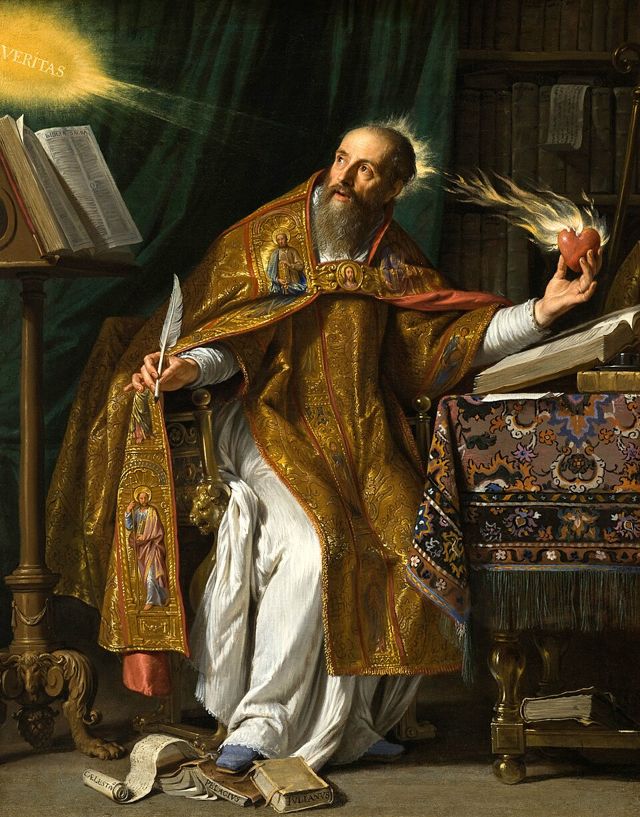
After Benozec Goeeoli in the Church of S. Augustine at San Gerpignano. August 28.3 Augustine. 379 grew out of the Pelagian controversy. He expired on Aug. 30, a.d. 430, in his seventy- seventh year. The body of S. Augustine was buried in the church of S. Stephen at Hippo, but was removed to Sardinia fifty-six years after by the exiled African bishops. When Sardinia fell into the power of the Saracens [medieval Christian name for Arab and Muslim peoples], in 710, Luitprand, King of the Lombards [a Germanic people who ruled much of Italy from 568 to 774], redeemed the body, and it was placed in the church of S. Peter in Pavia. The relics have been since moved into the cathedral. Some portions have been given lately (a.d. 1837) to the diocese of Algiers and placed in a church erected on the ruined site of Hippo. S. Augustine is represented with a burning heart in Iris hand.